Conversion bookkeeping for binary copolymers uses conserved component amounts to distinguish initial feed, residual feed and cumulative incorporated composition. It is an accounting constraint on a closed batch, separate from the kinetic prediction supplied by the copolymer composition equation.
Normalize initial total monomer amount to one mole. Let be its type-1 mole fraction, total molar conversion and the type-1 fraction in the remaining pool. Assume no additional feed, side losses or consumption outside the material being counted. The incorporated amounts areTheir sum is , so the cumulative type-1 fraction isThis is a molar-unit balance; conversion by mass requires the corresponding component molar masses. The IUPAC terminology distinguishes instantaneous composition from integrated conversion/composition relationships.[ref]
IUPAC Compendium of Chemical Terminology, fifth edition (Gold Book). Copolymerisation composition equation, entry 15391, integrated forms and composition drift
For an original example, choose , and residual . The incorporated amounts are 0.05 and 0.45 mol, giving . Individual monomer conversions are and . The residual mixture becomes richer in the less-consumed component even though the polymer contains less of it than the initial feed.
Nonnegative incorporated and remaining amounts impose, for ,For and , a reported residual fraction of 0.50 is impossible under the assumptions: it would leave mol of type 1 when only 0.20 mol was present initially.
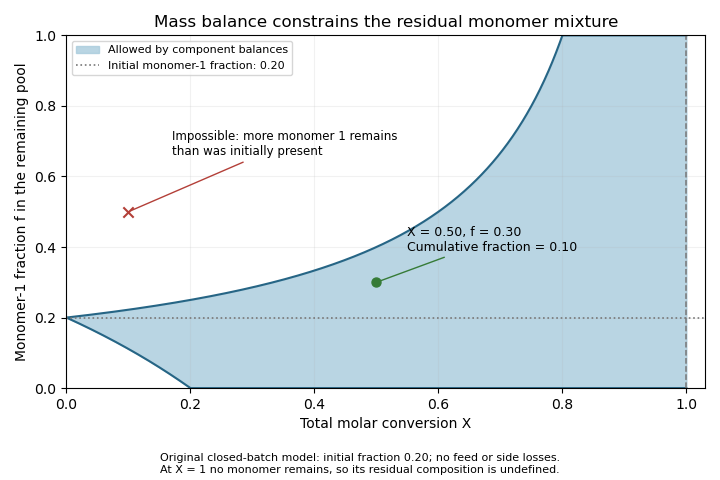
Conserved monomer amounts bound residual-feed composition at each conversion
. Original closed-batch molar bookkeeping for initial type-1 fraction 0.20. The feasible region requires both consumed amounts to be nonnegative; no reaction-rate constants are fitted. Residual composition is undefined at complete conversion. Details.
For a differentiable conversion trajectory, the instantaneous fraction is . Equivalently, . This is the bridge between conservation and kinetic composition drift. At complete conversion there is no residual mixture to assign an value; the total incorporated composition nevertheless equals under the closed-batch assumptions. The IUPAC experimental recommendation measures conversion and composition separately rather than replacing both by an initial feed label.[ref]
Radical Copolymerization Reactivity Ratios by IUPAC. Official recommendation announcement, conversion and composition observations
Articles by others on the same topic
There are currently no matching articles.