Molar mass turns a weighed sample into a count of specified particles. For a pure chemical substance with specified chemical formula and isotopic abundances, its molar mass iswhere is the sample mass and its amount of substance. The SI unit is ; the common laboratory unit is , with . Equal values of amount of substance correspond to equal counts of specified entities, but heavier entities give greater masses.
Combining this definition with molecular count and amount of substance givesThe Avogadro constant is exact under the modern definition of the mole. The mass is the mean mass per specified entity; if isotopes differ within the sample, individual molecules need not all have that mean mass.[ref]
Specify what counts: water molecules, hydrogen chemical atoms, and oxygen chemical atoms give different values of amount of substance for the same sample. For a mixture, dividing total mass by total amount of substance of its chosen entities gives a composition-dependent mean. A polymer sample can contain many chain molar masses; its number-average molar mass and weight-average molar mass answer different averaging questions. Relating either to degree of polymerization also requires a unit-mass convention and end-group accounting.
The number-average molar mass weights each molecule equally. For counts with molar masses ,A mass-proportional SEC detector response requires conversion to counts before determining this average.
The weight-average molar mass weights each population by its contribution to total mass:Here counts molecules with molar mass . SEC light-scattering detection can infer this average for an eluting slice under its optical and concentration assumptions; overlapping species need not have the same individual molar mass.
The relative molecular mass is the dimensionless ratio of a specified mean molecule mass to the unified atomic mass unit, written when treated as a physical quantity:Thus a relative molecular mass of approximately and a molar mass of approximately describe related quantities with different units. The conversion uses the molar mass constant, rather than identifying a dimensionless number with a mass per mole.
The molar mass constant converts relative atomic mass or relative molecular mass into molar mass. It is approximately . Its SI numerical value is determined experimentally: the exact Avogadro constant multiplies an experimentally determined unified atomic mass unit in kilograms. Treating as exactly is therefore an excellent elementary-calculation approximation, rather than a defining equality of the modern SI.[ref]
Choose approximate atomic weights and , and use . The chemical formula then gives water molar massThese are deliberately chosen rounded inputs, not exact atomic weights or a universal value for every water sample. Different isotopic abundances, notably those in heavy water, change the mean molar mass; chemical formula alone does not specify them. Adding atomic weights also neglects the tiny mass change associated with chemical bond energies, immaterial at this rounding precision.
For an illustrative pure water sample of mass , this convention givesThe count refers to water molecules. Their hydrogen chemical atom count is approximately , and their oxygen chemical atom count is approximately . The mean mass per water molecule is . Extra displayed digits expose the arithmetic; they do not imply that the sample composition or mass was measured that precisely.
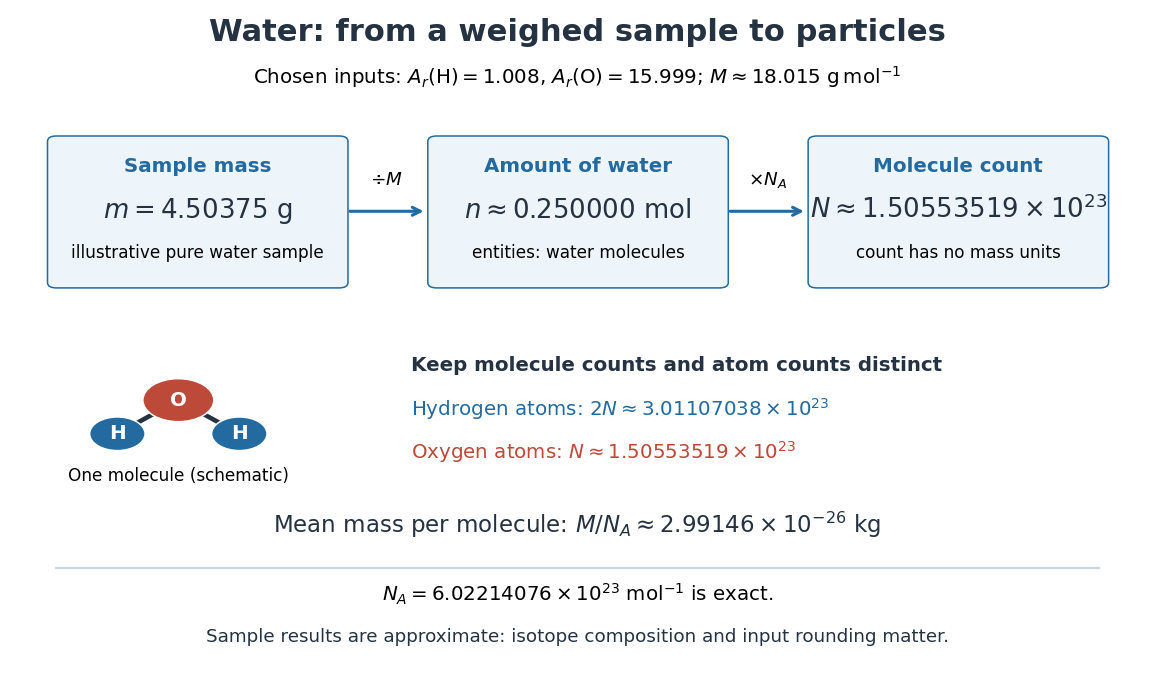
Mapping water mass through amount of substance to molecule and chemical atom counts using chosen approximate atomic weights
. Details. 
The same conversion makes stoichiometry a mass calculation. For the chemical equation , complete conversion of of molecular hydrogen and of molecular oxygen gives of water. With the chosen approximate atomic weights, the reactant masses are and , summing to . The ratio belongs to molecule counts and amount of substance, not to masses; this bookkeeping neglects the much smaller reaction energy contribution to mass.
Suppose a synthetic polymer population contains three chains of molar mass for every one chain of molar mass . Multiplying both chain counts by any common factor leaves the averages unchanged. Substitution into the existing number-average molar mass and weight-average molar mass definitions givesThe larger chains are only one quarter of the chain count but supply of the mass. Thus a weighted mean that emphasizes mass gives a larger result than one that weights each molecule equally. Total mass divided by total chain amount of substance gives , while is not the mean mass of a randomly chosen chain. Inferring chain counts from size-exclusion chromatography still requires the existing SEC detector response and SEC molar mass calibration assumptions.
An ideal gas law measurement obtains amount of substance without knowing the chemical formula in advance:Here is vapor pressure, is its occupied volume, is absolute temperature, is the molar gas constant, and is the mass of vapor occupying that volume at those conditions.
Santa Monica College's teaching experiment uses a Erlenmeyer flask with a pinhole foil cap, a water bath on a hot plate, a thermometer, and a barometer. Excess volatile liquid displaces air. A dissolved dye loses its colour and deposits when the liquid evaporates; three more minutes of heating follow. Cooling condenses retained vapor. Subtracting the dry assembly mass from the cooled assembly mass supplies . The flask volume comes from brim-full water mass and mass density at its measured temperature. Controls include a dry exterior, excluding bath water, and three trials.[ref]
11B: The Dumas Method (Experiment) by Santa Monica College. Santa Monica College, 11B, Experimental Set-up steps 1–6; Trials 1–3 steps 1–4: apparatus, dye endpoint, heating, drying and repetition
The inference assumes vapor pressure equals atmospheric pressure, vapor and bath reach thermal equilibrium, the retained vapor mass is recovered on cooling, and the vapor obeys the ideal gas law. Residual air, thermal expansion of the flask, and vapor temperature below bath temperature are explicit error questions in the teaching experiment. Repeating trials assesses repeatability; it does not remove a shared bias.[ref]
11B: The Dumas Method (Experiment) by Santa Monica College. Lab Report, questions 1–4: residual air, glass expansion, nonideal vapor and incomplete thermal equilibration
For a synthetic illustration, choose , , and . Using molar gas constant gives and under the ideal gas law. These are chosen model inputs, not observations of a particular chemical substance.
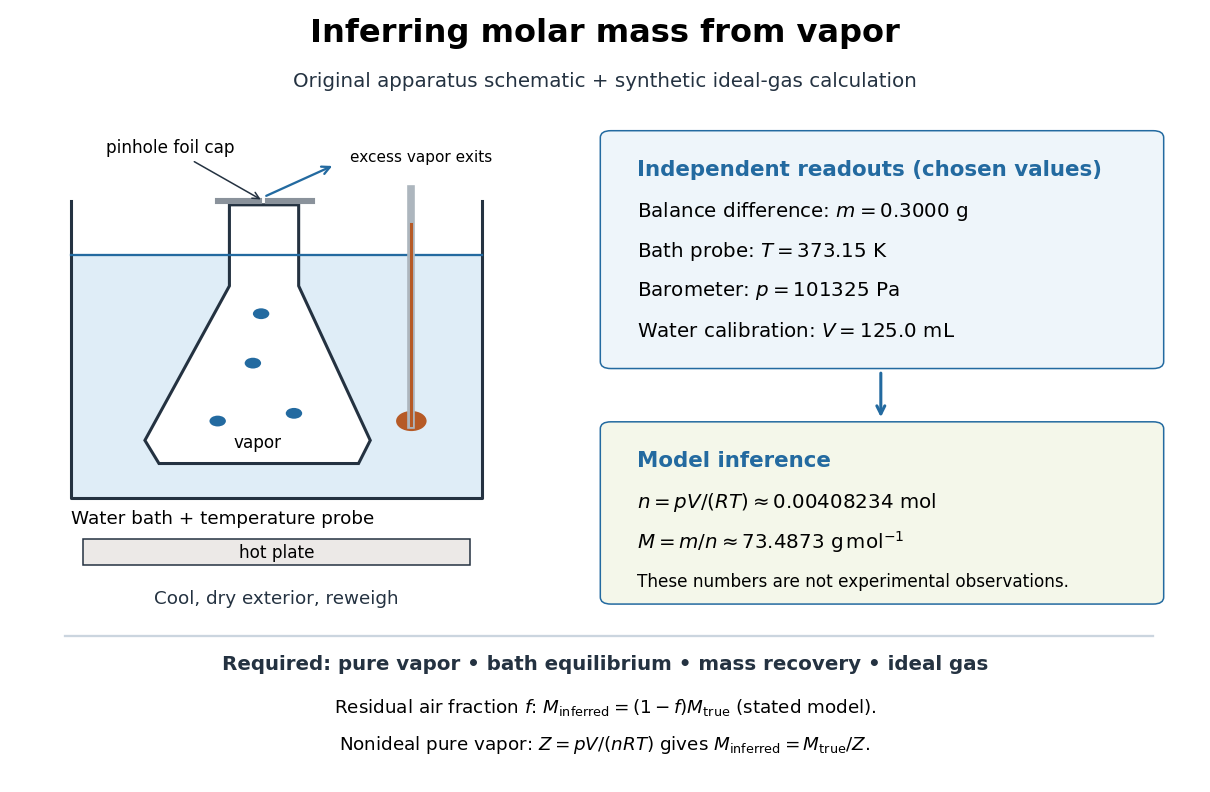
Vapor molar mass inference: apparatus, independent readouts, and the assumptions behind a synthetic ideal gas law calculation
. Details. 
An error's direction follows the model. Extra exterior water raises the apparent and hence . If a fraction of the hot gas particles is residual air, and only the unknown vapor contributes to recovered , an otherwise ideal gas calculation gives . For a pure nonideal vapor, define ; then , so the direction depends on . The dye endpoint alone cannot establish gas purity, thermal equilibrium, or ideality. These conditional checks explain why the same apparatus cannot provide a universal molar mass measurement for arbitrary mixtures or substances that decompose on heating.
Articles by others on the same topic
There are currently no matching articles.