Chemistry connects the composition and structure of chemical substances to their properties and transformations. Its central surprise is that rearranging the same chemical atoms can produce a different substance: molecular hydrogen and molecular oxygen can become water without changing which chemical elements are present. Chemical bonds explain the connections; chemical reactions describe the transformations; stoichiometry makes quantitative predictions from the bookkeeping.
This gives a useful route from an invisible world to measurable quantities. A molecule has a definite composition, such as two hydrogen chemical atoms and one oxygen chemical atom in water. A sample contains an enormous number of such molecules. Counting them through amount of substance, measured in moles, lets the same small-number ratios describe a macroscopic sample. The beauty is that the bookkeeping survives this huge change of scale.
The initial table of content was limited to the first level because it is larger than 1000 articles. There are 5940 articles in total. Expand a branch to load its children.
Biochemistry studies the chemistry of living systems: what their molecules are, how they recognize one another, and how their chemical reactions support the organization of a biological cell. It connects biology to chemical kinetics, stoichiometry and thermodynamics. A useful biochemical explanation follows both material and energy: which substrate becomes which reaction product, what sets the reaction rate, and how the transformation is driven.
Consider three connected examples. The stereochemistry of a sugar helps determine how it interacts with an enzyme's active site; the molecular formula alone cannot describe that recognition. Selective enzymes then direct material through metabolism, while ATP can participate in energy coupling that drives otherwise unfavourable transformations. These are different questions about the same working system, rather than three names for its energy supply.[ref]
Chemistry 2e by Paul Flowers and others. §12.7, Enzyme Structure and Function, Figure 12.25: substrate recognition and induced fit
This viewpoint is useful because it separates possible explanations for a stopped process. Missing substrate, inactive enzyme, depleted ATP and accumulated reaction product call for different interventions. Studying a cell-free extract can isolate some of those causes while leaving a substantial chemical reaction network intact.
Molecular recognition is selective association between molecules through noncovalent interactions, often involving complementary shape and charge. A binding partner can distinguish chemically similar molecules without permanently joining them by a new covalent bond.[ref]
IUPAC Compendium of Chemical Terminology, fifth edition (Gold Book). entry 08187, molecular recognition; DOI 10.1351/goldbook.08187
A simple one-site chemical equilibrium model makes selectivity quantitative. Let a free ligand concentration be , and let the dissociation constant of its complex with a binding partner be . With independent sites and negligible depletion of free ligand, the bound fraction is . For two partners with illustrative values of and , supplying gives fractions and .
Thus association can favor one partner strongly at a stated concentration. At very high ligand concentration, both fractions approach one, so selectivity in a practical measurement depends on conditions as well as binding constants. Affinity chromatography exploits this principle by attaching a ligand to a support and retaining selected proteins.[ref]
Agarose Derivatives for Purification of Protein by Affinity Chromatography by Pedro Cuatrecasas. opening text, reversible selective interactions
Recognition alone does not imply catalytic conversion or a downstream cellular response.A noncovalent interaction is an attraction or repulsion between chemical groups that does not require forming a new ordinary covalent bond between them. In biochemistry, examples include hydrogen bonds, electrostatic interactions and Van der Waals forces, acting either between molecules or within one molecule. These interactions help stabilize biomolecular structures and enable molecular recognition.[ref]
The Lennard-Jones potential gives a simple distance-dependent example:The steep positive term models short-range repulsion; the negative term supplies attraction. Here is separation, sets the energy scale and sets a length scale.[ref]
Lennard-Jones Fluid Reference Calculations: Cuboid Cell by NIST. section 3A, traditional pair potential
Substitution gives . At , the sixth-power term is and the twelfth-power term is , so . A pair can therefore have a preferred separation without acquiring a new covalent bond. Bringing the groups still closer eventually raises the energy sharply.
This is an illustrative pair model, not a complete description of every hydrogen bond or protein-binding event. Real molecular association also depends on geometry, other contacts and the surrounding solvent. Its central lesson is that noncovalent does not mean energetically negligible or independent of distance.
Protein purification separates a selected protein from other components of a sample while recovering material useful for a subsequent measurement or application. Different procedures exploit different properties. In affinity chromatography, a matrix-bound ligand selectively retains the target through a reversible interaction.[ref]
Agarose Derivatives for Purification of Protein by Affinity Chromatography by Pedro Cuatrecasas. opening text, selective interaction with an immobilized ligand
An enzyme example separates recovery from enrichment. Suppose a starting fraction contains total protein and measured activity units, while a collected fraction contains and units. The specific activity rises from to units per milligram: a threefold increase. Recovery of activity is , or . These are constructed assay values, not reported experimental data.
The preparation can therefore be enriched even while some target activity is lost. That inference assumes the assay reports the same catalytic property under comparable conditions; activation or inhibition can change activity without an equivalent change in protein amount. Protein purification consequently needs a stated target, an identity or activity measurement, and a recovery criterion. A visually clean fraction alone does not establish that its protein remains functional.
Protein mass purity is the fraction of the total protein mass in a preparation contributed by the intended protein. With target mass and total protein mass , the percentage is . The denominator includes other proteins, rather than the solvent or the entire mass of the solution.[ref]
For a constructed preparation containing target protein and other proteins, mass purity is . This does not say that of the target molecules are active, nor that of measured catalytic activity comes from them. Those are different quantities from a mass fraction.
An image-based estimate also requires a response model. Suppose densitometry gives target-band intensity 8 and contaminant intensity 2. If both stain equally per unit mass, the inferred purity is . If, instead, the target signal per mass is twice the contaminant's, the inferred masses are proportional to 4 and 2, giving . These invented response factors illustrate the assumption rather than a measured staining difference.
Thus an SDS-PAGE band pattern supports a mass-purity estimate when identification, detection and calibration are appropriate. Enzymatic purity and specific activity require additional assay information.
Generation of many copies of a specified nucleic acid target to support detection or further analysis. Interpretation depends on the validated test and sample.
A mucin is a heavily glycosylated protein contributing to mucus and to protective cell-surface layers. Its carbohydrate chains bind water and influence lubrication, molecular interactions, and resistance to degradation.
Secreted gel-forming mucins and membrane-associated mucins have different structural roles. A mucus layer is therefore more than an inert coating: its polymer network and glycosylation influence how particles, microbes, and signaling molecules encounter an epithelium.
A metabolite is a chemical species participating in metabolism, as a substrate, intermediate, product, or regulator. For example, pyruvate links glycolysis with several downstream pathways.
The same metabolite can belong to multiple pathways, so its concentration alone does not uniquely reveal the rate of one reaction. Measurements of metabolite amounts and measurements of metabolic flux answer different questions.
A hydroxyglutarate metabolite whose enantiomer and source matter. The R form accumulates after the neomorphic reaction of certain cancer-associated IDH1 mutants.
Haem biosynthesis assembles the iron-containing porphyrin cofactor used by proteins such as hemoglobin and cytochromes. In animals, its steps are distributed between mitochondria and cytosol, beginning with production of aminolevulinate and ending with iron insertion into protoporphyrin IX.
Compartmental organization and regulation keep synthesis coordinated with iron availability and cellular demand. The pathway illustrates how a small cofactor can support oxygen binding or electron transfer depending on the surrounding protein environment.
Metabolomics studies the small-molecule metabolites present in a biological sample, commonly using mass spectrometry or nuclear magnetic resonance. A measurement can compare metabolic states, but different analytical methods detect different portions of the chemical mixture.
A peak intensity is not automatically an absolute concentration: extraction efficiency, ionization, matrix effects, and instrument drift can alter the signal. Standards, blanks, and pooled quality-control samples help distinguish biological variation from analytical variation.
A pooled quality-control sample combines representative portions of study samples and is measured repeatedly to monitor analytical consistency. In metabolomics, it provides a shared mixture against which changes in retention, signal intensity, or instrument drift can be tracked.
It is distinct from a biological replicate and from a certified concentration standard. A stable pooled sample supports assessment of measurement reproducibility, but does not by itself prove correct identification or absolute quantification of every metabolite.
biomass pretreatment changes a feedstock before subsequent conversion, often to improve enzyme access. Increased accessibility must be balanced against sugar loss, inhibitor formation, energy cost and altered enzyme adsorption.
lipidomics measures the identities and relative or absolute amounts of lipids in a sample. Extraction, standards, response factors and isomer discrimination constrain inference; bulk composition alone does not determine leaflet distribution or local membrane properties.
proteomics studies the identities, amounts, modifications and associations of proteins in biological material. Measurements depend on extraction, detectability and reference condition; absence of a detected peptide is not proof that its protein is absent.
Proteome-scale assignment of proteins to cellular locations using fractionation profiles, localization labeling and complementary imaging.
Quantitative proteomics measures differences in protein abundance or related protein features across samples. Strategies include label-free quantification and isotope- or tag-based comparisons, often using peptides generated from proteins and analyzed by mass spectrometry.
Peptide signal must be connected to the protein being quantified. Shared peptide sequences, incomplete detection, and changes in modification state can complicate that inference. Absolute abundance and relative change therefore require different calibration and interpretation.
Label-free quantification compares abundance across separately measured samples without introducing a distinguishing isotope or chemical tag. In proteomics, a common approach integrates chromatographic signals of corresponding peptide ions.
Matching retention time and mass helps connect the same peptide across runs, while normalization addresses overall signal differences. A missing peak can reflect limited detection rather than true absence, so zeros and missing measurements should not be conflated.
A tandem mass tag is a chemical label designed so that differently encoded versions have the same overall mass but release distinguishable reporter ions during fragmentation. Labeled peptide samples can therefore be mixed and compared in one mass-spectrometric analysis.
Reporter-ion intensities estimate relative amounts for the pooled channels. Co-isolated peptides can contribute unrelated reporter signal and compress measured ratios, linking instrument isolation selectivity to the accuracy of biological comparisons.
Stable isotope labeling by amino acids in cell culture incorporates isotopically distinct amino acids into proteins during cell growth. Mixing differently labeled samples produces peptide pairs with predictable mass differences, enabling relative quantification by mass spectrometry.
The labels preserve closely related chemistry while changing mass. Interpretation requires adequate incorporation and awareness of amino-acid conversion or growth-related differences. The method compares labeled protein populations; it does not make every observed abundance change a direct change in protein synthesis rate.
Analysis of relatively large protein fragments to preserve linkage between sequence changes or modifications that separate into different peptides in bottom-up proteomics. It generally preserves less complete linkage than intact-chain analysis.
Analysis of intact protein ions and their sequence fragments to characterize proteoforms. Intact mass constrains composition, while informative fragmentation is needed to locate changes and resolve many isomeric forms.
An error in assigning a complete molecular form. Controlling peptide-level identification error does not automatically control errors in intact-form identity or modification linkage.
Analysis of proteins after digestion into smaller peptides. It can provide broad sequence and modification coverage, but digestion commonly loses information about which distant variations occur together in an intact proteoform.
A molecular form of a protein defined by its amino-acid sequence and covalent modifications, including processing. Different conformations and mass-spectrometric charge states do not by themselves define different proteoforms.
Dialysis exchanges small solutes between a sample and an external bath through a semipermeable membrane, while retaining suitably large macromolecules, such as proteins. The transport is passive diffusion: random motion carries permeant molecules both ways, with net transport down their concentration gradient. The bath is the dialysate. At equal permeant solute concentrations, microscopic exchange continues but net exchange stops.[ref]
Dialysis: an overview, Pierce Biotechnology technical note. Dialysis: an overview, Tech Tip 20, p. 1, Dialysis is Diffusion Through a Semi-Permeable Membrane
For example, a protein sample containing excess sodium chloride can lose the small ions to a low-salt dialysate without deliberately transferring the protein. Conversely, components of a new buffer solution can enter from the bath. This is useful before studying enzyme kinetics: changing the surrounding chemical solution can remove an interfering small solute while keeping the enzyme available for the next experiment.
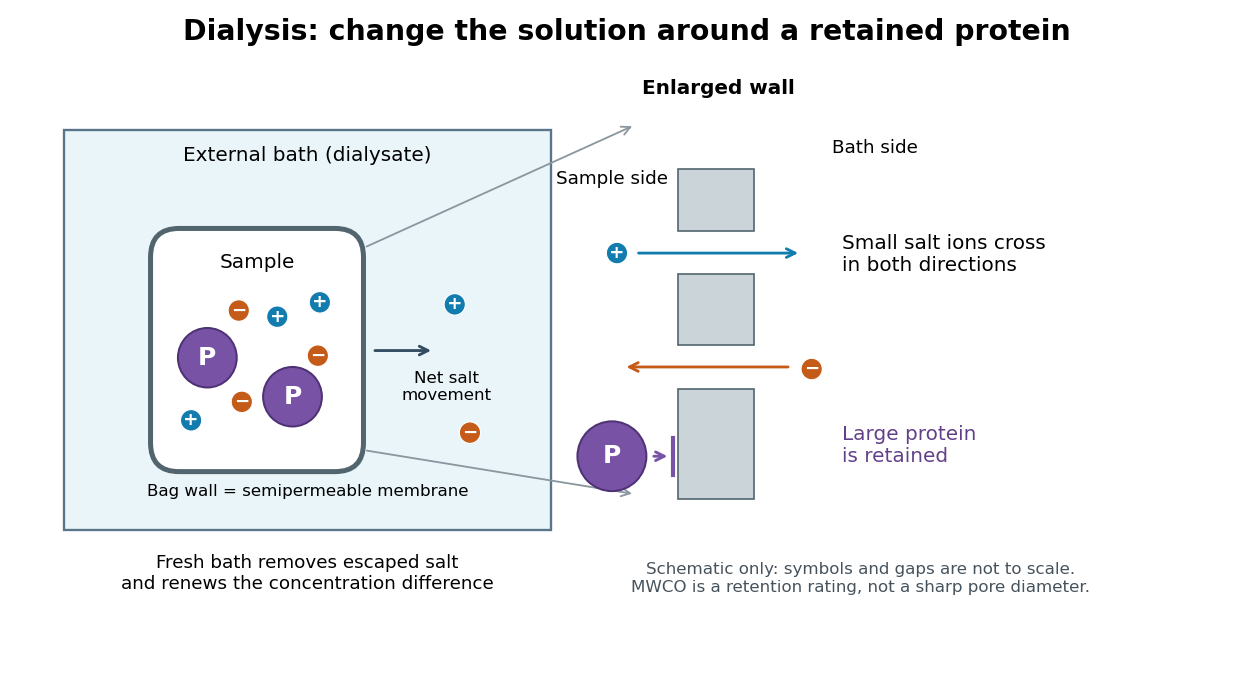
The striking feature is that the retained protein does not have to be captured and released again to change its surroundings. However, retention is conditional on the semipermeable membrane and the particular macromolecule, and dialysis is poorly suited to separating proteins of nearly the same size. The molecular weight cut-off is a nominal retention rating, not a sharp geometrical boundary.
The external chemical solution on the other side of a dialysis semipermeable membrane. Its composition supplies the boundary condition for exchange: it can receive unwanted small solutes or supply desired small solutes. A bath replacement discards the old dialysate and introduces a new reservoir with a specified composition.
The molecular weight cut-off rates retention of reference molecules. One manufacturer's definition uses the mass at which approximately remains after seventeen-hour dialysis, tested with globular proteins. A rating uses dalton units: a mass, not a length or an absolute passage threshold.[ref]
Dialysis: an overview, Pierce Biotechnology technical note. Tech Tip 20, p. 1, Factors Affecting Dialysis Rate: MWCO definition and globular reference molecules
A semipermeable membrane has a distribution of passage sizes, and a molecule's shape affects passage as well as its mass. Near the nominal MWCO, slow passage can make substantial retention compatible with eventual leakage. The protein-retention experiment below makes retention an observable quantity rather than a universal yes-or-no property inferred from the label.
Buffer exchange changes the small components surrounding a retained macromolecule toward those of a desired buffer solution. Components absent from fresh dialysate tend to leave; supplied components can enter. Each permeant solute has its own exchange problem.[ref]
Dialysis: an overview, Pierce Biotechnology technical note. Tech Tip 20, pp. 1-2, renewed gradients and Other Factors in Dialysis
For a dilute, nonbinding permeant solute, an ideal equilibrium calculation approaches the bath's specified concentration. That approximation need not describe a solute bound to a protein or a charged mixture with additional electrical constraints. Retaining a protein also does not by itself establish that its protein structure or catalytic function survives the change of buffer solution.
Consider an original ideal model with sample volume , bath volume , and initial sample solute concentration . Assume each volume is fixed, a freely permeant, nonbinding solute, no chemical reactions, complete mixing on each side, and equal concentrations at equilibrium. Each fresh bath initially contains none of this solute. The protein is perfectly retained in this model.
The first equilibration redistributes the initial amount of substance through both compartments. Conservation givesThis denominator includes the sample itself. For the chosen and , , rather than . Nine-tenths of the initial solute is in the bath and one-tenth remains in the sample; nothing has vanished during equilibration.
Discarding the equilibrated bath removes its solute. A second fresh bath starts with only of solute in the entire system, so the same argument applies again. Induction gives the geometric progressionHere counts completed equilibrations with fresh baths: is the first bath, follows one replacement, and follows two replacements. The normalized sample concentrations are respectively , and . Leaving the first bath in place for longer cannot lower the ideal equilibrium value below .
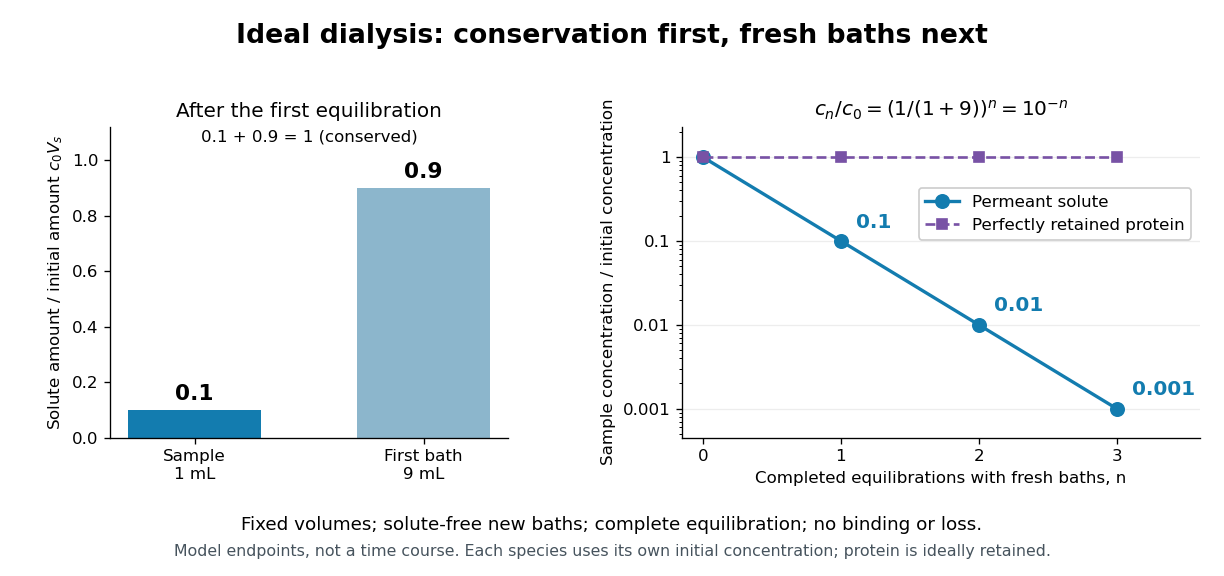
Repeated fresh baths reduce normalized solute concentration geometrically
. Original fixed-volume model, not experimental data. The left panel normalizes the first bath's conserved amount of substance by , distinguishing the sample's share from the bath's share. The right panel plots sample solute concentration divided by after each completed fresh-bath equilibration on a logarithmic vertical axis. The protein curve is normalized independently by its own initial concentration. The perfectly retained protein stays at normalized concentration one only because its amount of substance and the sample volume are fixed. Details.The same conservation argument handles a fresh bath already containing a permeant solute at fixed concentration :Thus the sample approaches , not necessarily zero. For example, if a hypothetical new buffer component starts at zero in the sample and at in every bath, its sample concentration reaches , and in the three equilibrations. Outward removal and inward replacement follow the same mathematics.
Equilibrium fractions do not specify elapsed time. An illustrative well-mixed linear ordinary differential equation model within one bath isHere is an effective transfer coefficient with units of volume per time. Adding the two equations conserves ; subtracting their normalized forms givesThe difference undergoes exponential decay. A bath replacement resets , renewing the driving difference without making jump instantly. The plotted points are equilibrium endpoints, not a measured time course or a timetable for an arbitrary protein.
Real sample volume can change through osmosis; proteins can be lost through leakage or adsorption to the semipermeable membrane. Consequently, a measured decrease in protein concentration alone cannot distinguish dilution from loss of protein. Measuring recovered volume as well as protein concentration permits an estimate of recovered protein mass.[ref]
Dialysis: an overview, Pierce Biotechnology technical note. Tech Tip 20, p. 2, Other Factors in Dialysis: water transport, volume change and nonspecific membrane binding
The manufacturer-issued Protein Preparation Handbook reports a paired dialysis comparison: of bovine serum albumin, in sodium chloride, was held behind a MWCO membrane against of water in a conical tube, shaken at room temperature. The bath was replaced after two hours. A conventional stirred-beaker treatment against of water supplied the comparison control. Residual salt was followed by sample electrical conductivity; results averaged two samples. This readout tests small-ion removal, not protein retention.[ref]
Protein Preparation Handbook, Thermo Fisher Scientific. Protein Preparation Handbook, printed p. 11, Figure 9A and caption: sample preparation, 10K membrane, baths, conductivity and conventional-dialysis reference
Its separate retention experiment used individual proteins at in saline or carbonate-bicarbonate buffer solution, pH , with membranes rated , , , and . After seventeen hours at , retained protein was estimated by a bicinchoninic acid assay. The size series and membrane series compare retention; they do not isolate shape independently of mass. The figure caption supplies neither a no-membrane recovery control nor a complete uncertainty analysis. These are manufacturer comparisons, not proof of universal recovery or unchanged enzyme function.[ref]
Protein Preparation Handbook, Thermo Fisher Scientific. Protein Preparation Handbook, printed p. 11, Figure 8 and caption: membrane series, preparation, duration, temperature and protein assay; the separately plotted vitamin B12 uses a different optical readout
The two experiments answer complementary questions: did the small solute leave, and did the desired macromolecule remain? In a new experiment, a bath blank and a starting salt standard would help interpret electrical conductivity, while a matched undialyzed protein aliquot and recovered volume would help distinguish handling loss from dilution. Those are proposed additional controls, not controls claimed for the published figures. Other ions also contribute to electrical conductivity, so the readout cannot generally identify sodium chloride alone in an unfamiliar buffer solution.
An enzyme accelerates particular chemical reactions, with catalytic selectivity arising from recognition and from the relative ease of the subsequent chemistry. Strong binding alone does not guarantee fast conversion. Nor does catalysis change the chemical equilibrium for an unchanged net chemical reaction. These distinctions explain how enzymes can direct the flow of material without creating an extra source of free energy.[ref]
Chemistry 2e by Paul Flowers and others. §12.7, opening paragraphs and Enzyme Structure and Function: alternative mechanisms, regeneration and specificity
For an original model of competing routes, let a substrate become either a desired reaction product or another reaction product :The labels represent hypothetical chemical species with the same elemental composition, not molecular structures. Assume fixed volume, irreversible first-order reactions, constant effective rate constants, and initially of with neither reaction product present. The model approximates a limited operating regime; real enzyme kinetics can include saturation and reverse reactions.
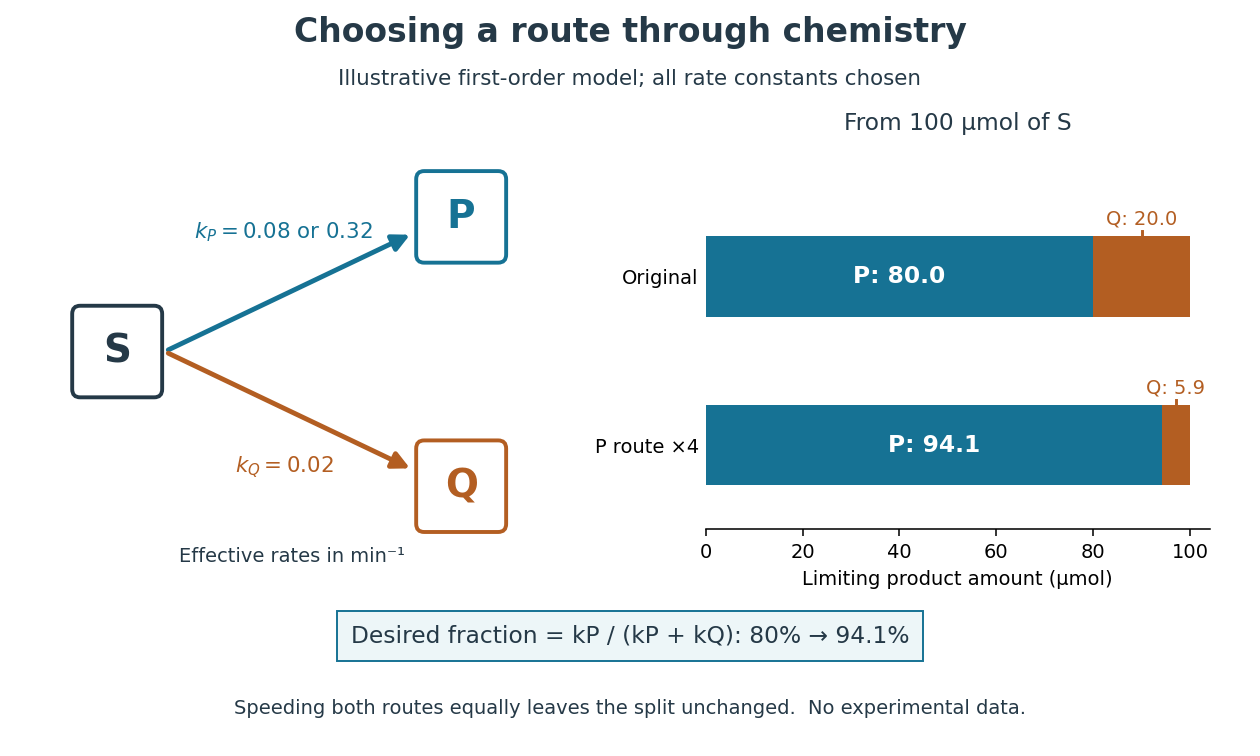
Selective acceleration changes the split between competing biochemical reaction products
. Original illustrative chemical reaction network and limiting product amounts from of hypothetical . Chosen effective rate constants are or and . The boxes label chemical species; they are not molecular structures. The bars are model limits, not experimental data. Details.The reaction-rate equations give , and , where denotes amount of substance. Consequently,With and , the eventual split is of and of . At ten minutes, the calculated amounts are approximately , and for , and . Selectively increasing fourfold changes the eventual desired fraction to . Increasing both rate constants fourfold instead preserves the split and only shortens the conversion time. Speed and selectivity answer different questions.
The bookkeeping matters independently of that model. In ideal alcoholic fermentation, complete conversion of of glucose yields each of ethanol and carbon dioxide. Of the initial of carbon chemical atoms, remain in ethanol and enter carbon dioxide. This is a chosen material-balance example using the net stoichiometry explained under Saccharomyces cerevisiae; it gives neither an observed yield nor the mechanism of the individual steps. Equal amounts of the two reaction products also do not mean equal masses.
Hexokinase provides a concrete connection between sugar chemistry and energy coupling: it transfers a terminal phosphate group from ATP to glucose, forming a phosphorylated sugar and adenosine diphosphate. The enzyme accelerates the transfer, while consuming ATP changes the net chemical reaction being carried out. The donated group reaches the substrate through the catalytic route.[ref]
Biology 2e by Mary Ann Clark and others. §7.2, First Half of Glycolysis, step 1: hexokinase and ATP-dependent glucose phosphorylation
For a symbolic teaching model, write for an unphosphorylated sugar, for its phosphorylated form, and for inorganic phosphate. These are labels for chemical states, not complete elemental formulas. Using one consistent reference convention at fixed pH and temperature, stipulate the following molar changes in Gibbs free energy:All three numbers are chosen illustrative values, not measured properties of glucose or a particular enzyme. The prime marks a biochemical reference convention with pH held fixed; explicit proton and metal-binding bookkeeping is suppressed consistently. The first two lines are a thermodynamic decomposition: cancelling water and inorganic phosphate gives the net transfer. They do not assert that the reaction mechanism first releases free inorganic phosphate and then recaptures it.
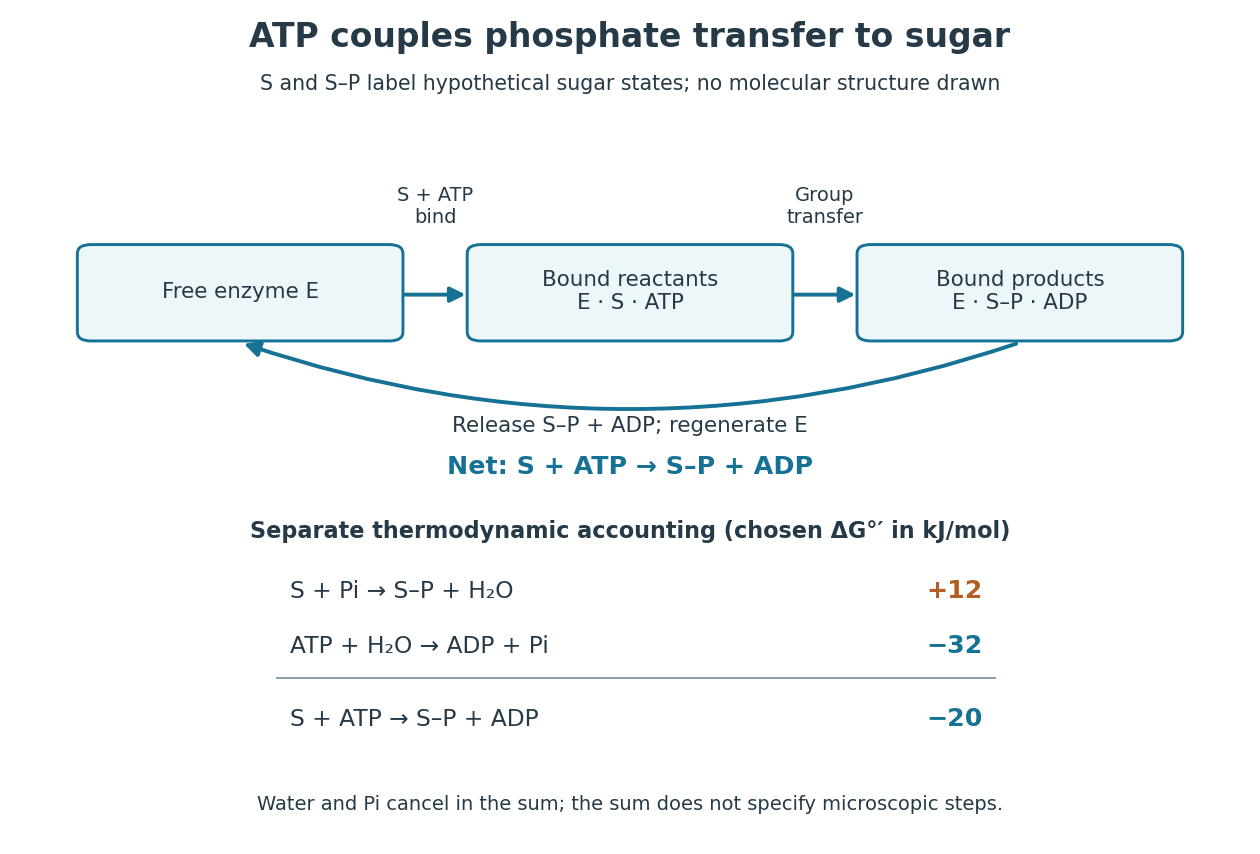
Because Gibbs free energy is a state function, consistently defined reaction changes add. A working reaction mechanism must also connect the desired conversion to ATP consumption; independently allowing ATP hydrolysis beside the sugar does not establish energy coupling. The general distinction is developed under energy coupling. ATP-dependent phosphorylation of a membrane protein can likewise connect a chemical change to active transport.[ref]
Biology 2e by Mary Ann Clark and others. §6.4, Energy Coupling, Figure 6.14: transfer to the sodium-potassium pump and its conformational cycle
Actual Gibbs free energy changes depend on thermodynamic activities. Even a favourable reference sum can be overcome by accumulation of reaction products or depletion of ATP; it supplies no prediction of the reaction rate. A living biological cell also regenerates ATP. Sustained operation therefore requires a connected metabolism, not an inexhaustible stock of a special molecule.
A cell-free extract is material obtained from disrupted biological cells after removing intact biological cells. Its biochemical activity can be tested separately from the whole organism. It can contain many enzymes and substrates, together with cofactor components; cell removal is different from purification of one component.
The cell-free extract experiment under yeast asks whether fermentation requires intact living biological cells. In his 1907 lecture, Eduard Buchner described grinding yeast with quartz sand and diatomite in a large mortar using a heavy pestle, wrapping the dough in canvas, then squeezing it in a hydraulic press. Adding concentrated sugar syrup to the expressed liquid produced carbon dioxide bubbles and foam; separate investigations identified ethanol.[ref]
Cell-free fermentation by Eduard Buchner. Cell-free fermentation, Nobel lecture delivered 11 December 1907, printed pp. 110–112, Figures 2–4 and accompanying preparation/readout text
Activity persisted after filtration through cell-removing porcelain candles. Toluene inhibited live yeast fermentation while the cell-free extract retained activity, addressing a different objection from cell removal. These comparisons support extracted chemical machinery as the cause; bubbles alone would not identify alcoholic fermentation.[ref]
Cell-free fermentation by Eduard Buchner. Printed pp. 112–114: residual-cell objection, biscuit-porcelain filtration, toluene comparison and extract activity
The inference is activity outside intact living biological cells, not that biological cells are unnecessary for making or maintaining the machinery. Nor was this a purified single-enzyme mechanism: the lecture acknowledges unsuccessful purification and reports that two separated inactive fractions recovered fermentation when reunited. Such a reconstitution asks which components must work together, extending the initial separation of organism from chemical activity.[ref]
Cell-free fermentation by Eduard Buchner. Printed p. 115: unsuccessful zymase separation; pp. 117–118: gelatine-filter fractions and restored activity on reunion
A metabolic pathway is a connected sequence of enzyme-catalyzed chemical reactions in metabolism, with a reaction product of one step serving as a substrate for another. A pathway boundary is a choice about which transformations to count: glycolysis ends at pyruvate, whereas subsequent fermentation or cellular respiration changes the final material balance. Adding the individual chemical equations cancels internal intermediates and exposes the net stoichiometry; it does not determine the reaction rate.
carbon-13 metabolic flux analysis infers pathway flows from isotope-labeling patterns and a specified metabolic model. A valid inference needs distinguishable routes, appropriate pool and growth assumptions, and uncertainty assessment.
type II fatty acid synthesis distributes successive biosynthetic steps among separate enzyme components. Its requirement in a parasite depends on species and life-cycle stage, and should not be inferred solely from pathway retention.
isoprenoid precursor biosynthesis supplies activated building blocks for diverse isoprenoid products. In blood-stage Plasmodium falciparum culture, supplementation with IPP can bypass the essential output of the apicoplast under the tested conditions.
The acyl-CoA pool is the set of acyl groups carried by coenzyme A in a specified compartment and condition. Carrier-bound intermediates must be distinguished from the same acyl chains esterified in membrane or storage lipids.
A metabolic flux is the rate of material flow through a specified reaction or pathway. Pool size, transcript abundance and maximal enzyme activity do not individually determine it.
Glycolysis converts one glucose into two pyruvates, yielding two net ATP and reducing two NAD+ to two NADH in the canonical pathway. It first spends two ATP, then produces four by substrate-level phosphorylation. The pathway itself consumes no molecular oxygen; sustained operation nevertheless requires regeneration of NAD+.[ref]
Biology 2e by Mary Ann Clark and others. §7.2, First Half of Glycolysis, step 5; Second Half of Glycolysis, steps 6–10; Outcomes of Glycolysis
The useful organizing idea is three separate ledgers: carbon chemical atoms, transfers between ADP and ATP, and redox transfers between NAD+ and NADH. Splitting the carbon skeleton doubles the number of downstream conversions; recycling a cofactor permits repeated operation. These counts explain the yield without memorizing a drawing of every enzyme. The two net ATP belong to glycolysis alone, not to complete cellular respiration.
Follow one glucose through canonical glycolysis, with no diversion of intermediates into other metabolic pathways. The investment stage uses two ATP to prepare the six-carbon substrate. Cleavage and rearrangement provide two glyceraldehyde 3-phosphate molecules, each containing three carbon chemical atoms. Each then yields one three-carbon pyruvate, one NADH, and two ATP in the payoff stage.[ref]
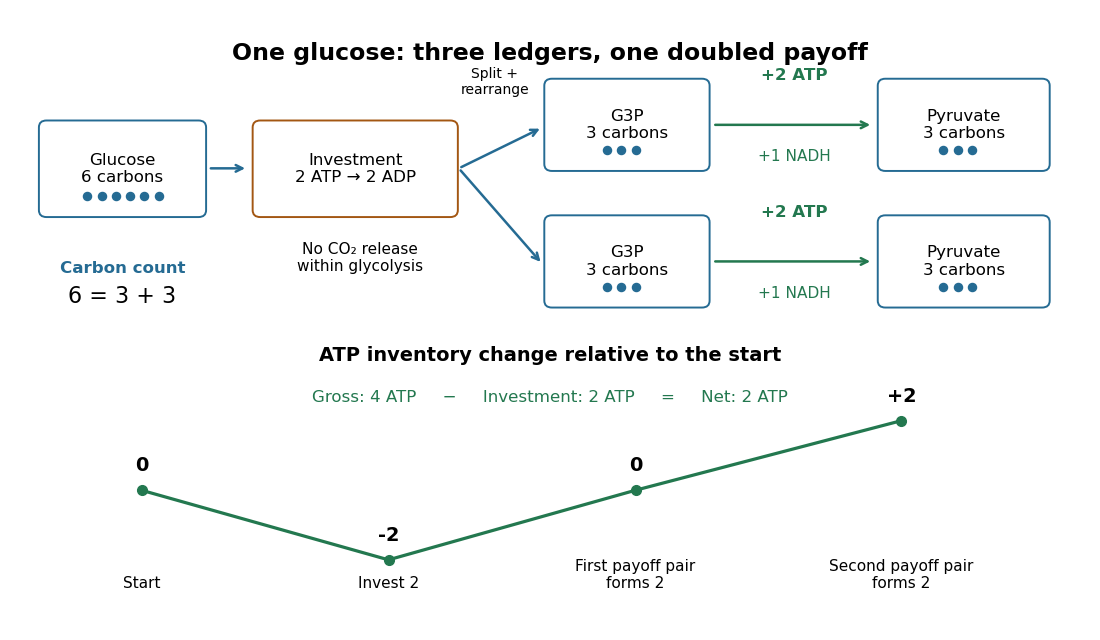
The material check is : all six carbon chemical atoms remain in the two pyruvates. No carbon dioxide has been released within this boundary. In the ATP ledger, each three-carbon route contains two ATP-forming transfers, soThe first pair of payoff transfers only restores the initial ATP inventory; the second pair creates the net gain. Four newly formed ATP is therefore compatible with only two additional ATP remaining.
For an original scaled example, stipulate complete conversion of of glucose. The initial of carbon chemical atoms becomes of pyruvate, still containing of carbon chemical atoms. The pathway spends of ATP, forms of ATP, and adds to the ATP inventory before any other ATP use. It also reduces of NAD+. These are calculated ideal amounts, not observed yields; side routes or incomplete conversion change the outcome.
A common biochemical net chemical equation isHere is inorganic phosphate. The names group biochemical protonation and metal-binding states; the displayed proton and water terms use a common shorthand rather than a unique specification of every chemical species. The robust ledger records two net ADP-to-ATP conversions and two NAD+-to-NADH conversions. Summing the individual chemical equations cancels two invested ATP against four formed ATP and cancels the internal substrates, giving those coefficients.
In the payoff stage of glycolysis, oxidation of glyceraldehyde 3-phosphate is coupled to reduction of NAD+. Each NADH carries a two-electron reducing equivalent. The formal half-chemical equationmakes the electron count explicit: two NADH per glucose carry four electrons. This is redox bookkeeping, not a claim that free electrons travel through the chemical solution or that NADH is itself ATP.
Fermentation can return NADH to NAD+ by reducing an organic substrate; reduction of pyruvate to lactate is one example. In aerobic cellular respiration, reducing equivalents reach an electron transport chain, reducing molecular oxygen. Other forms of cellular respiration use other electron acceptors, so absence of oxygen does not uniquely imply fermentation.[ref]
Biology 2e by Mary Ann Clark and others. §7.2, step 6 and its NAD+ regeneration paragraph; §7.5, opening comparison of fermentation and anaerobic respiration, Lactic Acid Fermentation and Figure 7.16 caption
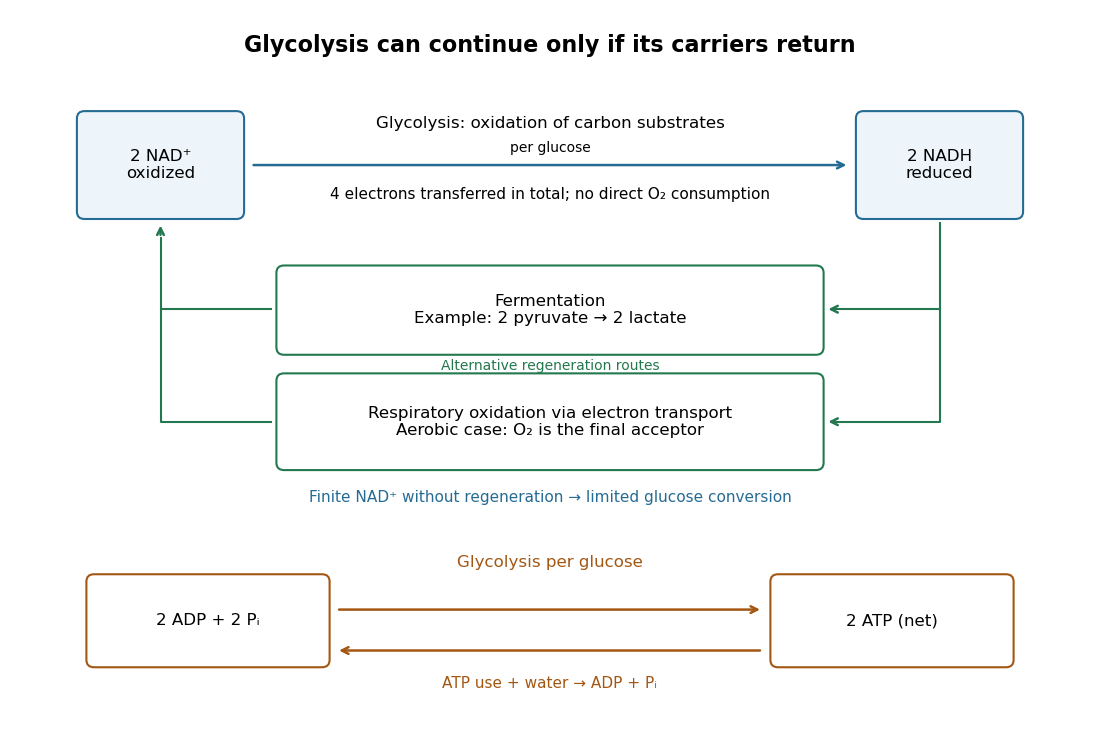
The need for NAD+ regeneration follows from a finite-pool argument. In a hypothetical closed preparation with of initially oxidized NAD+ and no regeneration, at most of glucose can complete the two NAD+-consuming conversions per glucose. This is an upper bound even with excess glucose, not a predicted stopping time: other limitations can stop the preparation earlier. With an intact fixed nicotinamide adenine dinucleotide pool and no side reactions, converting NAD+ into NADH preserves their sum but depletes the usable oxidized form.
ATP recycling imposes a second condition. Glycolysis needs some initial ATP for investment and consumes two net ADP and two inorganic phosphate per completed glucose. In a closed ideal preparation with only of initial ADP, no other source of ADP, and enough initial ATP and inorganic phosphate, at most of glucose can finish. This bound follows from the net ADP consumption, even though investment temporarily produces additional ADP. Initial investment also means that adequate final inventories alone cannot guarantee the route can start.
For continued operation at fixed carrier inventories, other chemical reactions must match the two net ATP formed per glucose with ATP use that restores ADP and inorganic phosphate, or exchange must supply those reactants. ATP hydrolysis coupled to cellular work is one route. Thus glycolysis can sustain useful energy coupling while neither its ATP inventory nor its NADH inventory grows indefinitely; matter cycles while glucose supplies fresh chemical free energy.
The final substrate-level phosphorylation in glycolysis provides a useful experimental handle: pyruvate kinase transfers a phosphate group from phosphoenolpyruvate to ADP, producing pyruvate and ATP. Adding lactate dehydrogenase couples each pyruvate formed to consumption of one NADH:These equations select free ionic forms consistently: phosphoenolpyruvate has charge , ADP , ATP , and pyruvate and lactate each ; NAD+ has one more positive charge than NADH. Each line conserves charge. Cancelling pyruvate gives one NADH consumed per ATP formed in this coupled system. A whole-pathway NADH measurement has a different meaning, because the earlier glycolysis redox step produces NADH.
The published An Optimized Enzyme-Coupled Spectrophotometric Method for Measuring Pyruvate Kinase Kinetics reports recombinant pyruvate kinase prepared in Escherichia coli, purified by chromatography and size-exclusion chromatography. UV-transparent microplate wells contained ADP, phosphoenolpyruvate, NADH, lactate dehydrogenase and a buffer solution with magnesium ions. An Epoch plate reader used spectrophotometry to follow absorbance at every five to ten seconds for one minute at . Its Figure 2 presents , increasing as NADH is consumed. Heat-inactivated pyruvate kinase gave minimal background; a validated active preparation was the positive control. These comparisons support an enzyme-dependent readout in the prepared system, rather than a whole-biological cell glycolysis measurement.[ref]
The same report uses for optical path length in Procedure B.2.i, but approximately in Data analysis §3. An absolute conversion requires the actual path length and sufficient coupling enzyme activity; no measured ATP rate is inferred here.[ref]
An Optimized Enzyme-Coupled Spectrophotometric Method for Measuring Pyruvate Kinase Kinetics by Saurabh Upadhyay. Procedure B.2.i; Data analysis §3; General notes, items 4 and 6: path-length inconsistency and linear-range conditions
For an original dimensional example, stipulate a blank-corrected absorbance decline , a calibrated path length and a chosen calibration coefficient . These are invented teaching inputs, not the protocol's measurements or its quoted coefficient. The Beer-Lambert law givesIn a stipulated reaction volume, this is of NADH consumed and, conditionally, of ATP formed. The conditional inference requires rapid pyruvate consumption by the coupling enzyme, no other NADH-consuming chemical reactions, and a linear, correctly calibrated optical response. The readout measures this last glycolysis step; it cannot establish the full two-net-ATP-per-glucose balance by itself.
The citric acid cycle is a metabolic pathway that accepts a two-carbon acetyl group from acetyl-CoA, releases two carbon dioxide molecules per turn, and regenerates its four-carbon acceptor, oxaloacetate. Its oxidation steps load electron carriers; oxidative phosphorylation subsequently uses their electrons to support ATP production. In mitochondria, most steps occur in the mitochondrial matrix, while succinate dehydrogenase lies in the inner mitochondrial membrane.[ref]
How Cells Obtain Energy from Food. Molecular Biology of the Cell, 4th edition by Bruce Alberts and others; Chapter 2, How Cells Obtain Energy from Food, The Citric Acid Cycle Generates NADH by Oxidizing Acetyl Groups to CO2; Figure 2-79 and Panel 2-9
The economy is striking: the acceptor is rebuilt rather than supplied anew for every incoming acetyl group. Regeneration does not create extra oxaloacetate. Withdrawal of intermediates for amino acid synthesis must be balanced by replenishment if the available pool is to remain steady. Thus the citric acid cycle connects energy metabolism to synthesis as well as to breakdown.[ref]
How Cells Obtain Energy from Food. Molecular Biology of the Cell, 4th edition by Bruce Alberts and others; Chapter 2, How Cells Obtain Energy from Food, final paragraph of The Citric Acid Cycle Generates NADH by Oxidizing Acetyl Groups to CO2: oxaloacetate and alpha-ketoglutarate as biosynthetic precursors
The glyoxylate shunt bypasses oxidative decarboxylations using isocitrate lyase and malate synthase. It permits net conservation of acetyl-unit carbon in four-carbon precursors, at a different balance of reducing-equivalent production from the oxidative route.
The carbon sequence is oxaloacetate plus an acetyl group to citrate , then isocitrate , alpha-ketoglutarate , succinyl-CoA , succinate , fumarate , malate and back to oxaloacetate . The numbers count the cycling carbon skeleton, excluding coenzyme A. Two carbon dioxide releases accompany the changes .[ref]
Biology 2e by Mary Ann Clark and others. §7.3, Steps in the Citric Acid Cycle, steps 1–8 and Figure 7.11
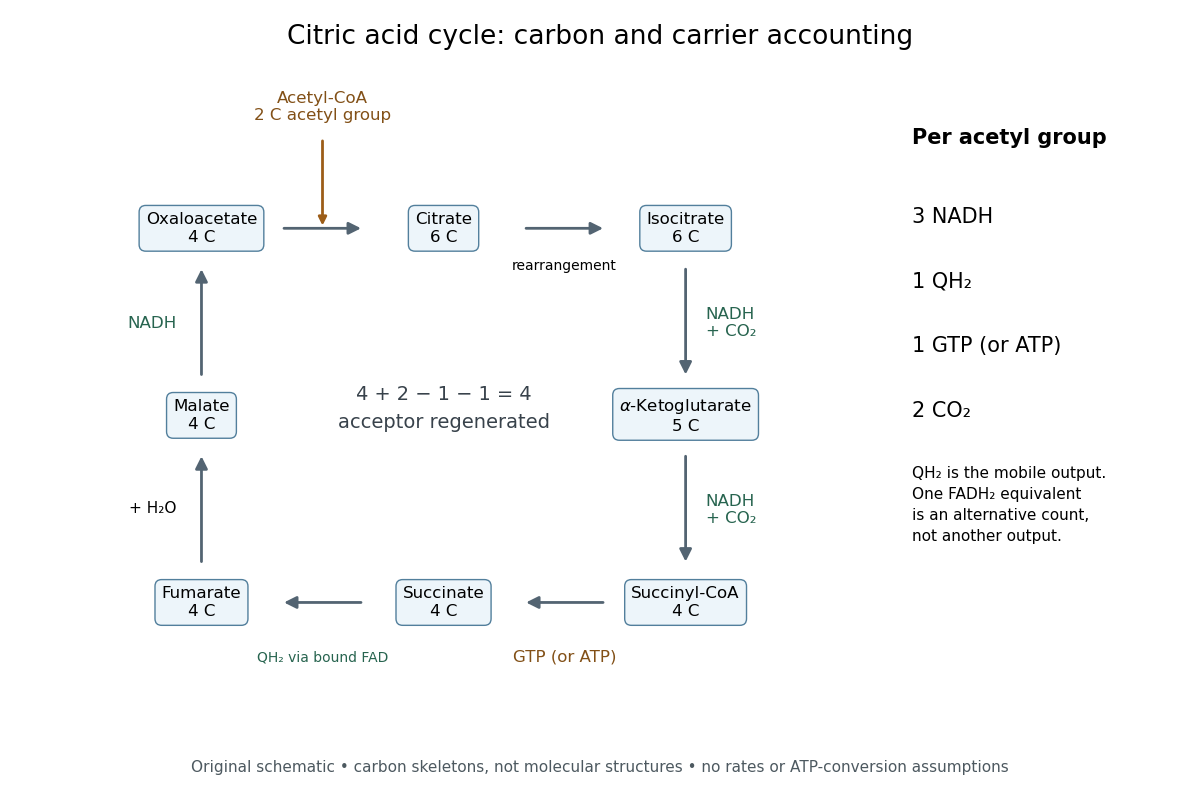
Per acetyl group: three NADH, one FADH2 equivalent, one GTP or ATP by substrate-level phosphorylation, and two carbon dioxide. Succinate dehydrogenase retains FADH2 and transfers its electrons to ubiquinone, forming ubiquinol. The FADH2 equivalent and ubiquinol count the same electron pair.[ref]
Biology 2e by Mary Ann Clark and others. §7.3, Citric Acid Cycle and Steps in the Citric Acid Cycle, steps 3–8, especially step 6, enzyme-bound reduced carrier; §7.4, Q and Complex II: ubiquinone reduction to QH2
A useful check adds the stepwise changes. The carbon count is ; the NADH count is . Each NADH carries two electrons, and the succinate dehydrogenase route supplies another pair, so one turn exports electrons. This arithmetic is an accounting identity, not an ATP yield calculation. Converting it to ATP requires the separate energy coupling and transport assumptions discussed under oxidative phosphorylation.
For a chosen ideal conversion of of acetyl groups, multiplication gives of NADH, of ubiquinol, of GTP and of carbon dioxide. The electron output is . If all these electrons subsequently reach oxygen with no competing sinks, four electrons per oxygen molecule require of oxygen. That is consumption by the connected electron transport chain; it is not an oxygen term in the cycle's own substrate ledger.
No cycle step directly consumes molecular oxygen. In ordinary aerobic mitochondrial operation, however, the mitochondrial respiratory chain must reoxidize NADH and ubiquinol to restore the oxidized electron carriers. Without that outlet, a finite oxidized-carrier pool cannot sustain continued turnover. Other electron acceptors and other forms of metabolism require their own analysis.[ref]
How Cells Obtain Energy from Food. Molecular Biology of the Cell, 4th edition by Bruce Alberts and others; Chapter 2, How Cells Obtain Energy from Food, The Citric Acid Cycle Generates NADH by Oxidizing Acetyl Groups to CO2: lack of direct O2 consumption and need to regenerate NAD+
The pyruvate dehydrogenase complex acts upstream: one three-carbon pyruvate gives one two-carbon acetyl group, one carbon dioxide and one NADH. These are additional to the cycle ledger.[ref] Consequently, processing one pyruvate through both stages gives three carbon dioxide and four NADH, while the succinate dehydrogenase contribution and the substrate-level phosphorylation contribution each remain one. Counting the upstream step inside the cycle would obscure where the extra carbon dioxide and NADH arise.
Net stoichiometry does not identify individual chemical atoms. In the ordinary forward citric acid cycle, neither entering acetyl group carbon is released in that same first turn: both released carbon dioxide carbon chemical atoms came from the starting oxaloacetate. The entering carbon remains in regenerated intermediates.[ref]
The Citric Acid Cycle (Boston University lecture slides). The Citric Acid Cycle, slide numbered 4, Origin of C-Atoms in CO2: entering acetyl carbons retained and released carbons from starting oxaloacetate
Consider a chosen ideal first-turn experiment, with negligible natural carbon-13 abundance and no exchange, side pathways, repeated turns or isotope effects. Supply of initially unlabelled oxaloacetate and of acetyl-CoA, of which has both acetyl group carbon positions labelled with carbon-13. The other has neither position labelled. The label refers only to the acetyl group, not to coenzyme A.
The input contains of labelled carbon chemical atoms. The of citrate initially formed contains of carbon chemical atoms, so its labelled-carbon fraction is . After exactly one forward traversal per starting oxaloacetate, the of released carbon dioxide has zero label, while the regenerated of oxaloacetate contains all of labelled carbon chemical atoms among total: .
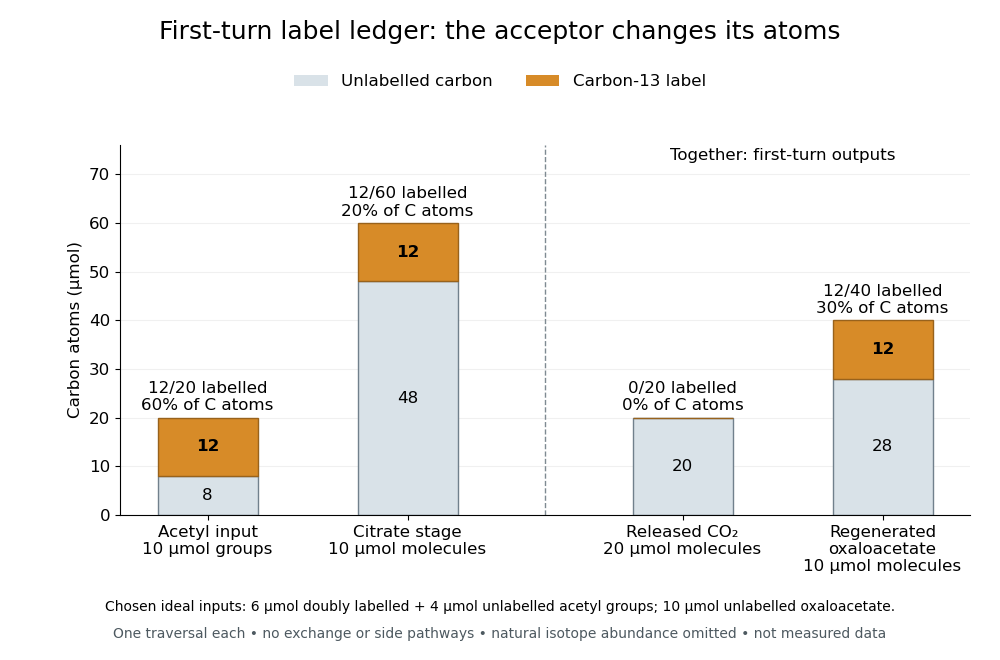
The conservation check is for total carbon and for label. In this model, of regenerated oxaloacetate molecules carry label, distinct from the labelled-carbon fraction. The regenerated oxaloacetate is the same chemical species and the same amount of substance as the initial acceptor pool, but its chemical atom identities have changed. Saying that the cycle oxidizes an acetyl group to two carbon dioxide is a net ledger, not a claim that those exact two incoming chemical atoms immediately leave. Later-turn label release requires positional tracking and mixing assumptions; the first-turn balance alone does not determine it.
Hans Adolf Krebs described the experimental reasoning in his 1953 Nobel lecture. Pigeon breast skeletal muscle retained strong oxidative activity after preparation in a Latapie mincing mill and suspension in aqueous medium. Small fumarate additions increased oxygen uptake by more than complete oxidation of the added fumarate could explain; added four-carbon acids could still be detected afterward. His Table 1 compares the increase in uptake with that calculated from complete consumption of the addition. These comparisons challenge the interpretation that the addition merely supplied extra fuel.[ref]
The citric acid cycle by Hans Adolf Krebs. The citric acid cycle, Nobel Lecture, 11 December 1953, printed pp. 400–401 and Table 1: minced-muscle preparation, uptake comparison and retained acid; authored transcript also available at studyres.com/doc/1333386/hans-a.-krebs---nobel-lecture
The lecture identifies the preparation apparatus but does not describe the gas-measuring instrument behind Table 1. The result supports regeneration, not a unique complete reaction mechanism. Its later discussion combines citrate formation from oxaloacetate with breakdown back toward the four-carbon intermediates to close the cycle. Competitive inhibition supplies another comparison: malonate inhibits succinate dehydrogenase, and succinate accumulates. Such evidence links a blocked step to the surrounding metabolic pathway; damaged tissue and restricted inhibitor access can complicate interpretation.[ref]
The citric acid cycle by Hans Adolf Krebs. The citric acid cycle, printed pp. 401–404, Figures 1–2 and malonate discussion: cyclic interpretation and inhibitor-access limitation; p. 399, preparation damage
An increase above the added fuel's own oxygen demand is a particularly revealing control on the explanation: it compares the proposed cause with the largest effect that simple consumption could produce. The modern mitochondrial oxygen electrode assay asks a different question about a prepared mitochondrion, testing respiratory control through ADP additions. Neither an oxygen uptake signal nor an accumulating intermediate is by itself a direct measurement of ATP production.
Energy metabolism comprises reactions that capture, transfer, and use energy to support cellular processes. Oxidation of nutrients can reduce electron carriers and support synthesis of ATP, which then couples favorable chemical change to otherwise unfavorable work.
ATP is a transferable chemical intermediate, not a substance that creates energy. In oxidative phosphorylation, electron transfer helps establish an electrochemical gradient across a membrane, and ATP synthase uses that gradient. Conservation of energy and the direction of free-energy changes constrain the whole process.
An electron transport chain transfers electrons from an electron donor through electron carriers to a terminal electron acceptor. In the mitochondrial respiratory chain, some transfers drive protons across the inner mitochondrial membrane; their return through ATP synthase can drive ATP formation.[ref]
Molecular Biology of the Cell, 4th edition by Bruce Alberts and others. Chapter 14, Electron-Transport Chains and Their Proton Pumps, Summary: carrier sequence, outward proton transport and ATP synthase
The useful separation is between an electron route and a proton route. The former ends in a redox chemical reaction; the latter changes an electrochemical gradient across a membrane. Energy coupling connects them without making electrons and protons interchangeable. An oxygen readout consequently need not be an ATP readout.
This article focuses on the mitochondrial respiratory chain. Bacteria can use other terminal electron acceptors in anaerobic respiration. In chloroplast light-dependent reactions, light supplies energy and linear electron transport connects water oxidation to NADP+ reduction, releasing oxygen. Thus neither oxygen consumption nor the mitochondrial arrangement defines every electron transport chain.[ref]
Biology 2e by Mary Ann Clark and others. §7.5, Anaerobic Cellular Respiration; §8.2, Generating an Energy Carrier: linear transport from water to NADP+
Transfer of reducing equivalents between a cell and an external acceptor or donor, by direct redox-protein contact, conductive structures or soluble mediators.
An extracellular conductive structure. Composition and conduction mechanisms vary; a filament or pilus image alone does not establish conductivity.
A porin–cytochrome assembly in Shewanella that couples a periplasm-facing multiheme component to an outward-facing cytochrome across the outer membrane.
A copper-containing electron carrier delivering electrons from the cytochrome-b6f pathway to photosystem I in many oxygenic photosynthetic organisms.
Plastoquinone is a mobile lipid-soluble electron carrier in photosynthetic membranes. Its reduction state helps communicate the balance of electron supply and demand between photosystems.
The cytochrome b6f complex transfers electrons between the two photosystems in oxygenic photosynthesis and contributes to proton-gradient formation. Its regulated throughput links lumen conditions to intersystem electron flow.
NADH supplies two electrons to respiratory complex I, then ubiquinone, respiratory complex III, cytochrome c and cytochrome c oxidase; terminal oxygen reduction forms water. Succinate dehydrogenase, or respiratory complex II, supplies another entry to ubiquinone. Respiratory complex I, respiratory complex III and cytochrome c oxidase move protons outward; respiratory complex II does not.[ref]
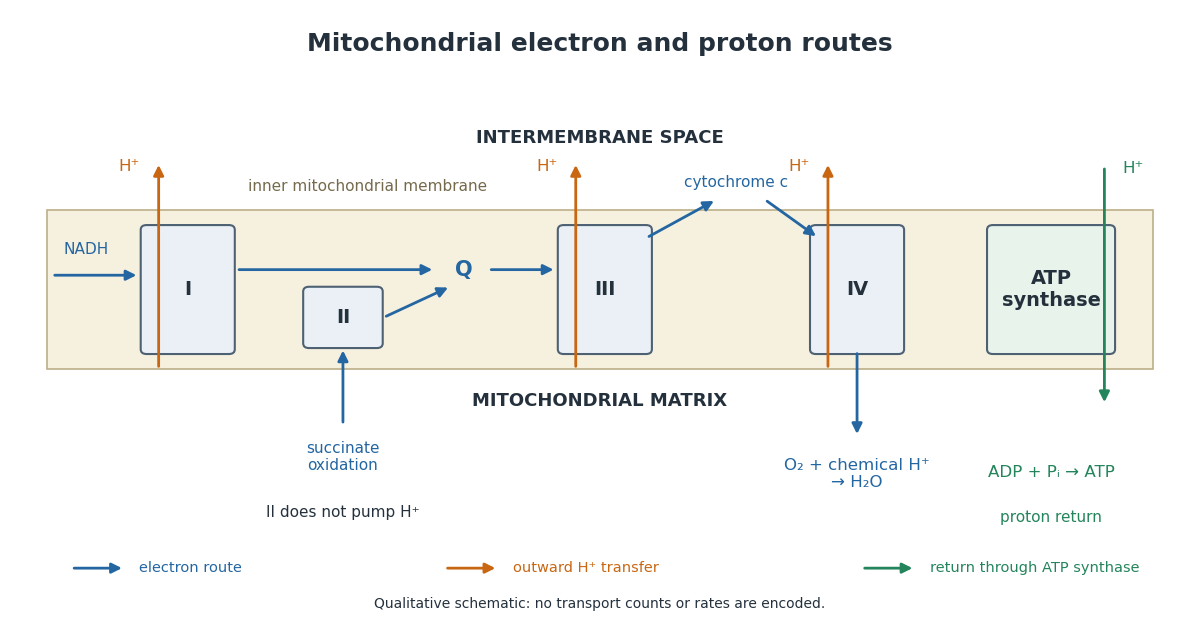
For an original electron balance, supply exactly of NADH to an ideal preparation with no other electron donor or competing electron acceptor. The donor supplies of electrons. Complete reduction of one oxygen molecule needs four electrons, so the corresponding oxygen consumption is . Adding the two formal half-reactions makes the result explicit:The cancelling electrons determine the donor-to-oxygen ratio. These chemical equations do not count transmembrane protons or determine an ATP yield. Chemical protons consumed in water formation and transported protons have different roles in the ledger.
Respiratory complex I, or NADH:ubiquinone oxidoreductase, transfers electrons from NADH to ubiquinone and couples the process to proton translocation across the inner mitochondrial membrane. Its flavin and iron-sulfur centers form part of the electron-transfer pathway.
The resulting contribution to the proton gradient can support ATP synthesis. Electron transfer and proton movement are coupled molecular processes; the complex does not directly phosphorylate ADP. Its physiological direction and behavior depend on redox and membrane-potential conditions.
Succinate dehydrogenase oxidizes succinate to fumarate and transfers the electrons through bound cofactors to ubiquinone. In mitochondria it is respiratory complex II, linking the citric acid cycle with the respiratory chain.
Unlike complexes I, III, and IV, it does not itself pump protons across the membrane. This distinction explains why electrons entering through succinate contribute differently to the proton-motive output than electrons entering through NADH.
Respiratory complex III, the cytochrome bc1 complex, transfers electrons from ubiquinol to cytochrome c. Its Q-cycle mechanism separates the two electrons from a quinol and couples their transfer to vectorial proton movement.
Cytochrome c carries one electron at a time, whereas ubiquinol carries two. The mechanism therefore connects carriers with different electron stoichiometries while contributing to the membrane electrochemical gradient.
Cytochrome c oxidase is respiratory complex IV. It receives electrons from cytochrome c and reduces molecular oxygen to water at metal-containing catalytic centers.
This reaction consumes substrate protons and is coupled to additional proton translocation across the membrane. Distinguishing chemical proton consumption from pumped protons is essential in counting the complex's contribution to the proton-motive force.
An electron carrier cycles between oxidation and reduction. Ubiquinone carries two electrons, while cytochrome c carries one at a time.[ref]
Biology 2e by Mary Ann Clark and others. §7.4, Q and Complex II; Complex III: mobile carriers and electron capacities
For example, transferring the two electrons supplied by one NADH requires two one-electron deliveries by cytochrome c. It does not require two permanently consumed cytochrome c molecules: an available electron carrier can unload, return and reload. Electron carriers recycle material while the net redox conversion supplies free energy.
Respiratory control links mitochondrial oxygen consumption to demand for ATP. When ADP permits faster ATP synthase turnover, proton return lowers the opposing electrochemical gradient, permitting faster electron transport.[ref]
Molecular Biology of the Cell, 4th edition by Bruce Alberts and others. Chapter 14, Electron-Transport Chains and Their Proton Pumps, Respiratory Control Normally Restrains Electron Flow Through the Chain
The mitochondrial oxygen electrode assay tests this connection by changing ADP availability while observing oxygen. A slowed reaction rate alone cannot locate the cause: depleted substrate, scarce oxygen, impaired enzymes and a strong opposing electrochemical gradient can all restrict turnover. A renewed response to ADP helps distinguish these possibilities.
In Respiratory enzymes in oxidative phosphorylation. I. Kinetics of oxygen utilization (1955), Britton Chance and G. R. Williams examined isolated liver mitochondria in isotonic medium with substrate and inorganic phosphate. A one-millilitre optical cuvette held the suspension. A vibrating platinum electrode lay outside the light path; calibrated electric current followed dissolved oxygen, with rapid changes recorded by a galvanometer oscillograph. Air-saturated and oxygen-depleted readings checked sensitivity. Their Figure 2 shows ADP additions accelerating oxygen consumption, followed by return to slow respiration; repeated additions restored acceleration. Figure 4B compares delayed substrate addition after ADP incubation with the reverse order, supporting little unrelated ADP loss in that preparation. These comparisons support coupling to ADP utilization. The authors discuss dilution, sensitivity changes and atmospheric oxygen entry, which especially biases slow respiration. The readout did not directly measure the membrane potential or prove the later chemiosmosis mechanism.[ref]
Respiratory enzymes in oxidative phosphorylation. I. Kinetics of oxygen utilization by Britton Chance and G. R. Williams. pp. 383–386, Preparations and Method, Figures 1–2; pp. 387–389, Endogenous Substrate and Figure 4B; Figure 5: rapid recording
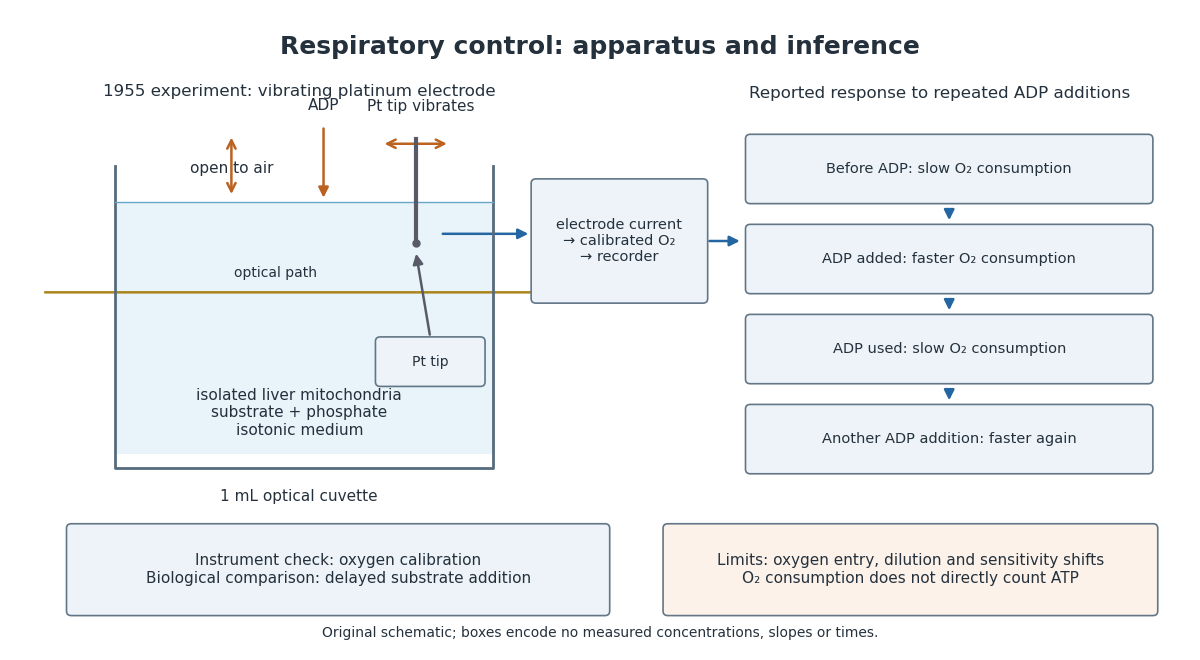
A control can test either the instrument or the biology. Calibrating electric current against oxygen checks the former; comparing responses before and after an ADP addition checks the latter. A valid calibration cannot by itself establish ATP formation, and a repeatable biological response cannot by itself fix an instrument's sensitivity.
The respiratory control ratio divides the oxygen consumption rate during ADP-stimulated respiration by that after supplied ADP has been used. It compares reaction rates, not ATP formed per oxygen.[ref]
Respiratory enzymes in oxidative phosphorylation. I. Kinetics of oxygen utilization by Britton Chance and G. R. Williams. pp. 386–387, Figure 2 and discussion of the ratio of respiration rates with and without ADP
A large ratio means strong stimulation under the comparison's conditions; it is not a universal measure of all mitochondrial functions.
For a constructed example, choose constant suspension volume and oxygen concentration declines of and during the two comparison windows. Assume no gas exchange or dilution and a correctly calibrated readout. A derivative converts each concentration slope into an amount of substance consumption rate:The common volume cancels in the ratio, so dividing the positive slope magnitudes gives the same answer. These are chosen inputs, not the 1955 observations. If an uncorrected influx of of oxygen occurred in both windows, the apparent rates would instead be and , giving . The same absolute error can inflate a ratio because it removes a larger fraction of its smaller denominator.
Oxidative phosphorylation couples respiratory redox conversion to ATP formation through chemiosmosis. ATP synthase uses inward proton flow to join ADP and inorganic phosphate.[ref]
Molecular Biology of the Cell, 4th edition by Bruce Alberts and others. Chapter 14, Electron-Transport Chains and Their Proton Pumps, Summary: ATP synthase and chemiosmotic coupling
The intermediate electrochemical gradient explains why respiratory uncoupling can preserve oxygen consumption while reducing ATP formation. An electron ledger alone cannot determine the recovery of useful free energy.
Proton return across a coupling membrane that is not coupled to productive ATP synthase turnover. Its absolute rate, fraction of total proton return and flux control coefficient are different quantities.
The amount of ATP formed per oxygen atom reduced during coupled respiration. Oxygen molecules contain two atoms, so the ATP: ratio is twice the conventional phosphorylation-to-oxidation ratio for the same measurements.
Chemiosmosis couples transmembrane ion movement down an electrochemical gradient to a chemical transformation. For mitochondrial ATP synthesis, protons return from the intermembrane space to the mitochondrial matrix through ATP synthase.[ref]
Molecular Biology of the Cell, 4th edition by Bruce Alberts and others. Chapter 14, Electron-Transport Chains and Their Proton Pumps, Summary: inward proton flow driving ATP synthesis
An original thermodynamic example separates the electrical and chemical contributions. At fixed temperature , use ideal dilute thermodynamic activities and the electric potential on each side. The molar electrochemical potential difference for inward transfer of a singly charged proton isHere is the molar gas constant, the Faraday constant, and the natural logarithm. The sign convention is destination minus origin: a negative difference makes inward transfer favourable. Both lower proton activity and a more negative electric potential inside favour inward movement.
Stipulate , , , and . These illustrative inputs give approximately and for the chemical and electrical terms, hence per transferred proton. For a hypothetical device coupling three inward protons per ATP to an ATP-formation cost of ,The sign follows by adding changes in the state function Gibbs free energy. It establishes thermodynamic feasibility for this chosen model, not its reaction rate. Three is a stipulated coupling count, not a universal ATP synthase stoichiometry; transport costs and leaks can also consume the available free energy.
Downhill ion transport through ATP synthase can drive ATP formation from its substrates. The electrochemical free-energy drop per transported ion combines the membrane potential and concentration term. Reverse coupling can use ATP hydrolysis to maintain the ion gradient.
Respiratory uncoupling allows proton return to bypass ATP synthase, dissipating the electrochemical gradient. Electron transport and oxygen consumption can continue while less ATP is recovered.[ref]
Molecular Biology of the Cell, 4th edition by Bruce Alberts and others. Chapter 14, Electron-Transport Chains and Their Proton Pumps, H+ Ionophores Uncouple Electron Transport from ATP Synthesis
In the thermodynamic example under chemiosmosis, reducing both the activity ratio to one and the electric potential difference to zero removes the driving contribution. The hypothetical ATP-forming conversion then costs . Continued donor oxidation would not restore coupling unless it rebuilt a usable electrochemical gradient. This distinction makes respiratory uncoupling useful conceptually: abundant oxygen consumption can coexist with poor recovery of ATP.
Substrate-level phosphorylation forms ATP by enzyme-catalyzed transfer of a phosphate group from a phosphorylated substrate to ADP. In canonical glycolysis, two such transfers occur for each three-carbon route, giving four gross ATP per glucose. Unlike oxidative phosphorylation, these transfers do not require an electron transport chain.[ref]
Biology 2e by Mary Ann Clark and others. §7.2, steps 7 and 10: phosphate transfer to ADP; §7.5, opening comparison of fermentation with respiration
The pyruvate kinase example under Coupled-enzyme readout of glycolytic ATP formation separates the material transfer from its detection. A favourable coupled chemical reaction supplies the driving change in Gibbs free energy; the enzyme supplies a catalytic route. Counting ATP-forming transfers gives a gross yield, while subtracting upstream ATP use gives the net yield.
A biochemist investigates the molecular chemistry of living systems, including the structure, reactions, and regulation of proteins, nucleic acids, lipids, and metabolites. The subject links chemistry with biology through experimentally testable mechanisms.
For example, measuring how an enzyme's reaction rate changes after a targeted amino-acid substitution can test a proposed catalytic role. Structural, kinetic, and cellular measurements answer complementary questions; a molecular interaction observed in isolation need not establish its importance in a living organism.
Meir Wilchek is a biochemist whose work helped establish affinity chromatography as a practical method of protein purification. His collaboration with Pedro Cuatrecasas used selective molecular recognition to retain a desired protein on a ligand-bearing support, connecting a biochemical interaction to a separation method.[ref]
Pedro Cuatrecasas by Alan R. Saltiel. p. 2, collaboration with Wilchek and development of affinity methods
The central idea differs from simply sorting proteins by size. An immobilized ligand supplies a binding partner for the target, while the experiment must still control unwanted retention and recover useful protein. The combination of specificity and reversibility makes a molecular interaction into an analytical tool.
For an illustrative comparison, two proteins of similar mass may behave differently on a column if only one recognizes the attached ligand. Conversely, a tightly retained protein is not automatically the intended target. Identity measurements and controls remain necessary. Wilchek's contribution is scientifically interesting because it makes biological selectivity useful for experimental isolation, rather than treating recognition only as a phenomenon to describe.[ref]
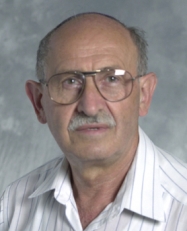
Portrait of Meir Wilchek
. Photograph explicitly identified as Wilchek Meir in the official departmental directory.Gennadiy Moiseyev is a researcher in retinoid biochemistry and the visual cycle. He was first author of a 2005 study demonstrating RPE65-dependent conversion of all-trans-retinyl esters into 11-cis-retinol in an expression system.[ref]
A subsequent study tested the enzyme's metal requirement. Chelation inhibited the measured activity, and supplying ferrous iron restored it; the tested ferric-iron additions did not. The study also examined recombinant RPE65 and measured iron associated with purified protein.[ref]
The contrast illustrates why the relevant variable is more specific than “some iron is present.” Oxidation state, accessible metal and assay conditions can affect whether an enzyme functions. Inhibition followed by chemically specific restoration provides a stronger mechanistic test than a correlation between protein abundance and product amount. Those biochemical experiments concern a defined reaction system; they do not by themselves establish a treatment or explain every physiological consequence of altered retinoid metabolism.
Venizelos Papayannopoulos is a biomedical researcher whose work concerns neutrophils and extracellular antimicrobial responses. He was first author of a 2010 study connecting neutrophil elastase and myeloperoxidase to the formation of neutrophil extracellular traps.[ref]
That work connected localization to chemistry. Neutrophil elastase entered the cell nucleus and cleaved particular histones, while experiments with purified components tested how those changes affected chromatin decondensation. A mouse loss-of-function comparison supplied evidence about trap formation in an infection model.[ref]
Neutrophil elastase and myeloperoxidase regulate the formation of neutrophil extracellular traps by Venizelos Papayannopoulos and others. Abstract and Fig. 1, component assays and genetic comparison
The scientific value lies in combining tests of different claims. Imaging can locate a protein; an enzyme assay can identify activity; removing a component can test a requirement in a larger system. Agreement among those observations supports a mechanism, while none is an automatic substitute for the others. This makes the research an example of how protein biochemistry can explain a changing cellular structure.
Emanuel Margoliash was a biochemist whose work on cytochrome c connected protein primary structure, molecular function and evolution. He isolated and sequenced the protein from different organisms and helped develop comparisons of amino acid sequences as evidence for phylogenetic trees.[ref]
His 1963 paper, Primary structure and evolution of cytochrome c by Emanuel Margoliash, made the structural comparison itself a source of evolutionary evidence. Subsequent collaborative work assembled a tree from twenty cytochrome-c sequences, combining published sequences with measurements from his laboratory.[ref]
A toy example shows the measurable idea. Align the five-residue strings
ACGKT and ACGRT: four positions agree and one differs, giving an observed mismatch fraction . These are invented strings, not Margoliash's data. An observed mismatch count is not automatically elapsed evolutionary time: repeated substitutions can hide earlier changes. The power of the approach is to make molecular resemblance explicit and test competing explanations, while retaining the distinction between sequence observations and an inferred history.Pedro Cuatrecasas was a biochemist who helped develop affinity chromatography and studied receptor biology. With collaborators including Meir Wilchek, he developed methods that used selective molecular binding to isolate particular proteins from complex mixtures.[ref]
His 1970 paper, Agarose Derivatives for Purification of Protein by Affinity Chromatography by Pedro Cuatrecasas, explained the organizing principle: attach a suitable ligand to an insoluble matrix, then exploit its reversible interaction with the desired macromolecule. The immobilized ligand supplies chemical selectivity, rather than requiring the target protein to be distinguished only by bulk size or charge.[ref]
Agarose Derivatives for Purification of Protein by Affinity Chromatography by Pedro Cuatrecasas. opening text, reversible recognition and covalently attached ligand
The method separates capture from recovery. Binding a target is useful only if the experiment can distinguish it from other retained material and recover it in a usable state. This makes protein purification a problem of controlled interactions as well as apparatus. Cuatrecasas also applied binding measurements and affinity methods to the insulin receptor, connecting recognition of a hormone to a physically isolable molecular component.[ref]
M. Soriano-Garcia is the first-listed author of a structural study connecting calcium ion binding with organization of the Gla domain of prothrombin. The 1992 paper reports an X-ray crystallography structure of calcium-bound prothrombin fragment1 at resolution and lists a chemistry affiliation at Michigan State University.[ref]
The comparison was mechanistically informative. In crystals without bound calcium, much of the Gla domain was disordered; in the calcium-bound preparation, the domain was well resolved and bound seven calcium ions. Carboxylate groups of gamma-carboxyglutamate residues helped coordinate those ions. Thus calcium was associated with a particular folded arrangement, rather than simply being another ingredient in solution.[ref]
The Ca2+ ion and membrane binding structure of the Gla domain of Ca-prothrombin fragment 1 by M. Soriano-Garcia and others. Abstract: apo/calcium-bound comparison and coordination
The study illustrates a limit of structural interpretation. Failure to resolve a region in a crystal does not prove that the corresponding amino acids are absent. The same sequence can be present while adopting multiple arrangements that do not yield one sharply defined crystallographic position. Comparing binding states can therefore reveal organization without implying that a missing part of the image was missing from the protein.
J. Stenflo coauthored the 1974 work identifying gamma-carboxyglutamic acid in prothrombin, connecting Vitamin K dependence with a specific chemical modification of a clotting protein. The study isolated a four-residue peptide from the calcium-binding amino-terminal region and found mobility that ordinary amino-acid composition did not explain.[ref]
Nuclear magnetic resonance and mass spectrometry identified two modified glutamic-acid residues in that peptide. The result supplied a chemical identity for the anomaly, rather than treating an altered migration pattern alone as a complete explanation.[ref]
Vitamin K dependent modifications of glutamic acid residues in prothrombin by J. Stenflo and others. Abstract: proton NMR, mass spectrometry and two gamma-carboxyglutamic-acid residues
An additional carboxyl group changes a side chain's chemical possibilities, including its interactions with ions. This makes post-synthesis chemistry biologically significant: two protein preparations with the same genetically specified sequence can differ in modifications and function. The finding helped connect a nutritional requirement, a measurable molecular difference and the behavior of a calcium-binding protein, while preserving the distinction between a chemical observation and a physiological inference.
R. E. Humbel coauthored experimental work identifying the chemical structure of human insulin-like growth factors with E. Rinderknecht. Their 1978 study determined the complete sequence of serum-derived insulin-like growth factor 1: a single chain of seventy amino acid residues connected by three disulfide bonds.[ref]
The comparison with proinsulin connected a biological activity to a molecular relationship. Corresponding regions resembled the insulin chains, while an intervening connecting segment remained in the growth factor. Conserved residues were compatible with a related folded structure; sequence similarity was evidence for that inference, not an atomic structure determination.[ref]
The amino acid sequence of human insulin-like growth factor I and its structural homology with proinsulin by E. Rinderknecht and R. E. Humbel. Abstract: insulin-chain correspondence, connecting segment and structural interpretation
This research illustrates why a bioassay and sequence analysis complement one another. Two preparations can produce similar responses without containing identical proteins. Establishing residue order and covalent connections provides an independent way to distinguish related signaling molecules.
- Amino-terminal sequences of two polypeptides from human serum with nonsuppressible insulin-like and cell-growth-promoting activities: evidence for structural homology with insulin B chain by E. Rinderknecht and R. E. Humbel
- The amino acid sequence of human insulin-like growth factor I and its structural homology with proinsulin by E. Rinderknecht and R. E. Humbel
E. Rinderknecht is the first-listed author of primary studies with R. E. Humbel that chemically characterized serum polypeptides with insulin-like and growth-promoting activity. Their 1976 amino-terminal sequencing paper compared two preparations then called NSILA I and II and proposed the designation insulin-like growth factor from their biological properties and resemblance to insulin.[ref]
Of the first thirty-one residue positions examined, twenty-two were identical between the two polypeptides. That is about identity over the measured segment: substantial similarity, but not identity of the entire molecules. The measured segment and the comparison being made must therefore accompany any percentage. The later complete sequence of insulin-like growth factor 1 supplied a more extensive chemical description.[ref]
The scientific contribution is a shift from classifying preparations by their effects to distinguishing specific related proteins. Shared biological activity, shared amino-terminal residues and a complete molecular sequence are progressively different kinds of evidence; none should be silently substituted for another.
- Amino-terminal sequences of two polypeptides from human serum with nonsuppressible insulin-like and cell-growth-promoting activities: evidence for structural homology with insulin B chain by E. Rinderknecht and R. E. Humbel
- The amino acid sequence of human insulin-like growth factor I and its structural homology with proinsulin by E. Rinderknecht and R. E. Humbel
Christian B. Anfinsen investigated the relation between amino-acid sequence and protein folding. Refolding experiments connect recovery of a protein's native structure with recovery of its biological activity.
The work supports the thermodynamic interpretation of folding under appropriate conditions: sequence and environment constrain the accessible stable structure. It does not imply that every protein folds rapidly or independently of cellular assistance.[ref]
Principles that govern the folding of protein chains by Christian B. Anfinsen. Primary publication: scientific topic and stated experimental result
Biochemist whose research addressed protein folding.[ref]
https://www.nobelprize.org/nomination/archive/show_people.php?id=16045. Primary identity record

Portrait of Christian B. Anfinsen
. Edward A. Hubbard / National Institutes of Health, circa 1950s; courtesy NIH Record and NIH, via the National Library of Medicine. Public domain (PD-USGov-NIH). Source.Poul Nissen coauthored the structural basis of ribosome activity in peptide bond synthesis by Poul Nissen and others.
Substrate-analogue structures in this study locate peptide bond formation in an RNA-based active site of the ribosome. This is concrete structural evidence for the catalytic role of ribosomal RNA, linking the geometry of the substrate-binding site to translation.
Paul D. Boyer developed a binding-change mechanism for ATP synthase. Different conformations of catalytic sites bind substrates, form ATP, and release it at different stages of the cycle.
This connects mechanical coupling with catalysis: rotation changes the state of a catalytic site rather than requiring an identical chemical environment at every moment.[ref]
https://www.nobelprize.org/prizes/chemistry/1997/summary/. Official prize account: enzymatic mechanism underlying ATP synthesis
Biochemist (1918–2018), recognized for elucidating the enzymatic mechanism of ATP synthase.

Portrait of Paul D. Boyer
. GBHayes. CC BY-SA 4.0, via Wikimedia Commons. Source. Articles were limited to the first 100 out of 5940 total.
Articles by others on the same topic





Chemistry is fun. Too hard for precise physics (pre quantum computing, see also quantum chemistry), but not too hard for some maths like social sciences.
And it underpins biology.