Consider a stipulated continuous-allocation problem. Amounts of two activities use units of a common resource, with budget six. The feasible regionis a triangle with extreme points , and . It is the intersection of three closed half-spaces, hence a closed convex set. The general intersection argument is short: a line segment between two points in every constraint set belongs to every constraint set, so it belongs to their intersection.[ref]
Convex Optimization by Stephen Boyd and Lieven Vandenberghe. §2.2.1, p. 27: half-spaces; §2.3.1, p. 36: intersections preserve convexity
For an original numerical check, take and . Their resource totals are and . Every convex combination is nonnegative and has resource totalIn particular the midpoint is , using units. This verifies the full line segment, rather than just a plotted sample of it.
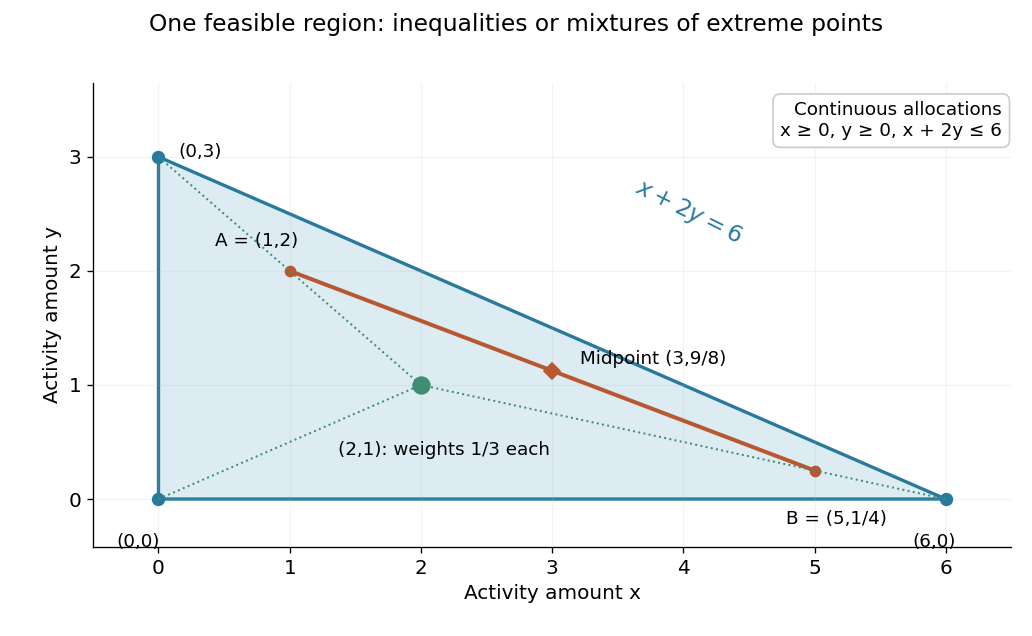

This is useful whenever divisible quantities share linear limits: the feasible choices remain compatible under averaging. A new linear equation also preserves this property, because averaging two identical constraint values gives the same value. The affine subspace and closed half-space viewpoints explain this without requiring a separate argument for every budget.
Articles by others on the same topic
There are currently no matching articles.