For positive integers , two finite cyclic groups combine into one cyclic group precisely when their group orders are coprime:The reason is that both cyclic counters must return to their identity elements simultaneously. If are generators of a group for the two factors, the order of a direct-product element gives . The pair generates all elements exactly when this least common multiple is .
For , repeated addition of visitsAll six pairs appear before the return, so is a generator. In contrast, in the same step gives only . Every nonidentity element has order of a group element two, so none can generate all four pairs. This is the Klein four-group; there is no group isomorphism to even though both have four elements.
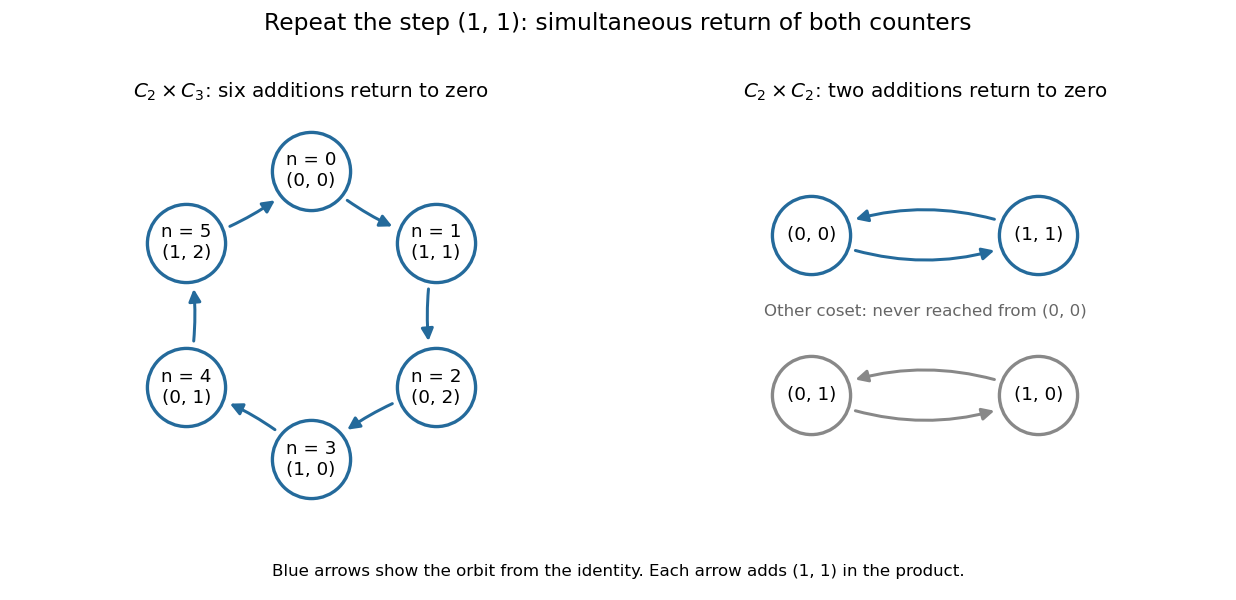

For a brief proof of the converse, each component order of a group element divides the corresponding factor group order. Every pair's order therefore divides . If , this is smaller than , so no pair can generate the whole product. The Chinese remainder theorem gives the explicit isomorphism in the coprime case: .
Articles by others on the same topic
There are currently no matching articles.