Each block starts with a one-bit
BFINAL flag and a two-bit BTYPE field. The BTYPE values are 0 for stored data, 1 for fixed Huffman codes, 2 for dynamic Huffman codes, and 3 for an invalid reserved value. For compressed blocks, symbol 256 ends the current block; BFINAL = 1 says this is the last block. An end-of-block symbol does not mean a literal zero byte, and in a nonfinal block it does not end the whole stream.[ref]DEFLATE Compressed Data Format Specification version 1.3 by L. Peter Deutsch. RFC 1951, section 3.2.3: header, block types and decoding loop
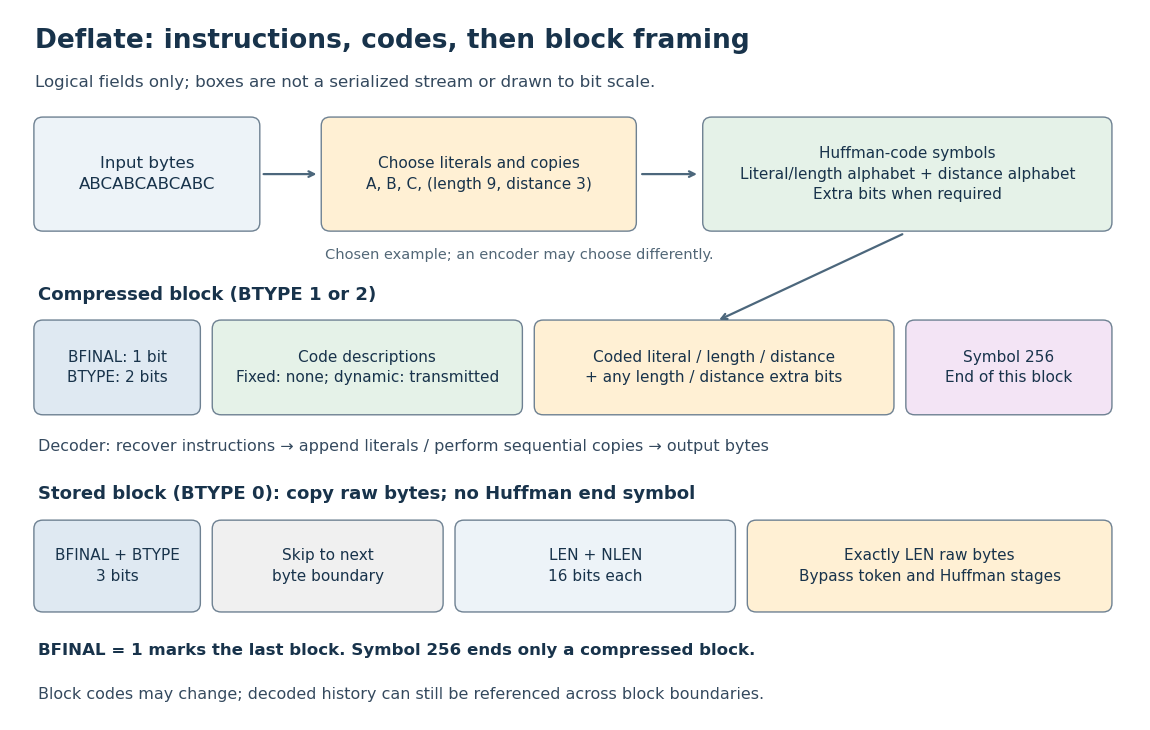
Deflate separates literal and copy instructions from Huffman coding and final-block framing; stored blocks bypass both stages
. Details. 
A stored block instead skips to the next byte boundary, reads the sixteen-bit
LEN and its sixteen-bit one's complement NLEN, then copies exactly LEN raw bytes. Its length field replaces the compressed block's end-of-block symbol. A compressed block need not end at a byte boundary, so the next block header can start inside the current byte.[ref]The diagram shows logical fields, not a serialization into bits. RFC 1951 specifies bit packing separately, including different conventions for codewords and other fields (section 3.1.1). For PNG, the filtered image data is compressed inside a zlib wrapper with its own header and checksum; raw Deflate and a complete PNG file therefore have different framing.[ref]
Articles by others on the same topic
There are currently no matching articles.