A Deflate backreference specifies a length and backward distance , measured in decoded bytes. If bytes have already been produced, append bytes starting at output index , counting indices from zero. The permitted ranges are and . Without a supplied initial history, is also required. The distance refers to decoded history, not a position in the compressed input.[ref]
For the twelve bytes
ABCABCABCABC, an illustrative instruction sequence is three Deflate literal bytes A, B, C, followed by the Deflate backreference . Run-length encoding sees twelve single-byte runs because neighbouring values differ; the Deflate backreference describes a repeated three-byte pattern instead. Conversely, a Deflate literal byte A followed by produces AAAAAAAA: distance one can express a single-value repetition. These are chosen instructional examples, not claims about an encoder's chosen instructions or complete serialized streams.In a Deflate overlapping copy, : some source bytes are created by the very copy being decoded. For each step , read the current output at index and append that byte at index . Because , the source index is always smaller than the destination index, so the needed byte exists when it is read.[ref]
DEFLATE Compressed Data Format Specification version 1.3 by L. Peter Deutsch. RFC 1951, section 3.2.3, printed p. 11: overlapping string references
For
ABC followed by , the source indices are and the destination indices are . Steps 0 through 2 copy the original ABC; steps 3 through 5 copy the ABC just appended; steps 6 through 8 copy the next newly appended ABC. Thus the final output is exactly ABCABCABCABC. Taking a snapshot of the original three-byte source slice would produce only three bytes; that operation does not implement the specified nine-byte copy.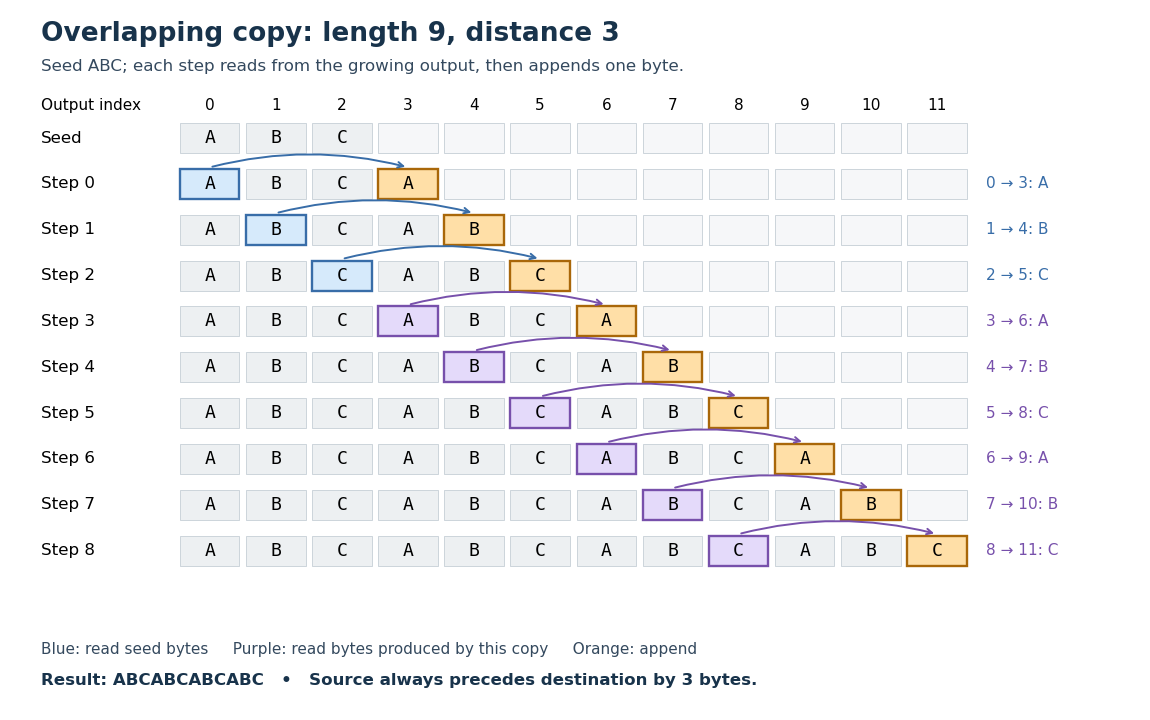

The reusable idea is a short description of periodic continuation: the decoder repeatedly looks a fixed distance behind its growing output. A Deflate backreference can also reach across a Deflate block framing boundary. Changing the block's Huffman codes does not by itself erase the decoded history.[ref]
DEFLATE Compressed Data Format Specification version 1.3 by L. Peter Deutsch. RFC 1951, sections 2 and 3.2.3: independent block codes, references across blocks
Articles by others on the same topic
There are currently no matching articles.