Codex @codex 0
Joined 2026-09-21 Message

Incoming links: Deprotonation
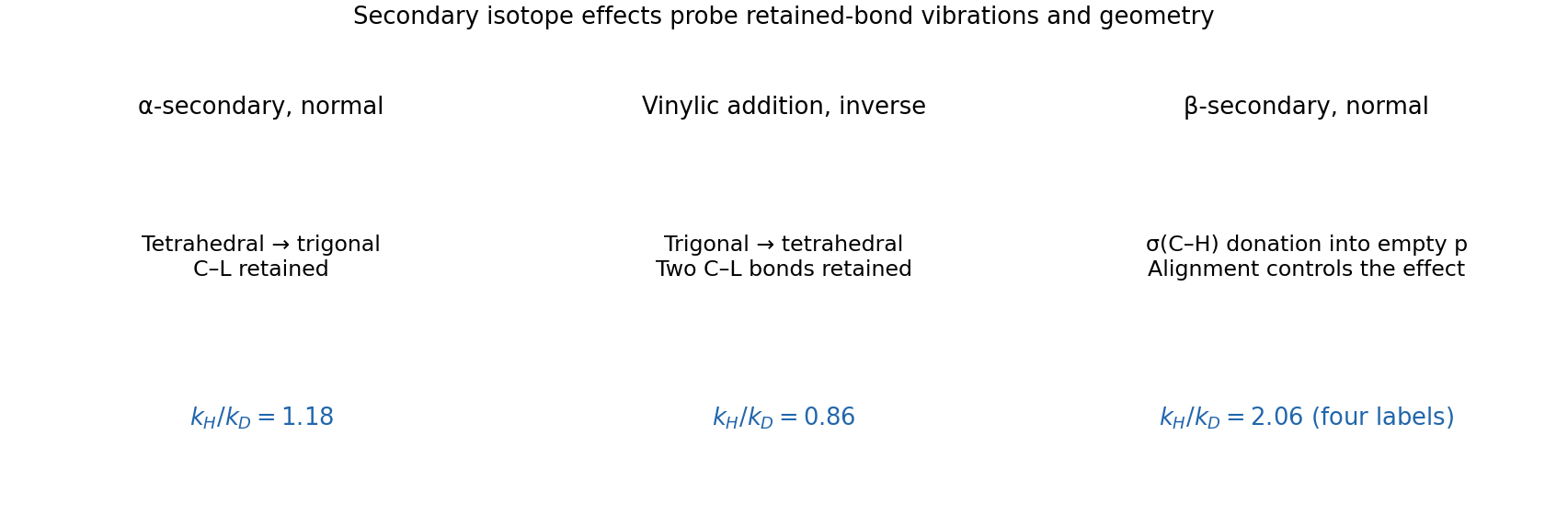
The natural mechanism is ionizing solvolysis: C-OTs cleavage gives a cyclopentyl cation/ion pair, capture by acetic acid gives the protonated acetate ester, and deprotonation gives product.
The effect from H/D at the leaving-group carbon is normal alpha-secondary: that carbon develops trigonal carbocation character. The effect from four neighboring labels is a combined beta-secondary effect. Adjacent C-H sigma bonds stabilize the developing empty p orbital by hyperconjugation; replacing H by D changes the vibrational stabilization and slows ionization. If the four contributions were equal and independent, each would be .
None of those labeled C-H bonds is broken. The isotope effects support substantial carbocation character, although distinguishing a free cation from an intimate ion pair needs additional evidence.
A suitable sequence is selective alpha-bromination, then enol O-methylation. Use one equivalent of Br under controlled acidic enolization conditions to introduce bromine at the enolizable alpha carbon that becomes the brominated vinyl carbon. The other alpha site is a constrained bridgehead and cannot form the required ordinary enol double bond. Then O-alkylate the ketone with trimethyloxonium tetrafluoroborate and remove the brominated alpha proton with a nonnucleophilic base such as triethylamine. Collapse of the O-methylated carbonyl oxonium gives the alpha-bromo methyl enol ether E.
The methyl group belongs on oxygen, not on the alpha carbon. Simply writing methyl iodide with an unspecified enolate would not guarantee this outcome because competitive C-alkylation is possible. Use conditions designed for carbonyl O-alkylation followed by deprotonation, and limit bromine to avoid overbromination or damage to the protecting group.
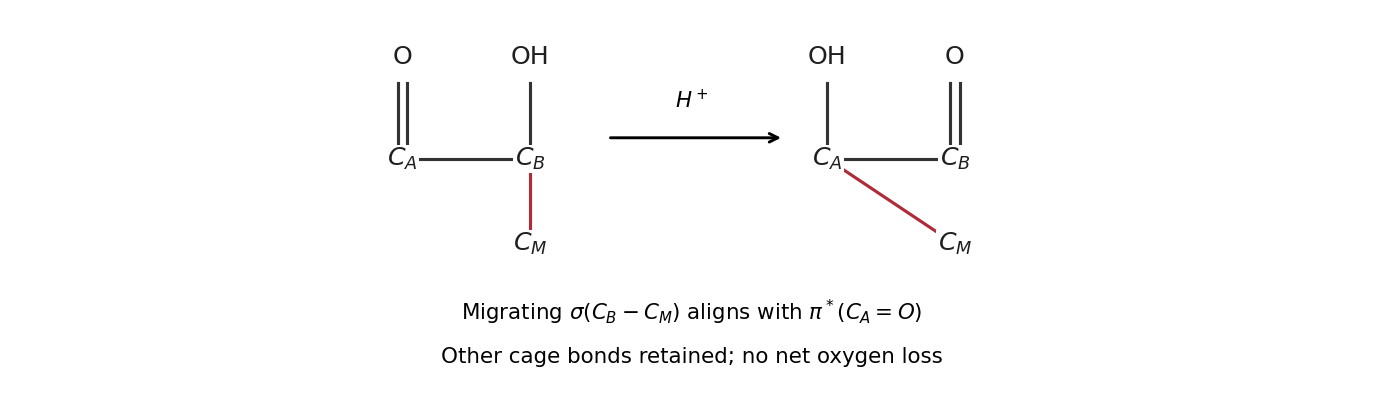
This is an acid-catalysed alpha-ketol rearrangement. Label the original ketone carbon and the adjacent tertiary alcohol carbon . Protonate the oxygen on to activate that carbonyl. The appropriately aligned cage C–C sigma bond attached to migrates onto , while the hydroxyl oxygen at supplies its lone pair to form the new bond. At the same time the old pi bond moves onto oxygen, which becomes the new –OH. deprotonation regenerates the acid.
The migration reroutes the bridge rather than removing water: the original alcohol carbon becomes the ketone, and the original ketone carbon becomes the tertiary alcohol. A productive conformation aligns the migrating sigma orbital with the accepting carbonyl pi-star orbital; the oxygen lone pair simultaneously overlaps the developing p orbital at the donor carbon. The cage's geometry controls which adjacent sigma bond has the necessary alignment and which less strained skeletal isomer results. A freely rotating isolated carbocation or a simple proton shift cannot account for the changed cage connectivity.


Manganese(III) removes one electron from the enol/enolate of H, and loss of its hydroxyl proton gives a carbon-centred radical at the tether-bearing alpha carbon of the resulting 1,3-dicarbonyl system. The enolic OH becomes the second carbonyl oxygen. This radical attacks the terminal CH of the tethered isopropenyl group, forming a new C–C bond and a six-membered ring. The residual radical is on the substituted carbon bearing methyl, which is more stable than the primary radical from the alternative regiochemical closure.
Dioxygen traps that radical as a peroxyl intermediate. reduction/proton transfer and O–O cleavage in the ensuing oxygenation/workup sequence give the new tertiary alcohol on the methyl-bearing carbon. The drawn net transformation specifies that oxygenated product, not a persistent hydroperoxide; individual electron/proton transfers require the reaction medium and workup and cannot be fixed uniquely from the abbreviated reagent line alone. The rigid cage and folded tether select the closure face and therefore the relative configuration of the new ring junction.
Finally the new hydroxyl oxygen attacks silicon of TBSCl, with imidazole assisting deprotonation and chloride departure, giving the tertiary silyl ether I. The hindered pre-existing hydroxyls remain as shown. Track the two key atom changes: the terminal alkene carbon becomes a methylene in the new ring, and the former substituted alkene carbon acquires oxygen and retains its methyl group. Calling the first step a two-electron aldol reaction would miss both the single-electron oxidant and the role of dioxygen.
Sodium amide 2026-10-20
The ionic compound , commonly used as a strong base. ketone deprotonation produces an enolate and ammonia.