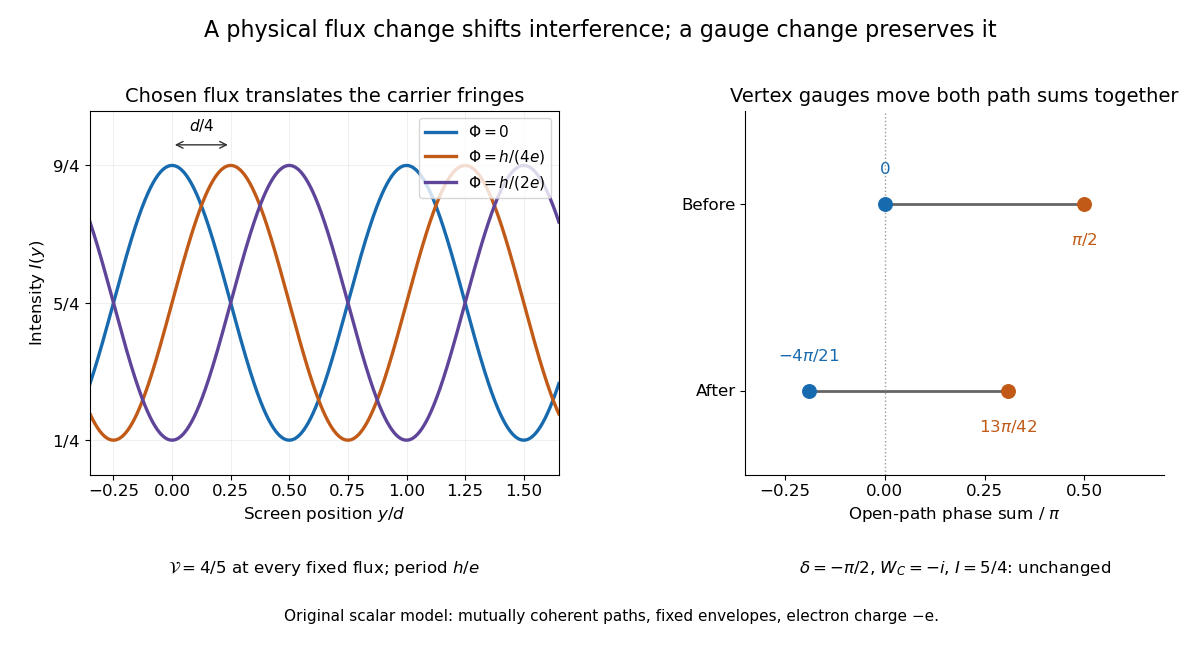
A four-vertex model proves the essential gauge invariance without solving an Electron scattering problem. Use two directed paths and . Assign an edge phase and a complex unit link to each directed edge, with . These links represent discretized magnetic line integrals multiplied by . Under a gauge transformation with arbitrary vertex phases ,Both path products acquire the same factor . Their gauge-invariant ratio is the closed-loop holonomyEvery intermediate vertex phase cancels. For any fixed nonnegative real amplitudes , the interference quantity is unchanged too. A gauge-dependent open-path phase consequently cannot be interpreted as an observable by itself.
For an exact example, measure phases in units of and order edges as . Choose edge phases and vertex phases . The transformed edge phases areThe upper and lower sums become and ; their difference remains . With amplitudes , , the intensity remains . Sweeping one physical loop phase through instead produces extrema and , agreeing with the interferometric visibility example above.

Articles by others on the same topic
There are currently no matching articles.