An anyon is a two-dimensional quasiparticle whose exchange or braiding statistics can differ from bosonic and fermionic statistics.
An anyon fusion rule specifies which total anyon charges can result from combining charges . The nonnegative integers are anyon fusion multiplicities. The vacuum anyon is the identity for this product, and identifies the antianyon.
A matrix encoding multiplication by charge in the anyon fusion rule. These matrices commute in a braided monoidal category. On a sphere, the dimension of the anyon fusion space with puncture charges and total vacuum anyon charge is .
The dual charge to an anyon , characterized by . Reversing the orientation of an anyon strand replaces its label by its antianyon. Its quantum dimension satisfies .
The identity charge of an anyon fusion rule: . In an anyon fusion tree, a strand of this charge may be erased using the unit conventions.
The Hilbert space of ways to combine the specified anyon charges to the specified total charge. For two inputs its dimension is the anyon fusion multiplicity . Repeated anyon fusion is described by an anyon fusion tree.
The unitary operator implementing a chosen positive exchange of adjacent anyons in total charge . In a multiplicity-free theory it is a scalar. An inverse crossing uses its inverse. Two positive exchanges give the anyon monodromy .
The full double braiding of two anyons. The anyon balancing identity gives in a permitted anyon fusion channel. Unlike a single anyon R-matrix entry, this scalar is invariant under an anyon vertex gauge transformation.
An anyon whose full anyon monodromy with every other charge is the identity in every allowed anyon fusion channel. The vacuum anyon is transparent. Transparent charges and their anyon fusion summands form a symmetric subcategory of the braided monoidal category. They can have quantum dimension greater than one.
Apply the anyon balancing identity to the vacuum anyon channel in . Transparency gives . Thus a transparent anyon has bosonic or fermionic topological spin. This does not require its quantum dimension to equal one.
For transparent anyons , the hexagon identities for braiding for braiding express double exchange of with any charge as the successive double exchanges of and with . Both are identities. Naturality restricts the resulting identity to every simple anyon fusion summand of , proving that is transparent.
A basis diagram recording an order for successively combining anyon charges, with every edge labeled by its intermediate charge and every vertex by a permitted anyon fusion rule. Changes of parentheses are implemented by anyon F-matrices.
The convention in which the value of an unknotted, untwisted charge- loop is its quantum dimension . For multiplicity-free anyon fusion, a split-fuse bubble with input charges and total charge gives times the identity strand; the corresponding completeness resolution has coefficient .
The convention in which the anyon fusion trees form an orthonormal basis and a splitting vertex followed by its adjoint fusion vertex gives the identity on the total-charge strand. A closed normalized state has norm one. It differs from the isotopy normalization of anyon diagrams, in which an unknotted closed charge- strand evaluates to .
A change of the chosen orthonormal basis of every anyon fusion space. In a multiplicity-free theory each basis change is an independent wave phase . Splitting vertices acquire and adjoint fusion vertices acquire its inverse. A scalar diagram is invariant under these choices when its splitting and fusion vertex factors cancel. A closed diagram with independently specified unmatched vertex tensors need not be invariant.
The unitary matrix relating the anyon fusion trees and . Fix the convention . An inverse change of parentheses uses the adjoint matrix, so its entries are complex conjugates with exchanged indices.
The dimension of the anyon fusion space for two anyons with total charge . A multiplicity-free theory has .
The topological spin is the phase produced by a rotation of anyon , equivalently its self-exchange phase in an Abelian anyon theory. The two-dimensional spin-statistics relation is .
In a ribbon anyon theory, twisting a composite charge is equivalent to twisting each input and applying their full anyon monodromy. The topological spin obeys and ; the latter is the ribbon duality convention, with no complex conjugation of the scalar.
A charge-flux composite carries electric charge and localized magnetic flux . Mutual encircling of and produces the phase from the Aharonov-Bohm and Aharonov-Casher effects.
The Aharonov-Bohm effect is the phase acquired when a charge encircles magnetic flux , even when the magnetic field vanishes along the charge's path.
In the magnetic Aharonov-Bohm effect, a coherent electron wave takes two routes around inaccessible magnetic flux. Recombination converts their relative wave phase into displaced interference fringes. In 1959, Yakir Aharonov and David Bohm proposed a shielded solenoid geometry and identified the obstruction to removing the magnetic vector potential throughout the accessible region.[ref]
Significance of Electromagnetic Potentials in the Quantum Theory by Yakir Aharonov and David Bohm. 1959, §2, pp. 486–487, Fig. 2 and reflecting-barrier discussion
Use International System of Units, electric charge , and magnetic minimal coupling . Let run from the same source to the same detector point . The oriented closed curve follows and then backwards. For a static magnetic vector potential, the magnetic contribution to the relative wave phase isHere is the oriented magnetic flux through a spanning surface. Equal or calibrated nonmagnetic propagation phases are assumed. For an electron, , where is the elementary charge; reversing reverses the sign. The observable is the gauge-invariant holonomy , rather than a unique local value of the magnetic vector potential.
The accessible region is a multiply connected region: cannot contract to a point without entering the excluded flux region. Stokes theorem does not set the line integral to zero, because a spanning surface must cross that excluded region, where the magnetic field need not vanish. There is real magnetic flux in the apparatus; only the accessible paths are idealized as free of the magnetic field. The exterior of a finite straight solenoid also permits routes around its ends, so its exact topology and leakage differ from those of an infinite solenoid or an excluded solid torus.
An explicit model makes the obstruction visible. Outside an infinite flux tube of radius , choose cylindrical coordinates andIts curl vanishes there, but a loop with winding number has . Locally ; the angular coordinate changes by on a circuit. For generic , that candidate gauge removal changes the wave function's single-valued boundary condition. On a simply connected region, a smooth static magnetic vector potential with zero curl instead has a globally defined scalar primitive and is a pure gauge potential. Thus local zero magnetic field and globally removable magnetic vector potential are different conditions.
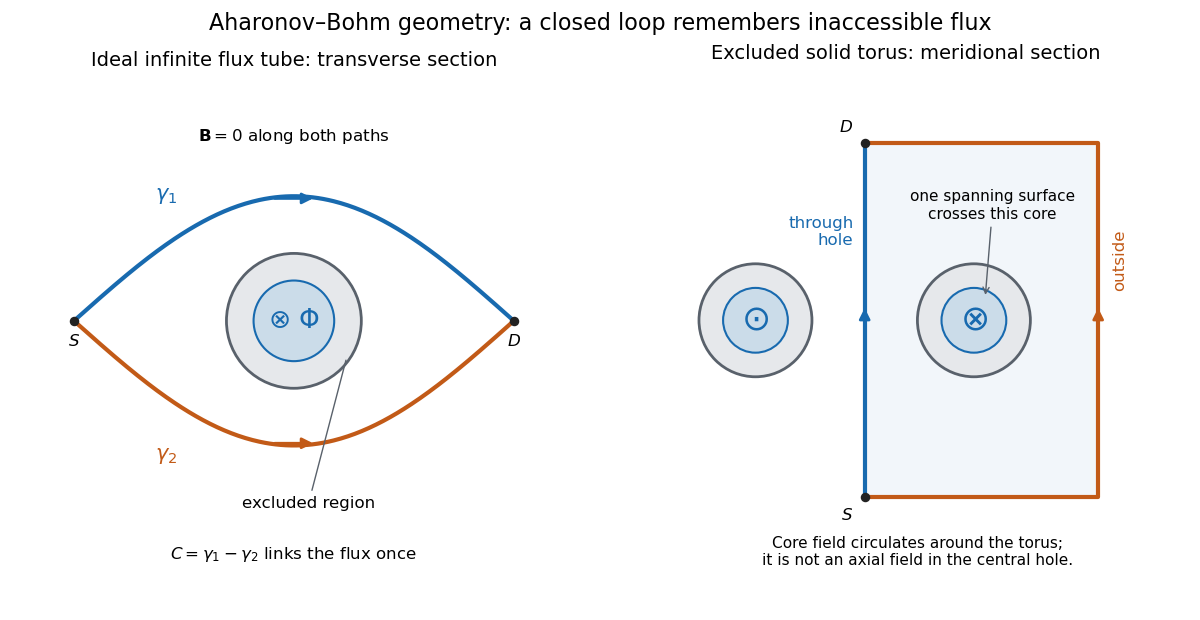
Two accessible paths can link inaccessible magnetic flux
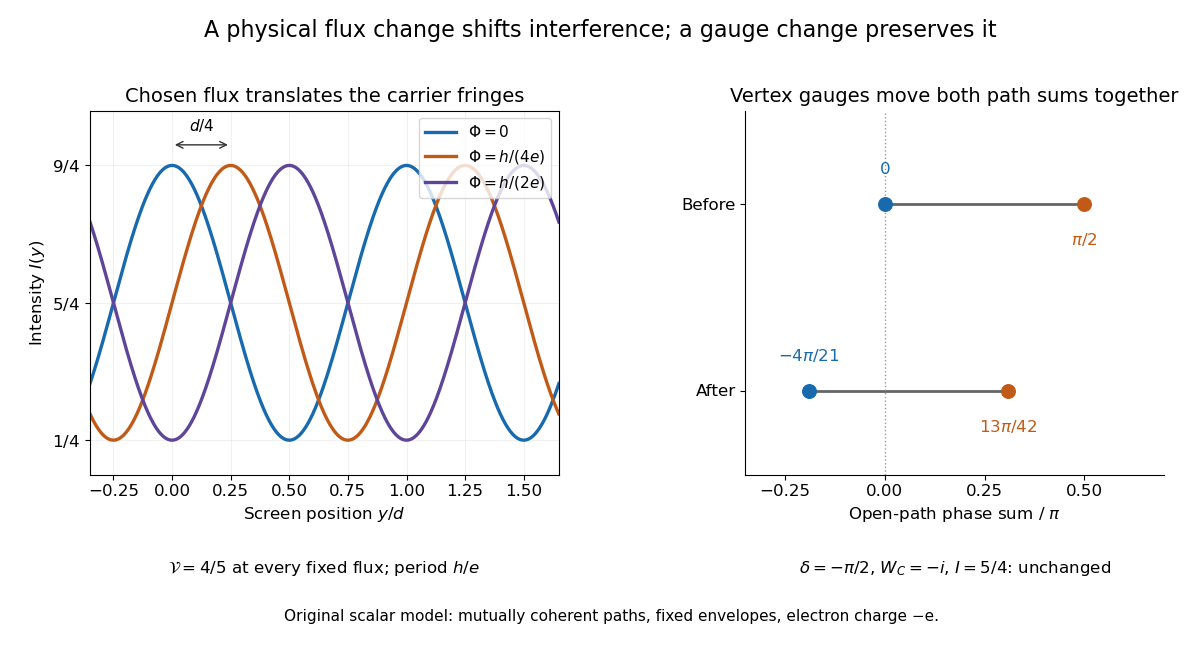
. Original functional geometry. Left: a cross-section of an ideal infinite flux tube; traverses the blue route forwards and the orange route backwards. Right: a meridional section of an excluded solid torus; the magnetic field circulates inside its core, with opposite signs through the section. One route passes through the central hole and the other outside the torus. The drawn linking surface intersects one core section. Paths denote coherent alternatives, not measured trajectories; shielding thicknesses and beam optics are schematic. Source. Details.For an original interference example, take mutually coherent scalar amplitudes with constant individual intensities and an imposed carrier phase , as in off-axis holography. ThenThe interference fringe spacing is . An electron enclosing has , shifting maxima by for this orientation. Increasing the magnetic flux by changes by and restores the same pattern: the electron Aharonov-Bohm effect has magnetic flux quantum . This uses , the Planck constant. It does not require the source's magnetic flux to vary continuously during a single exposure.
For , , the extrema are , , and the interferometric visibility is . A fixed Aharonov-Bohm phase translates these fringes without changing their contrast. Averaging unresolved fluctuating phases can reduce the contrast; a darkened pattern alone cannot identify enclosed magnetic flux. These formulas assume coherence, indistinguishable alternatives and stable beam envelopes.
The appeal of the Aharonov-Bohm effect is that a local Lorentz force calculation along either ideal path misses information carried by their global arrangement. It gives a physical example of holonomy and supplies the encircling phase used in Chern--Simons flux attachment. This alone does not establish intrinsic topological order. The static comparison also matters: changing magnetic flux can induce an electric field, so a time-dependent experiment requires the scalar-potential contribution as well as the displayed spatial line integral.
For circumference and Hamiltonian operator with a periodic boundary condition, the plane waves have energies , where and . Minimal coupling gives , where is the magnetic flux oriented consistently with increasing position around the ring. The ordered spectrum is periodic in with period one, corresponding to magnetic flux quantum .
On , its lowest two energies are and . Their crossings at half-integer can be opened by a potential that couples the relevant momentum states.
In the plane wave basis of a ring, has matrix elements . Near , degenerate perturbation theory on givesup to corrections from remote states. Thus the avoided crossing gap is to first order when .
For , a parabolic approximation about a potential minimum instead gives a local quantum harmonic oscillator spacing . A local gauge transformation removes the flux from this approximation. Actual ring levels retain exponentially small flux dependence through quantum tunnelling, while nonquadratic corrections to their mean energies are algebraic in .
In 1986, Akira Tonomura and collaborators coated a ferromagnet shaped as a torus with superconducting niobium and copper. A cooled stage held it in a 150 kV field-emission electron microscope. An electron biprism overlapped object and reference waves; film holograms were reconstructed optically. Room-temperature leakage screening selected samples; varying copper thickness tested electron penetration.[ref]
Below the superconducting transition, through-hole and outside electron waves differed in wave phase by zero or modulo . Warming through it changed the interference reversibly. Leakage and coherent-penetration bounds do not prove zero magnetic field.[ref]
Evidence for Aharonov-Bohm effect with magnetic field completely shielded from electron wave by Akira Tonomura and others. p. 794, Figs. 6–7: experimental limits
Why these two phases? The shield's superconducting flux quantum is , whereas the probing electron has electric charge . Substituting givesAn odd therefore moves a carrier fringe by half its spacing; an even leaves it unchanged modulo a full spacing. The phase quantization provides an internal check on the superconducting enclosure. It does not mean that zero wave phase proves zero trapped magnetic flux.[ref]
The Aharonov-Bohm effect and its applications to electron phase microscopy by Akira Tonomura. 2006, p. 49, Confirmation experiments on the AB effect; Fig. 2 on p. 48
The readout is electron holography in the off-axis holography geometry: a known tilted reference converts an unknown relative wave phase into a spatial carrier displacement. Reconstructing a magnetic wave phase assumes stable reference phase, adequate coherence and a calibrated carrier; electrostatic charging and material traversal can also shift wave phase. Optical wave phase amplification rescales the displayed fringe displacement. The experiment's shielding and comparison tests support the magnetic inference; an interferogram by itself measures the total relative wave phase, rather than separately certifying every contribution. The ideal field-free model describes the limiting geometry, while finite leakage and penetration remain questions of experimental bounds.
A four-vertex model proves the essential gauge invariance without solving an electron scattering problem. Use two directed paths and . Assign an edge phase and a complex unit link to each directed edge, with . These links represent discretized magnetic line integrals multiplied by . Under a gauge transformation with arbitrary vertex phases ,Both path products acquire the same factor . Their gauge-invariant ratio is the closed-loop holonomyEvery intermediate vertex phase cancels. For any fixed nonnegative real amplitudes , the interference quantity is unchanged too. A gauge-dependent open-path phase consequently cannot be interpreted as an observable by itself.
For an exact example, measure phases in units of and order edges as . Choose edge phases and vertex phases . The transformed edge phases areThe upper and lower sums become and ; their difference remains . With amplitudes , , the intensity remains . Sweeping one physical loop phase through instead produces extrema and , agreeing with the interferometric visibility example above.
The Aharonov-Casher effect is the electromagnetic dual in which a magnetic moment or flux acquires a phase by encircling electric charge.
Two particle types are mutual semions when taking either once around the other multiplies the state by .


