The combination cost is the work needed to reconstruct an answer from the returned smaller answers. In a time complexity calculation, also count partitioning the input, preparing arguments, and other work outside recursive calls. Write their total as for a size- call. For an ideal balanced divide-and-conquer algorithm making calls of size , the recurrence relation iswhere is a fixed positive integer and is the base case cost. Take , a power of two, so the size becomes one after exactly divisions. This is a model of total sequential work: all smaller calls contribute, even if a machine could run some simultaneously.
At level , there are calls, each of size . Expanding the recurrence relation gives the exact identityThe first term counts the base cases; the sum stops before their level because describes work in nonterminal calls. This separates depth, number of calls, and local work. Merge sort has two smaller calls and a linear merge algorithm, giving in Big O notation. The MIT notes derive this by summing equal work across levels, and contrast it with the same two-way split followed by quadratic local work.[ref]
Lecture 3: Insertion sort, merge sort. 6.006 Introduction to Algorithms, Fall 2011, Lecture 3: slides 32–44, recurrence and equal work per level; slide 46, quadratic local work
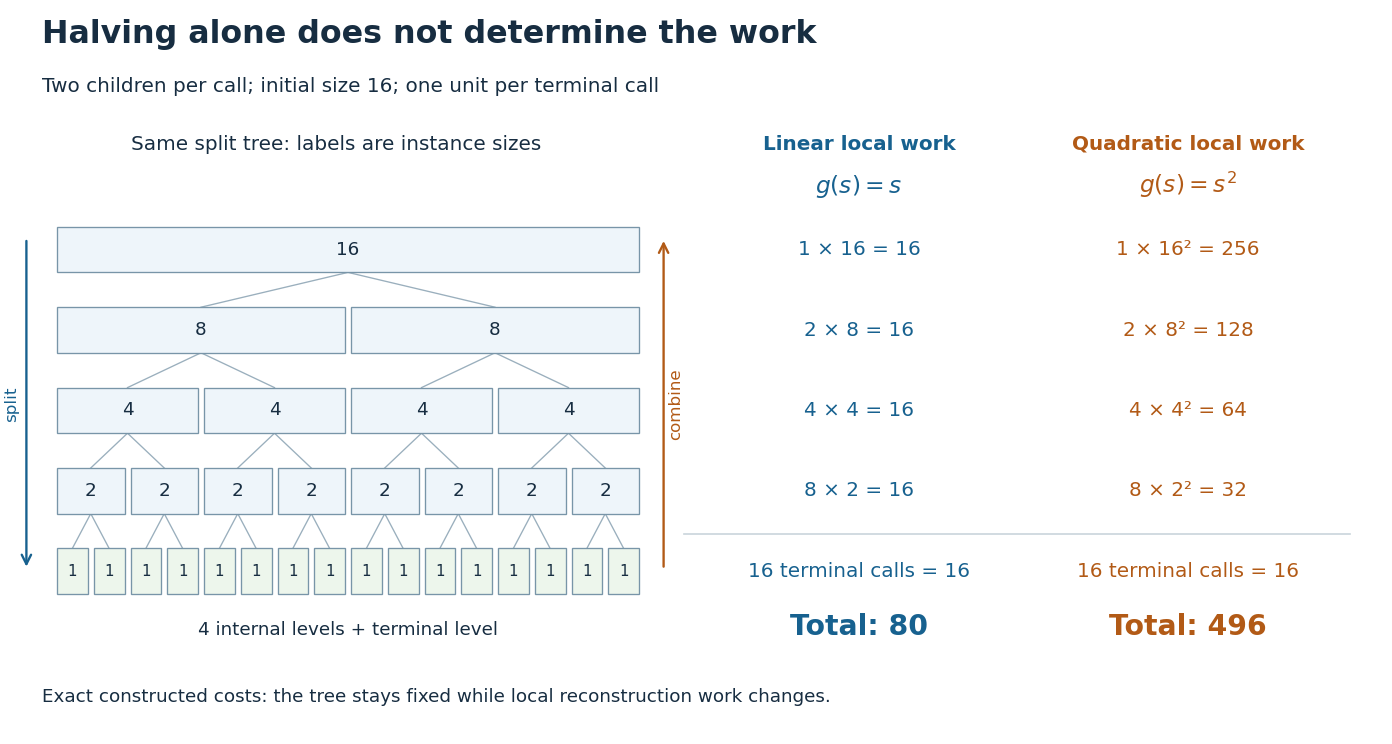
The same halving tree can have linear or quadratic work at each call
. Original exact cost models with , two children per nonterminal call, and one unit per base case. For local work , every internal level costs 16 and the total is 80. For , internal levels cost 256, 128, 64, 32 and the total is 496. The tree shows instance sizes; the ledger counts work rather than execution order. Details.
For the first constructed model, set , and . Every internal level costs , while the leaves cost . Thus , giving . If the same split instead has , then the finite geometric series givesso . The root alone already costs in this second model. Smaller arguments do not eliminate expensive reconstruction. These are stipulated operation counts, rather than measured running times or exact merge sort instruction counts.
Binary search has a different saving: after its comparison, only one half remains a candidate. With constant-cost indexed array access and comparisons, its worst-case time complexity satisfies an upper recurrence relation for , with . There is one continuing branch, rather than two. At most nonempty candidate ranges are inspected for . Copying the retained half into a fresh array on every step would add linear work at that step and lose this logarithmic bound. The shrinking range and its representation both matter.
Articles by others on the same topic
There are currently no matching articles.