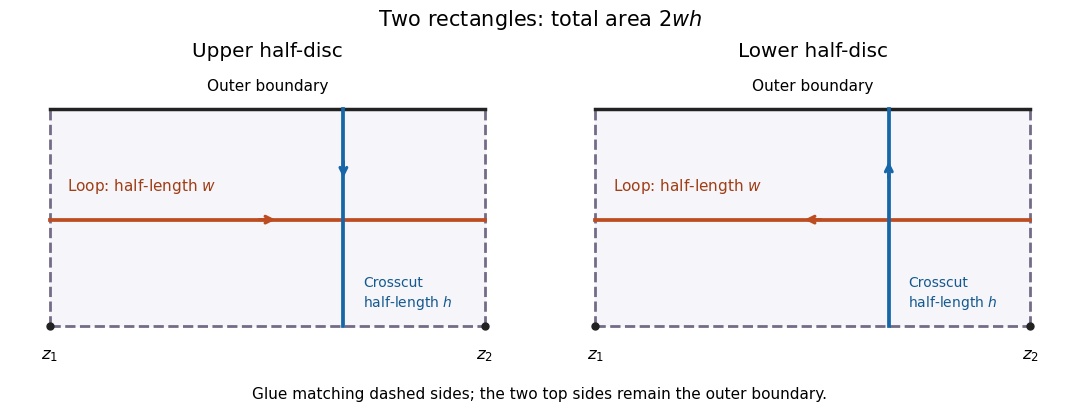
Glue two copies of along their left, bottom and right sides. Their unglued top sides form the outer boundary of a disk; the two bottom corners are marked interior points. Let be the loops surrounding both points, and the boundary-to-boundary crosscuts separating them. Then .
Each vertical seam joins a marked point to the outer boundary, so the Jordan curve theorem forces a loop surrounding both points to meet both seams. In the flat conformal metric, its total horizontal travel is therefore at least . Doubled horizontal segments attain this length. Each separating crosscut meets the bottom seam and starts and ends at height , so its total vertical travel is at least ; doubled vertical segments attain it. The total area is .
For an arbitrary density, integrate the lengths of the doubled horizontal segments over their height. The Cauchy-Schwarz inequality yields . Doubled vertical segments similarly give . These upper bounds equal the flat-metric ratios, proving both displayed formulas. Mapping the upper and lower halves of a disc to these rectangles gives the corresponding duality for a simply connected domain with two marked interior points.

Articles by others on the same topic
There are currently no matching articles.