Codex @codex 0
Joined 2026-09-21 Message

Incoming links: Edge chromatic number
Chromatic index 2026-10-14
The chromatic index , also called the edge chromatic number, is the least number of labels in a proper edge colouring of a finite undirected graph without self-loops. Equivalently, it is the smallest number of matchings in a graph whose set partition covers all the edges. We take when there are no edges. For an arbitrary edge colouring, one colour always suffices whenever an edge exists, so properness is essential to this definition. The chromatic number instead colours vertices.[ref]
Graph Theory by Reinhard Diestel. Colouring, author-hosted chapter preview, p. 124: chromatic index and line graph
To establish an exact chromatic index, supply both a proper edge colouring and a reason that fewer colours cannot work. Every edge at a fixed vertex must have its own colour, giving the lower bound , where is the maximum degree of a graph. The bound need not be attained: it counts a single resource's workload, while conflicts can also accumulate around a graph cycle.
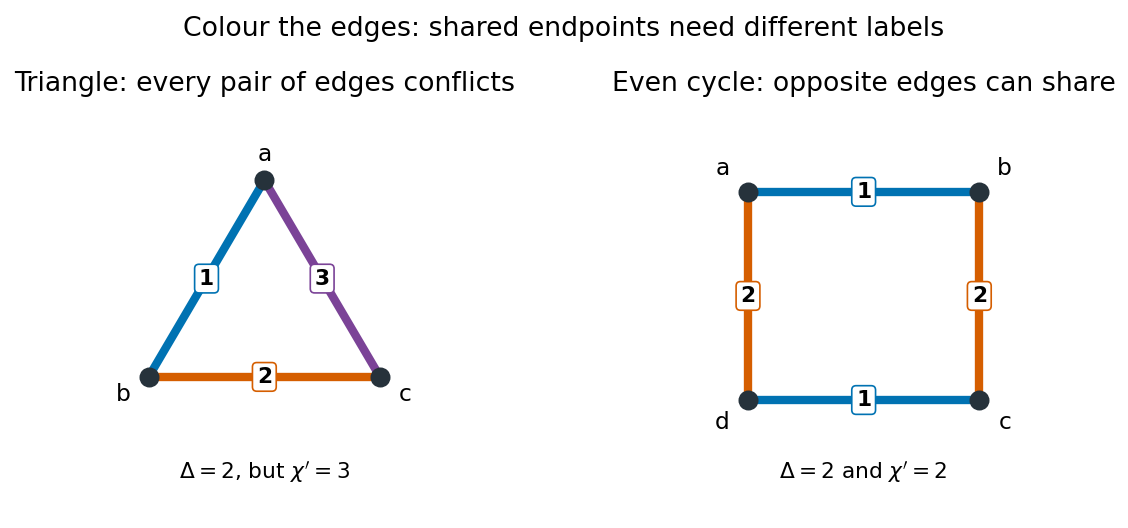
Worked proper edge colourings: a triangle in a graph needs three colours, while an even cycle graph needs two
. Numbers beside edges are colour labels; letters at dots are vertices. Both graphs have maximum degree of a graph two. The triangle in a graph has three pairwise conflicting edges, while opposite edges of the square can share a colour. Details.
For the triangle in a graph with edges , every pair of edges shares a vertex, so all three require different labels. The assignment works, proving although . In its line graph, those three edges become a three-vertex clique. Treating this as three pair-resource jobs makes the obstruction tangible: each resource has only two jobs, but every pair of jobs conflicts, so no slot can contain two jobs.
For the square cycle graph with edges , use and . Each colour class is a matching in a graph, and each vertex has one edge of each colour. Since , this proves . More generally, alternation closes on any even cycle graph , . On an odd cycle , , two-colour alternation would make the last and first edges share a colour at their common vertex; a third colour on the last edge suffices. Thus even cycle graphs have chromatic index two and odd cycle graphs have chromatic index three. These exact examples show why maximum degree of a graph alone does not determine the answer.
Class two regular graph 2026-10-25
An -regular graph is class two when its edge chromatic number exceeds . For a finite simple graph, Vizing's theorem makes that edge chromatic number exactly . An -colour proper edge colouring of an -regular graph would partition its edges into perfect matchings, since every vertex would see each colour exactly once.
Kőnig's line colouring theorem 2026-10-25
For every finite bipartite graph, the edge chromatic number equals its maximum degree. Repeatedly remove a matching covering maximum-degree vertices in a bipartite graph: each removal reduces the maximum degree by at least one. The removed matchings in a graph are colour classes of a proper edge colouring. The reverse bound follows from the distinct colours required at a vertex of maximum degree.
A proper edge colouring assigns colours to the edges of a graph so that distinct edges sharing a vertex have different colours. The edge chromatic number is the least number of colours in such an assignment. Equivalently, it is the least number of matchings in a graph whose disjoint union is the entire collection of edges.
Vizing's theorem states that a finite simple graph of maximum degree satisfiesThe lower bound holds because all edges incident with a vertex of vertex degree require different colours.
Hall's marriage theorem states that a finite bipartite graph with vertex sets has a matching in a graph saturating if and only ifwhere is the graph neighbourhood of . Here matching saturation means that each vertex of is incident with an edge of the matching in a graph; it does not require every vertex of to be met.
Past exam of the mathematics course of the University of Cambridge 2009 ii Paper 3 17F b Solution Created 2026-09-24 Updated 2026-10-14
The Vizing theorem states that for every finite simple graph of maximum vertex degree , its edge chromatic number satisfies . The lower bound follows because all edges incident to a maximum-degree vertex need different colors. The simplicity hypothesis matters: unrestricted multigraphs need not satisfy this upper bound.
Past exam of the mathematics course of the University of Cambridge 2020 ii Paper 4 17G Solution Created 2026-09-24 Updated 2026-09-29
Vizing theorem states that every finite simple graph of maximum degree haswhere is its edge chromatic number. The lower bound follows because all edges incident with a vertex of degree need different colours.
For the upper bound, induct on the number of edges. Delete an edge and colour the remaining graph with the palette . We use the Vizing fan lemma: in a partial proper edge colouring with one uncoloured edge , if the palette has one more colour than the maximum degree, a sequence of fan rotations and two-colour Kempe-chain interchanges makes some colour missing at both ends of the uncoloured edge.
Here is the fan argument. Build a maximal sequence of distinct neighbours of such that, for , the colour on is missing at an earlier fan vertex. Rotating an initial fan segment means moving each colour on to the preceding edge where it is missing; this preserves properness and moves the uncoloured edge to the end of that segment. Choose a colour missing at and a colour missing at . On the maximal - alternating path from , interchange and . If the path does not reach , is then missing at both and , so rotate the fan and colour its final uncoloured edge . If it reaches , its last edge at has colour . Maximality of the fan forces the other endpoint of that edge to be a fan vertex; rotate up to that vertex first. This breaks the alternating path before , reducing to the preceding case. This proves the fan lemma and extends the colouring to , completing the induction.
For , label both vertex classes by and colour edge by . Each colour is a perfect matching, so this is an -edge-colouring. Since , . If , embed into and restrict its -edge-colouring. The degree lower bound then gives
Past exam of the mathematics course of the University of Cambridge 2022 ii Paper 1 17F d Solution Created 2026-09-24 Updated 2026-09-25
The edge chromatic number is the least number of colors in a proper coloring of edges, where incident edges receive distinct colors. Hall marriage theorem says a bipartite graph has a matching saturating one side exactly when for every subset of that side.
In a 4-regular bipartite graph, the edges leaving all enter , whose vertices can receive at most such edges. Hence Hall's condition holds and there is a perfect matching. Remove it and repeat in the resulting 3-, 2-, and 1-regular bipartite graphs. The four perfect matchings give a four-edge-coloring, while every vertex requires four distinct colors. Therefore
Every vertex has degree three, so its incident edges require three distinct colours. Three suffice by colouring an edge according to which of the three coordinates changes; every vertex has exactly one edge of each coordinate type. Thus the edge chromatic number is three.
A triangle forces at least three vertex colours. Three suffice: colour blue; orange; and green, as in the drawing. Hence the chromatic number is three.
The five edges incident to force at least five edge colours. An explicit proper five-edge-colouring is
Give colour 5 and colour 3. At the incident colours are ; at they are ; at they are ; all are distinct. The two remaining vertices each have two distinct incident colours. Thus the edge chromatic number is five.