A proper edge colouring gives different labels to any two distinct edges sharing a vertex. We work with finite undirected graphs without self-loops; distinct parallel edges in a multigraph must also have different colours. For a simple graph, whose edges are two-element sets, the condition isEvery colour class is a matching in a graph. Conversely, a set partition of the edges into matchings in a graph supplies a proper edge colouring. Thus minimizing colours means grouping all the edges into as few matchings in a graph as possible.
The line graph makes the relationship with proper vertex colouring explicit: replace each original edge by a vertex, joining two new vertices exactly when their original edges share an endpoint. A proper edge colouring of becomes a proper vertex colouring of its line graph , so . For a multigraph, retain a distinct new vertex for each parallel edge.[ref]
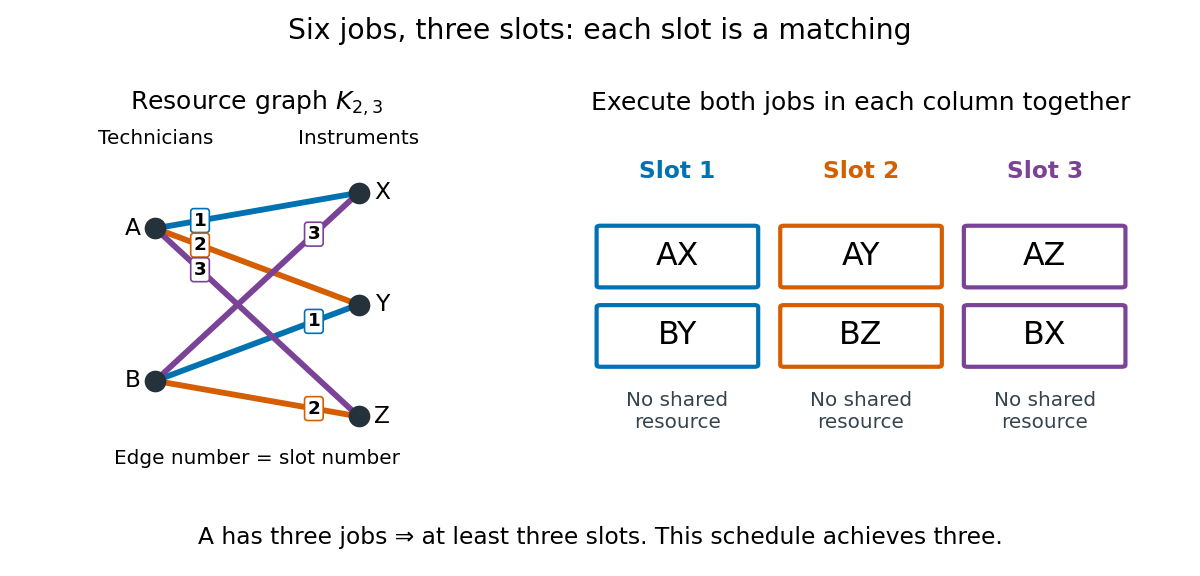
Suppose each job occupies two distinct resources for one whole slot, and each resource can serve at most one job in that slot. Make resources vertices and jobs edges. Two jobs conflict exactly when their edges share a vertex, so a valid schedule is a proper edge colouring. Each slot is a matching in a graph; the chromatic index is the minimum number of slots. The colour labels specify the slots, rather than physical colours. This model assumes all jobs are available initially, with equal duration, interchangeable slots and no additional conflicts. The school-timetable motivation in Graph Theory by Reinhard Diestel (author-hosted Colouring preview, opening paragraphs, pp. 123–124) uses this resource-pair interpretation.
Here is a complete example. Two technicians must each use three instruments once. Each job needs its technician and its instrument simultaneously. The six jobs are the edges of the complete bipartite graph :Within each , the two jobs use different technicians and different instruments, so is a matching in a graph. The three matchings in a graph together cover every job exactly once. Technician has three jobs, so fewer than three slots cannot suffice; the displayed schedule uses three. This is an optimal proper edge colouring with chromatic index three, witnessed by both a schedule and a resource-workload lower bound.

Repeated jobs requiring the same resource pair become distinct parallel edges of a multigraph, rather than one edge. Additional restrictions change the problem: prescribed allowed slots lead to list edge coloring, while unequal durations, deadlines, or jobs needing more than two resources require a richer scheduling model. Selecting a largest matching in a graph solves a single-round question; a shortest complete schedule must organize all jobs across rounds.
Articles by others on the same topic
There are currently no matching articles.