An even integer is a perfect number if and only ifThis forces to be a prime number, as shown under Mersenne number. It does not say that every prime exponent works, nor classify possible odd integers.[ref]
Perfect numbers and Mersenne primes by Keith Conrad. Theorem 1.1, pp. 1–2: even-number equivalence and proof
For the forward direction, put and use coprimality of and . Multiplicativity of the sum-of-divisors function and the finite geometric series giveThe prime number hypothesis makes ; replacing it with a composite number changes this factor.
For a short converse outline, write with and an odd integer. The condition givesHere is a positive integer and a proper divisor of . If , the distinct divisors alone exceed the required sum . Thus and , forcing to be prime and .
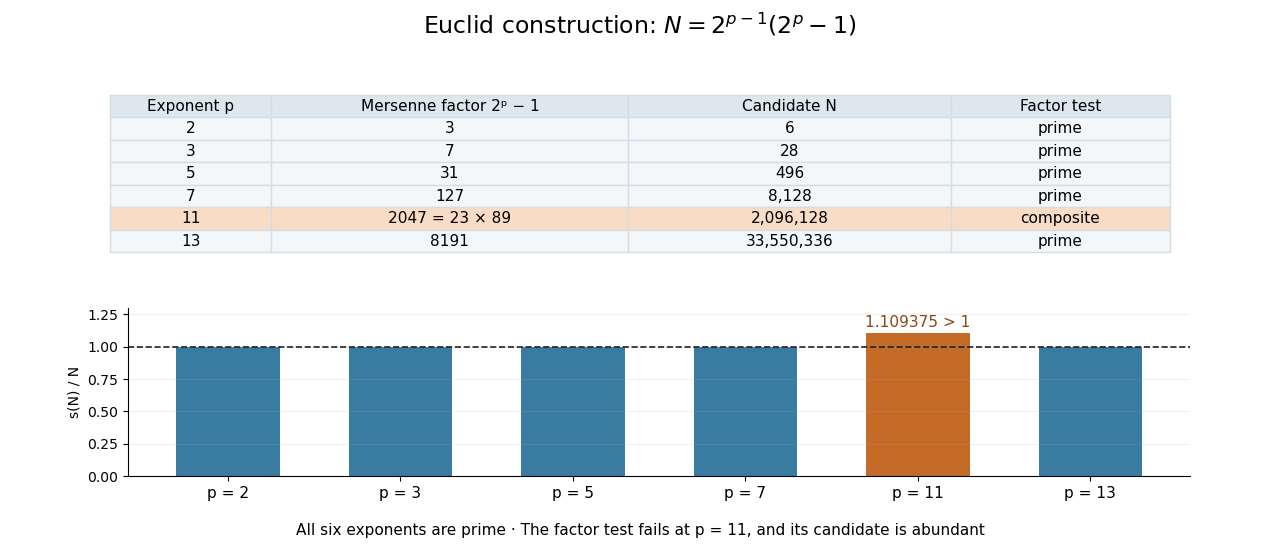
The prime exponents give Mersenne primes and therefore perfect numbers. But gives . The resulting candidate hasso . It is an abundant number, not a perfect number. Checking only that the exponent is prime would miss this obstruction.
Articles by others on the same topic


The Euclid–Euler theorem, also known as Euler's theorem in the context of number theory, relates to the area of geometry and can be specifically described in two ways.