Flow-history ambiguity of a timed expiratory volume arises because integrating volumetric flow rate retains the total gas moved but discards its detailed time ordering. If a timed measurement is , then every admissible perturbation satisfyingproduces the same from . Nonnegative flow restricts the possibilities, but generally does not leave a unique waveform. This is an integral null-space ambiguity in expiratory measurements.
An original example preserves both FEV1 and FVC. Let a constant baseline flow continue for 4 s. Modify only the first second, with s, byand set afterward. The modified flow stays between 0.5 and 1.5 L/s during the first second. Its cumulative difference from the baseline isAt one second the difference returns to zero. Both traces therefore have FEV1 of 1 L, FVC of 4 L and FEV1 to FVC ratio of 0.25. Their peak expiratory flows differ: 1 versus 1.5 L/s. At half a second, the modified trace has expelled approximately 0.159 L more than the baseline, before the later flow difference cancels it.
These artificial waveforms isolate information loss; they are not physiological reference curves. A timed volume is not interchangeable with a peak value or an entire flow-volume history. The 2019 technical statement requires inspection of both volume-time and flow-volume displays because the displays expose different features of a maneuver.[ref]
Adding more timed integrals can constrain the waveform more strongly, but finitely many such summaries still leave many possible continuous histories unless a restrictive model is imposed. Report which waveform features were actually measured rather than inferring all of them from one scalar volume.
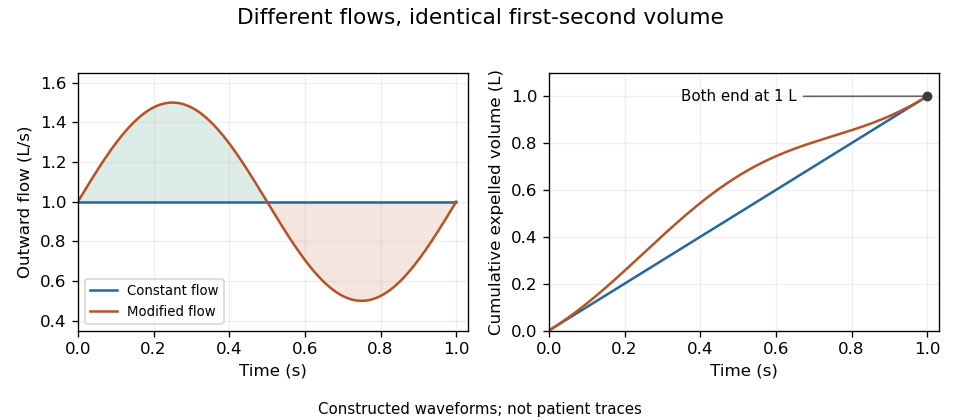
Original flow histories with identical first-second expired volume; equal integrals conceal different volumetric flow rates
. Details. 
Integral null-space ambiguity in expiratory measurements is the existence of different volumetric flow rate functions producing the same finite collection of cumulative expired volumes. Let belong to an appropriate function space and let the measurement map beThis is a linear map. Every perturbation in its null space leaves all the measurements unchanged: .
The null space is large even when observations occur at several times. Put . On any interval , choose a sine wave completing an integer number of cycles and set it to zero outside that interval. Its integral across that interval is zero, so every recorded cumulative volume is unchanged. Different cycle counts give infinitely many such functions. Sufficiently small amplitudes preserve positive volumetric flow rate wherever the baseline stays bounded away from zero.
An original example records volumes at 0.5, 1 and 2 s from a baseline volumetric flow rate of 1 L/s. Add L/s only over the first 0.5 s. All three recorded volumes remain 0.5, 1 and 2 L, but the instantaneous volumetric flow rate ranges from 0.6 to 1.4 L/s during that interval. The added shape is invisible to these cumulative measurements.
A finite-dimensional model changes what can be identified. If is restricted to known basis functions, the observations become , where . Unique coefficients require matrix rank . For the stipulated linear-flow model , two observations have rows and determinantDistinct positive times therefore identify in that model. Volumes 1.5 L at 1 s and 4 L at 2 s yield L/s and .
That model-based uniqueness is not recovery of an arbitrary waveform. The primary spirometry statement's complementary volume-time and flow-volume displays preserve information beyond a few timed volumes.[ref]
Standardization of Spirometry 2019 Update by Brian L. Graham and others. Equipment, Display
State the allowed model class before treating a small set of summaries as a complete measurement. Articles by others on the same topic
There are currently no matching articles.