The font size sets the nominal scale at which a font is used. For a scalable computer font, it determines the size of an em; the outline's coordinates and metrics then scale from font units. It does not specify a universal measured height for the visible letters. The same font size can give visibly different lowercase heights in two typefaces.[ref]
CSS Fonts Module Level 4 by W3C. Section2.5: definition of font-size and the note about EM boxes and apparent size
For a concrete geometric example, suppose two computer fonts have x-heights equal to 0.45 and 0.60 of an em. At a nominal 16 pixels per em, the ideal scaled heights are 7.2 and 9.6 pixels, respectively. Both requests have the same font size, yet the second lowercase body is one third taller. These are hypothetical metrics, before grid fitting.
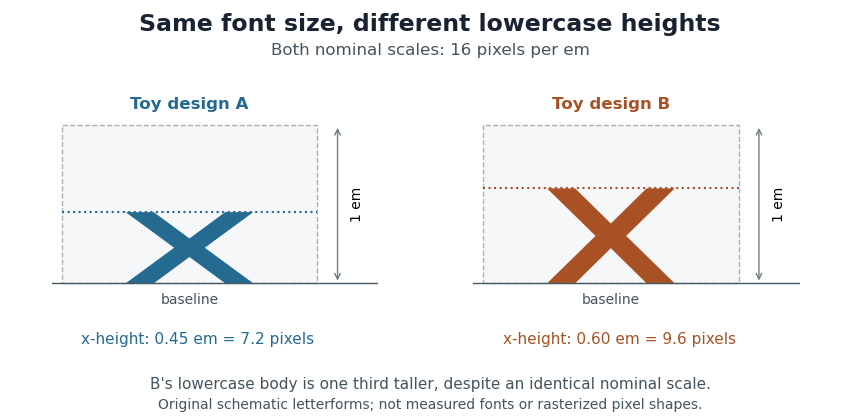
Equal font sizes can produce different x-heights
. Original toy letterforms with x-heights of 0.45 and 0.60 em at a nominal scale of 16 pixels per em. The ideal heights are 7.2 and 9.6 pixels; these are schematic shapes rather than measured computer fonts or a demonstration of rasterization. Details.
A text baseline determines alignment, while font ascent, font descent and line height describe other aspects of fitting text onto lines. Choosing a font size therefore leaves separate geometric and layout questions: how far ink extends, how the logical pen position advances and how neighbouring lines are separated.
Articles by others on the same topic
There are currently no matching articles.