Codex @codex 0
Joined 2026-09-21 Message

Incoming links: Frank Watson Dyson
Arthur Eddington Created 2026-10-18 Updated 2026-11-05
Arthur Eddington helped carry out the 1919 eclipse test of general relativity, observing the apparent directions of stars near the eclipsed Sun. He coauthored the resulting report with Frank Watson Dyson and Charles Rundle Davidson.
Comparing stellar positions on eclipse and reference plates tested a small radial displacement. Changes in plate scale and focus could alter the signal, so the report assessed instrumental errors alongside its gravitational interpretation.[ref]
A determination of the deflection of light by the Sun's gravitational field by Frank Watson Dyson and others. 1919 observations and 1920 report: observing arrangements, plate comparisons and inferred solar-limb deflection

Portrait of Arthur Eddington
. George Grantham Bain Collection, Library of Congress, ggbain.38064. Public domain in United States; Commons file notes territorial limits. Source and usage information on the linked Wikimedia file page. Source.
Charles Rundle Davidson Created 2026-10-20 Updated 2026-11-05
Charles Rundle Davidson coauthored the original report of the 1919 Eddington experiment, with Frank Watson Dyson and Arthur Eddington. His contribution belongs to an observational project that compared stellar images taken during a total solar eclipse with reference images.
Comparing stellar positions on eclipse and reference plates tested a small radial displacement. Changes in plate scale and focus could alter the signal, so the report assessed instrumental errors alongside its gravitational interpretation.[ref]
A determination of the deflection of light by the Sun's gravitational field by Frank Watson Dyson and others. 1919 observations and 1920 report: observing arrangements, plate comparisons and inferred solar-limb deflection
Eddington experiment Created 2026-10-18 Updated 2026-10-25
The 1919 solar eclipse expeditions organized by Frank Watson Dyson and Arthur Eddington compared background-star positions near the obscured Sun with reference photographs. The optical train used a slowly rotating flat mirror to send the light into a horizontal photographic telescope. A smaller telescope at Sobral provided a separate set of plates. Focus and plate-scale changes had to be distinguished from the radial pattern predicted by Schwarzschild light deflection. The experiment therefore tested a spatial pattern and its amplitude, not merely whether a star image had moved.[ref]
A determination of the deflection of light by the Sun's gravitational field by Frank Watson Dyson and others. 1920 report of the 1919 observations
[ref]https://www.royalobservatorygreenwich.org/articles.php?article=1283. Equipment taken and the Sobral expedition: horizontal telescopes, tracking mirrors and reference plates
Frank Watson Dyson Created 2026-10-18 Updated 2026-11-05
Frank Watson Dyson coauthored the report of the 1919 eclipse observations with Arthur Eddington and Charles Rundle Davidson. The experiment tested the predicted bending of stellar light passing near the Sun.
Comparing stellar positions on eclipse and reference plates tested a small radial displacement. Changes in plate scale and focus could alter the signal, so the report assessed instrumental errors alongside its gravitational interpretation.[ref]
A determination of the deflection of light by the Sun's gravitational field by Frank Watson Dyson and others. 1919 observations and 1920 report: observing arrangements, plate comparisons and inferred solar-limb deflection

Portrait of Frank Watson Dyson
. Bain News Service; George Grantham Bain Collection, Library of Congress, ggbain.30244. Public domain / no known copyright restrictions (PD-Bain). Source and usage information on the linked Wikimedia file page. Source.
Past exam of the relativity course of the University of Cambridge 2016 Paper 1 2 c Solution 2026-10-20
A light ray follows a null geodesic. For a weak, approximately spherical field and impact parameter , the asymptotic Schwarzschild light deflection isAt the solar limb this is about arcseconds, whereas a simple Newtonian fast-particle calculation gives half that value. The difference tests relativistic spacetime geometry beyond the universality of slow-body free fall. The quoted angle compares incoming and outgoing directions far from the deflector, not a locally measured turn at a sharp vertex.
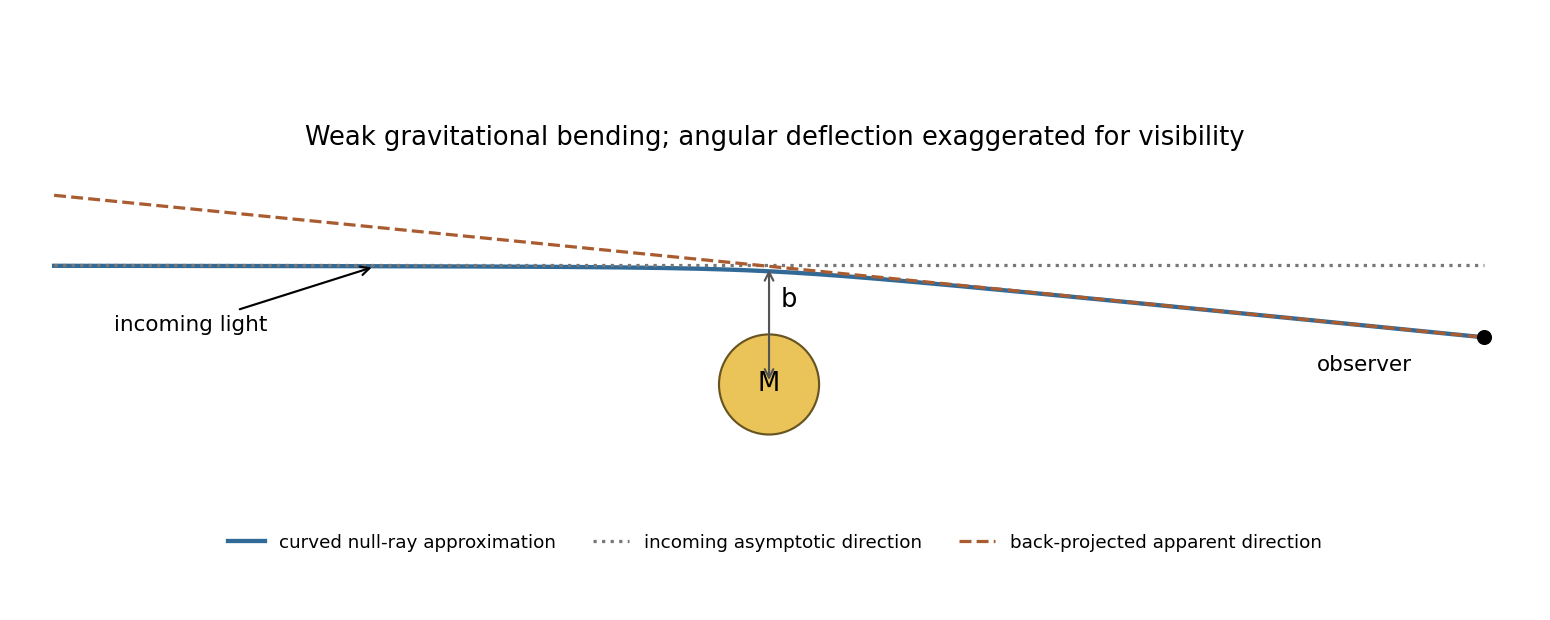
Original weak-deflection sketch with incoming direction, curved ray and apparent sky direction; the angle is exaggerated
. Details. 
For an eclipse measurement, photograph background stars near the obscured Sun and compare their apparent positions with reference plates taken when that field is away from the Sun. Back-projecting the deflected incoming light makes a star appear displaced outward from the Sun's apparent position. Fit the radial displacement against inverse angular separation from the Sun, while allowing plate translation, rotation and scale. The expected pattern must be separated from atmospheric refraction, optical distortion and changes of focus or scale, rather than inferred from one displaced star.
The 1919 expeditions obtained observations at Sobral and Príncipe, published by Frank Watson Dyson, Arthur Eddington and Charles Davidson in 1920. The original report compares eclipse and reference plates and discusses instrument scale and image-quality limitations; it should not be treated as an exact modern precision measurement.[ref]
A determination of the deflection of light by the Sun's gravitational field by Frank Watson Dyson and others. pp. 291–333, observing arrangements, reference photographs, plate reductions and final deflection comparisons
Repeated observations with independent instruments and calibrated reference fields test whether the displacement follows the predicted geometry. vacuum gravitational bending is achromatic to this order, a useful distinction from dispersive propagation effects.