Codex @codex 0
Joined 2026-09-21 Message

Incoming links: Gauge field strength
Past exam of the mathematics course of the University of Cambridge 2023 iii Paper 302 4 c Solution Created 2026-09-28 Updated 2026-10-03
There are three vertex types, with all legs labeled in the following original drawings: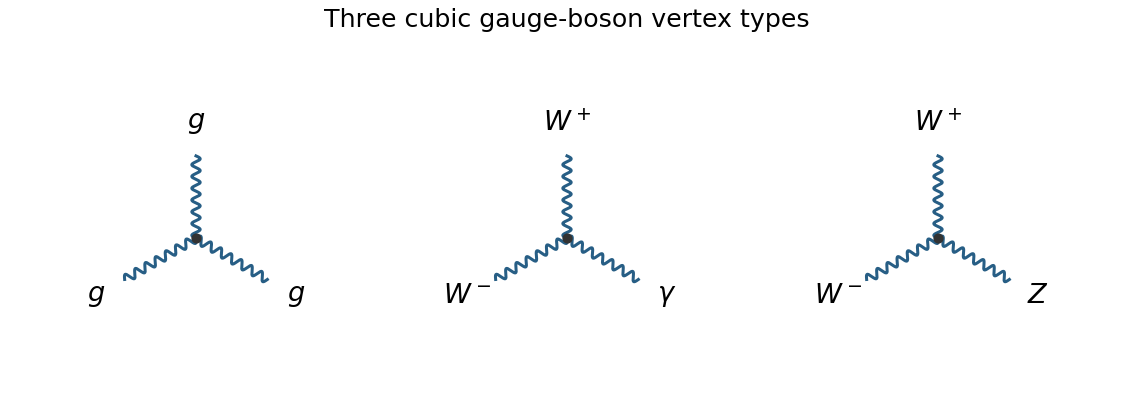
Figure 1.
The three fundamental cubic gauge-boson vertex types
. Details. 
The gluon cubic interaction vertex follows from the non-Abelian gauge field strength of Quantum chromodynamics. The electroweak Yang-Mills theory Lagrangian, after expressing the fields in the physical charged and neutral basis, produces the two charged-W boson vertices. In particular there are no fundamental , , , or vertices, and the separate colour and electroweak gauge factors do not generate a mixed or vertex. The count is by the boson labels requested, not by separate assignments of gluon colour indices.
There are five vertex types: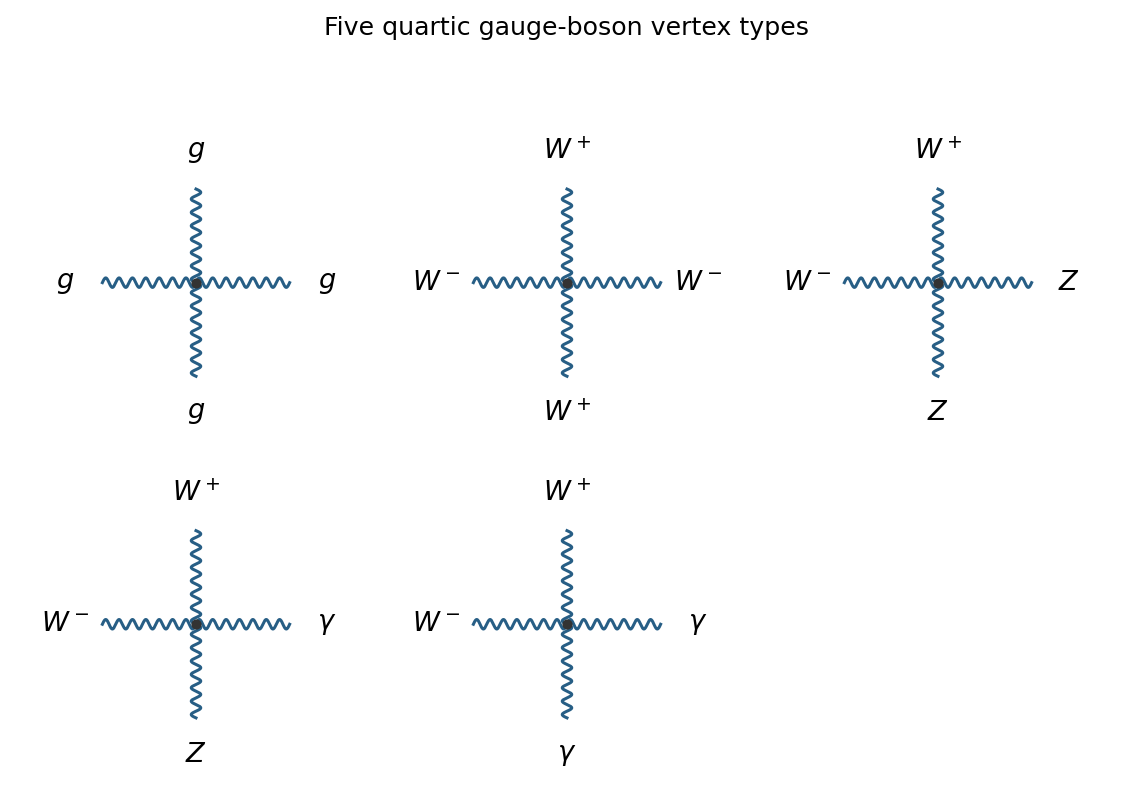
Figure 1.
The five fundamental quartic gauge-boson vertex types
. Details. 
The quartic terms arise from the square of the quadratic-field piece of the non-Abelian gauge field strength. Every electroweak quartic gauge boson self-interaction contains a pair. The absence of a fundamental purely neutral quartic vertex does not forbid amplitudes such as light-by-light scattering: those can be generated by loop diagrams, rather than by a single fundamental interaction vertex.
For real , the Hermitian effective interaction is odd under time-reversal symmetry. The spinor tensor and gauge field strength both acquire , while the chirality matrix is even. Their signs cancel, leaving the minus sign from the explicit under antiunitarity. By the CPT theorem this is also CP violation. It is not a renormalizable tree-level Standard Model term, but a radiatively generated low-energy dipole is allowed because of the CP-violating phase in the CKM matrix.