The glide angle is the inclination of a descending flight path below the horizontal. A positive will denote descent here. For aerodynamic reasoning it is important to specify motion relative to the air: a steady wind can change the ground track without changing the air-relative glide angle at the same operating condition.
For a steady unpowered descent, resolve gravitational weight perpendicular and parallel to the air-relative velocity. With lift normal to that velocity and drag opposing it,The still-air horizontal distance per unit height lost is therefore . NASA's description connects this geometry with a historical observation: the Wright brothers flew parallel to a dune slope, letting the slope provide an estimate of the flight-path angle.[ref]
For an original constant-velocity model, set and airspeed . Then , horizontal air-relative speed is , and downward speed is . In still air, a stipulated height loss corresponds to horizontally.
If a constant horizontal wind component is positive along the direction of travel, the ground-frame horizontal speed is . With no vertical wind and ,A headwind makes that ratio about ; a tailwind of the same magnitude gives . All three cases retain the same air-relative angle and sink rate. Their groundspeeds and ground-frame path angles differ.
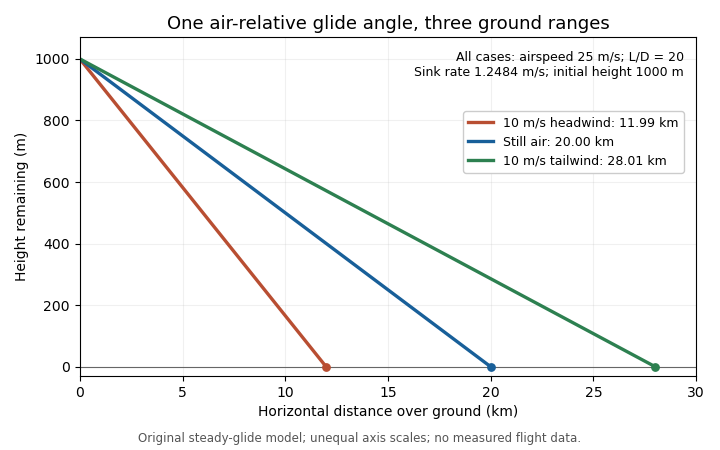
The same air-relative glide condition gives different ground ranges in a stipulated constant headwind, still air and tailwind. Original model; unequal plotting scales mean displayed line angles are not the physical glide angles.
Details. 
This distinction separates a measured ground trajectory from an aerodynamic lift-to-drag ratio. Estimating the latter from height and horizontal travel requires accounting for air motion and identifying the steady portion of the trajectory.
Articles by others on the same topic
There are currently no matching articles.