Henry Eyring developed an activated-complex treatment of chemical reactions, relating rates to a potential-energy surface and the population crossing a barrier. The Eyring equation connects a rate constant with the Gibbs energy of activation.
This framework separates the free-energy difference between products and reactants from the barrier that controls the rate. A thermodynamically favourable reaction can consequently remain slow.[ref]
https://www.chemistry.utah.edu/the-legacy-of-henry-eyring/. University of Utah: activated-complex theory and the 1935 paper
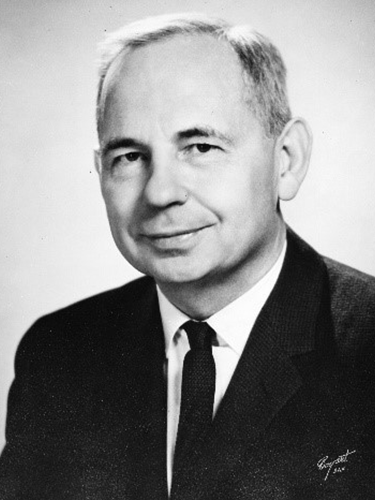
Portrait of Henry Eyring
. External portrait hosted by The Society of Rheology. Source. Articles by others on the same topic

Henry Eyring (1901-1981) was a prominent American theoretical chemist known for his work in chemical kinetics and reaction theory. He played a significant role in the development of theories related to the behavior of molecules during chemical reactions and is best known for the Eyring equation, which describes the rate of a chemical reaction in terms of the energy barrier that must be overcome for the reaction to occur.