
Ariane Haase Created 2026-10-18 Updated 2026-11-05
Ariane Haase coauthored a magnetostriction measurement system using Fibre Bragg gratings as optical strain gauges. The apparatus measured small samples in pulsed magnetic fields, resolving strain of order with a -kHz bandwidth at low temperatures.[ref]
High resolution magnetostriction measurements in pulsed magnetic fields using Fibre Bragg Gratings by Ramzy Daou and others. Author list and abstract, corresponding to Review of Scientific Instruments 81 (2010), 033909: fibre gauges, strain resolution and bandwidth.
Frank Steglich Created 2026-10-18 Updated 2026-11-05
Frank Steglich coauthored an apparatus for measuring very small magnetostriction in pulsed magnetic fields. A fibre Bragg grating serves as an optical strain gauge attached to a small crystal: changes in its reflected wavelength report changes in length. The 2010 instrument resolved strain of order with 47,000 hertz bandwidth and was demonstrated on gadolinium compounds at low temperatures. It connects an optical measurement to the way electronic and magnetic changes deform a solid.[ref]
High resolution magnetostriction measurements in pulsed magnetic fields using Fibre Bragg Gratings by Ramzy Daou and others. Review of Scientific Instruments 81, 033909 (2010), abstract and instrument description
A physicist studying correlated electrons and emeritus director of the Max Planck Institute for Chemical Physics of Solids.[ref]
Hohe Auszeichnung für Frank Steglich by Einstein Stiftung Berlin. Opening paragraph: physicist in correlated-electron physics; founding director and director emeritus of MPI for Chemical Physics of Solids

Portrait of Frank Steglich
. MPI CPfS (photo credit on the named institutional article; individual photographer unspecified). External portrait hosted by Einstein Stiftung Berlin. Source. Franziska Weickert Created 2026-10-18 Updated 2026-11-05
A researcher whose joint work demonstrated fiber Bragg grating measurements of magnetostriction. The optical gauge records how a specimen’s dimensions change in a pulsed magnetic field. The experiment must resolve the rapid response during the pulse, rather than assuming a slowly varying field and a static length measurement.[ref]
High resolution magnetostriction measurements in pulsed magnetic fields using Fibre Bragg Gratings by Ramzy Daou and others. Abstract and fast-readout implementation: optical strain measurements during magnetic-field pulses
Mathias Doerr Created 2026-10-18 Updated 2026-11-05
Mathias Doerr coauthored a magnetostriction measurement system using Fibre Bragg gratings as optical strain gauges. The apparatus measured small samples in pulsed magnetic fields, resolving strain of order with a -kHz bandwidth at low temperatures.[ref]
High resolution magnetostriction measurements in pulsed magnetic fields using Fibre Bragg Gratings by Ramzy Daou and others. Author list and abstract, corresponding to Review of Scientific Instruments 81 (2010), 033909: fibre gauges, strain resolution and bandwidth.
Michael Nicklas Created 2026-10-18 Updated 2026-11-05
A researcher whose team used fiber Bragg gratings to measure magnetostriction of small single-crystal specimens. Bonding the fiber sensor to a sample transfers its strain into an optical wavelength shift. The apparatus makes structural responses accessible under short, strong magnetic field pulses and cryogenic conditions.[ref]
A single crystal of gadolinium antimonide carried a fibre Bragg grating cyanoacrylate-bonded along its axis. The pulsed magnetic field paralleled that axis. Broadband light, a circulator and a spectrometer resolved reflected-wavelength shifts at . Pre-pulse readings measured noise; low fibre thermal expansion reduced thermal background. A residual post-pulse shift indicated possible heating. Spectral distortion checked bond uniformity, while the fibre's smaller cross-section limited loading; bonding was not assumed force-free. Longitudinal strain showed a kink near .[ref]
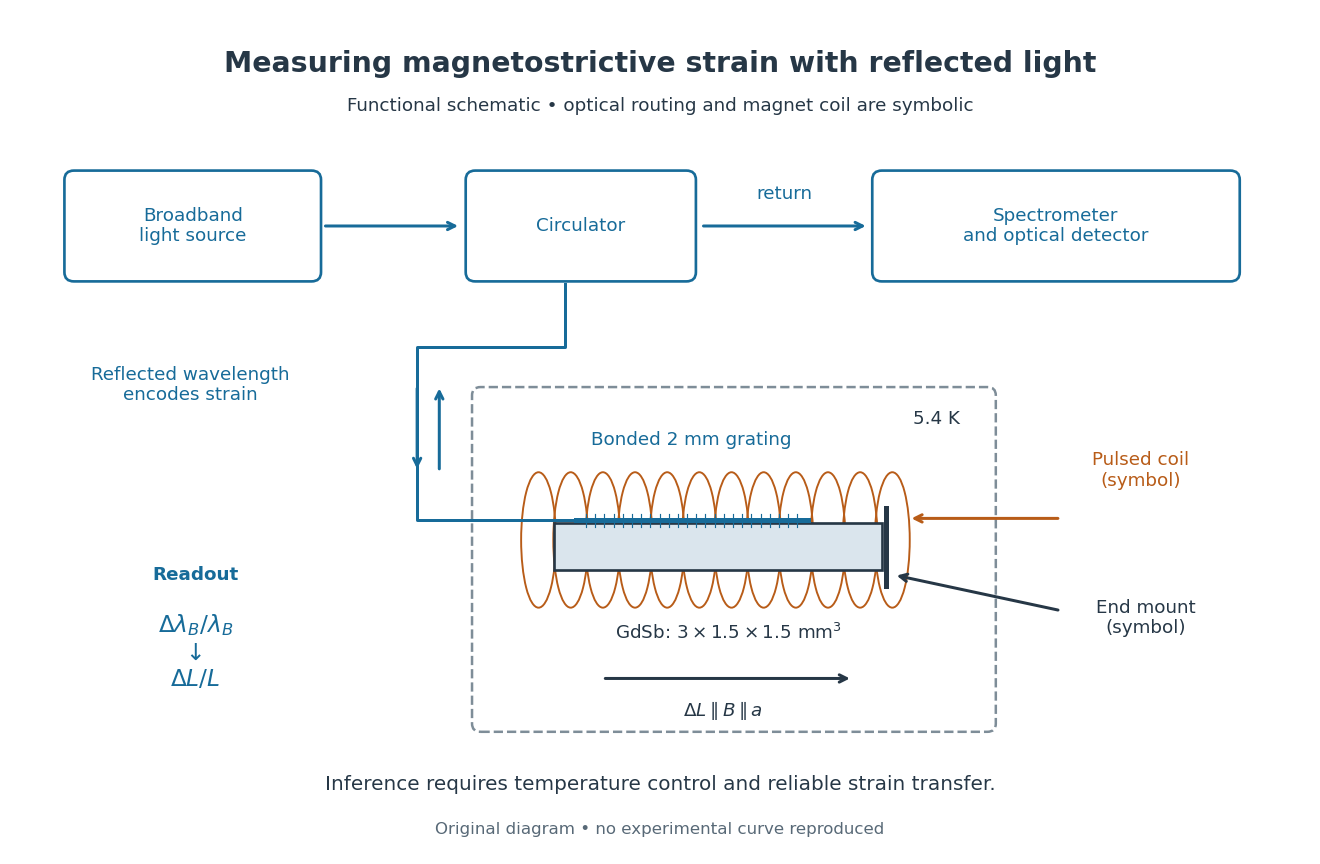
Functional optical chain for measuring magnetostrictive strain
. Original schematic of the bonded-sensor experiment. The magnet coil and optical routing are functional symbols, not a reconstruction of winding geometry or instrument placement.[ref]High resolution magnetostriction measurements in pulsed magnetic fields using Fibre Bragg Gratings by Ramzy Daou and others. PDF Fig. 1 and methods
Details.
The distinction between readout and inference is essential. The fibre Bragg grating senses a change of reflected wavelength; interpreting this as the specimen's strain requires good strain transfer and a controlled temperature. A useful independent control would compare a bonded sensor with a nearby unloaded sensor through the same pulse. Another would vary bond stiffness or specimen cross-section to test loading. These are proposed checks, not additional procedures claimed for the experiment above. The pulsed magnet's winding details were not specified in the inspected account.
This experiment measures one longitudinal component of strain. Establishing the first-order volume change would require three orthogonal normal components under the same conditions. GdSb also has its own antiferromagnetism and field-dependent magnetic structure: this measured curve does not establish the simple saturated isotropic law. Its role here is to make the measurement chain and its limitations concrete.
Ramzy Daou Created 2026-10-18 Updated 2026-11-05
A researcher whose team developed an optical method for measuring magnetostriction in pulsed magnetic fields. A fiber Bragg grating attached to a small specimen changes its reflected wavelength as the specimen strains. Fast optical readout tracks tiny length changes during the short field pulse, including at cryogenic temperatures. The method connects mechanical deformation with the magnetic response of a material without requiring electrical strain readout beside the specimen.[ref]
High resolution magnetostriction measurements in pulsed magnetic fields using Fibre Bragg Gratings by Ramzy Daou and others. Abstract and apparatus description: fiber-grating strain sensing, pulsed-field bandwidth and low-temperature operation