A physicist investigates physical phenomena through experiments, observations, mathematical models and computation. Quantitative predictions connect a physical theory's assumptions with measurements, while discrepancies can expose missing effects or a failed mathematical model.
Experimental and theoretical work often interact: a new measurement can motivate a new description, and a physical theory can suggest which quantities to measure or which background effects must be excluded. The specialized lists organize individual contributions by their main subject.
Robert H. Swendsen co-developed the Swendsen-Wang algorithm with Jian-Sheng Wang. Their 1987 paper introduced collective updates for spin-system Monte Carlo simulations, reducing the difficulty of sampling large correlated regions near a phase transition.[ref]
Nonuniversal critical dynamics in Monte Carlo simulations by Robert H. Swendsen and Jian-Sheng Wang. abstract and cluster-update construction
The key distinction is between physical dynamics and a sampling algorithm's dynamics. Replacing many single-spin changes by a collective update can preserve the intended equilibrium probability distribution while changing how quickly samples decorrelate. An improvement in simulation speed is therefore not a claim that a real magnet changes by that same update rule. Swendsen's Carnegie Mellon profile identifies his field as computational physics.[ref]

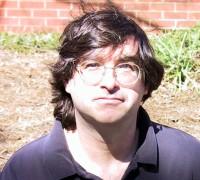
Portrait of Robert H. Swendsen
. Source. Jian-Sheng Wang co-developed the Swendsen-Wang algorithm with Robert H. Swendsen. Their method constructs and updates clusters of spins rather than changing one spin at a time, addressing critical slowing down in equilibrium Monte Carlo simulations.[ref]
For example, a large nearly aligned region in an Ising model can be difficult to reverse through local changes because intermediate configurations create costly boundaries. A collective move can change the region coherently while the full transition rule retains the desired equilibrium statistics. The useful question is then the correlation between successive samples, not merely how many update attempts are executed. Wang's institutional personal-page redirect identifies his current research homepage.[ref]
https://phyweb.physics.nus.edu.sg/~phywjs/. Redirect to the identified author homepage
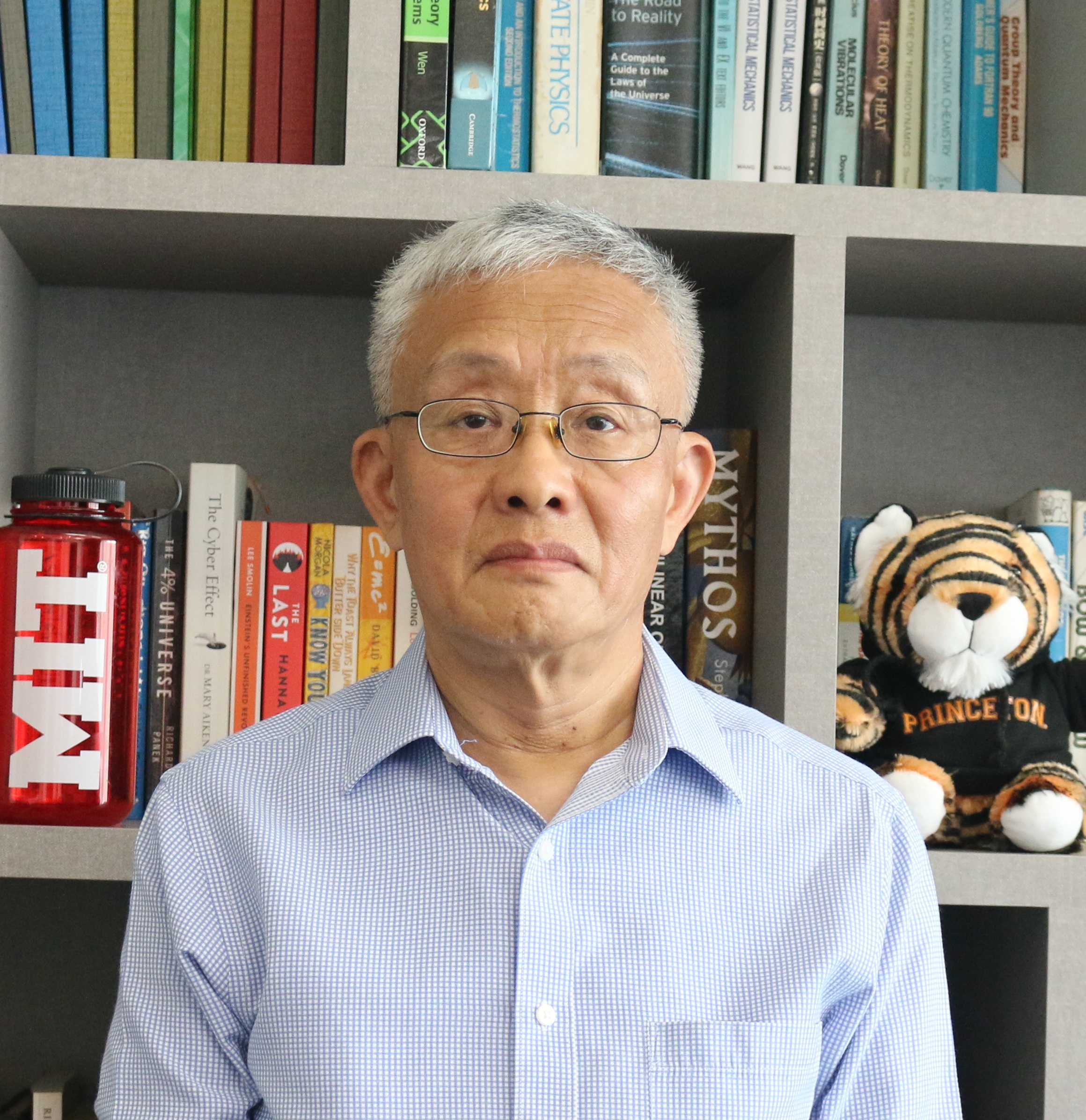
Portrait of Jian-Sheng Wang
. Source. Bertrand Duplantier works on random geometry and statistical physics. With Scott Sheffield, he gave a probabilistic construction of a Liouville quantum gravity area measure and a relation between Euclidean and random-geometry scaling exponents.[ref]
Liouville Quantum Gravity and KPZ by Bertrand Duplantier and Scott Sheffield. abstract, regularized area measure and KPZ relation
The construction illustrates why a random field cannot always be manipulated as an ordinary pointwise function. A Gaussian free field first receives a spatial regularization, such as its average around a small circle. Exponentiating this smoothed field requires a scale-dependent normalization before taking a limit. Merely writing without specifying that procedure omits an essential mathematical step.
Their result links how a set scales under ordinary area with how it scales under the random area measure. It turns a prediction from mathematical physics into a statement about precisely defined random objects, rather than identifying the two notions of dimension by analogy alone.[ref]
Liouville Quantum Gravity and KPZ by Bertrand Duplantier and Scott Sheffield. abstract and quantum scaling formulation
Jeremy A. Riousset led the generalized gas-discharge study cited here; the paper credits him with methodology, software and formal analysis. It extends breakdown calculations beyond parallel electrodes.[ref]
The geometric issue can be seen directly from Gauss's law. In a charge-free gap, a planar field is constant, a radial cylindrical field varies as , and a spherical field varies as . Thus an electron crossing a curved gap encounters a changing electric field, even when the applied electric potential difference is fixed. A breakdown criterion based only on a uniform field can miss that variation. This example motivates the paper's use of electrode geometry as part of the model, rather than treating every gap as two flat plates.

Illustrated avatar of Jeremy A. Riousset
. Avatar identified by the university profile, not a photographic portrait. Source.Joshua S. Méndez Harper studies electrostatic charging in granular materials through laboratory and field experiments. His Portland State profile connects frictional charging with phenomena ranging from clumping during grinding to electrical activity in volcanic plumes.[ref]
He also coauthored the generalized gas-discharge paper, contributing validation and formal analysis.[ref]
A Generalized Townsend's Theory for Paschen Curves in Planar, Cylindrical, and Spherical Geometries in Planetary Atmospheres by Jeremy A. Riousset and others. Author contributions
Charging particles and initiating a discharge are distinct physical questions: collisions can create a distribution of charge, while the resulting electric field must still support ionization and current through the surrounding gas. Measuring both particle charge and discharge conditions therefore tests more than observing a visible spark.
Portrait of Joshua S. Méndez Harper
. Source. Josef Dufek studies fluid dynamics in geological and atmospheric systems, especially flows containing several interacting phases. His research group combines computation, laboratory experiments and field measurements to investigate volcanic processes and particle-laden flows.[ref]
https://pages.uoregon.edu/jdufek/. Research, multiphase interactions and experimental methods
For example, ash in a volcanic plume exchanges momentum and heat with its surrounding gas. Treating the particles as a passive color added to a gas-flow picture can fail when their loading changes the flow itself. A model must decide which exchanges to resolve directly and which to represent statistically. Dufek also coauthored the generalized gas-discharge study, linking particle-rich environments with electrical breakdown questions.[ref]
Portrait of Josef Dufek
. Source. Jared P. Nelson coauthored the generalized gas-discharge study; its contribution statement credits validation, formal analysis and investigation. The published affiliation places this work in Embry-Riddle's Space and Atmospheric Instrumentation Lab.[ref]
A simple illustration of the geometric effect uses coaxial conducting cylinders. With inner radius , outer radius and applied electric potential difference , Gauss's law gives the charge-free field magnitudeFor and , the field at the inner surface is ten times that at the outer surface. Equal gap width and voltage therefore do not imply a uniform ionization environment. This independently derived example illustrates why the field near a curved electrode can differ strongly from the average field across the gap.
Annelisa B. Esparza coauthored the generalized gas-discharge study, with investigation and data curation among the published contributions.[ref]
A Generalized Townsend's Theory for Paschen Curves in Planar, Cylindrical, and Spherical Geometries in Planetary Atmospheres by Jeremy A. Riousset and others. Author contributions
An Embry-Riddle research account also identifies her participation in planetary electrical-discharge research.[ref]https://erau.edu/about/news-and-stories/news/embry-riddle-researchers-study-lightning-effects-on-mars. Named student researcher and research context
A controlled test of a breakdown model would specify the gas, pressure, electrode shape and separation, then measure the electric potential difference at discharge onset. Altering electrode curvature while holding the gap width fixed isolates a geometric change that a planar approximation suppresses. Surface condition and the criterion used to identify onset must also be recorded. Consistent measurement definitions make datasets from different apparatus comparable.
Hans Wondratschek developed mathematical treatments of crystallographic symmetry and wrote the teaching pamphlet Matrices, Mappings and Crystallographic Symmetry by Hans Wondratschek. It connects vectors, matrices and coordinate transformations with the operations of space groups.[ref]
A symmetry operation can be written as an affine mappingwhere is its linear part and its translation. Combining two operations gives , so the translation cannot simply be added without accounting for the intervening linear map. For example, inversion followed by translation differs from translation followed by inversion. The formula turns that geometric distinction into a concrete calculation.
His pamphlet also distinguishes changes of coordinate description from physical symmetry operations. Re-expressing the same crystal in another basis changes its matrix descriptions while preserving the underlying structure.[ref]
Matrices, Mappings and Crystallographic Symmetry by Hans Wondratschek. §4.2, combination of mappings; §5.3, coordinate transformations
Nicholas Metropolis helped develop electronic-computer implementations of the Monte Carlo method at Los Alamos. Instead of tracking every possible sequence of events analytically, the method samples individual random histories and estimates quantities from their collective outcomes.
His firsthand 1987 account describes simulations of neutron transport: sampled flight distances and interactions generate a history, and repeating histories estimates transport behaviour. The scientific contribution connects probability to a computational experiment, making problems accessible even when their many possible paths are difficult to enumerate.[ref]
The Beginning of the Monte Carlo Method by Nicholas Metropolis. The Spark and The Method, pp. 126–127

Nicholas Metropolis in his Los Alamos identification photograph
. Los Alamos National Laboratory badge photograph; Wikimedia Commons provenance record.Paolo Chiggiato authored teaching material on vacuum technology for ion sources and accelerators. The treatment connects gas sources, molecular transport, conductance and pumping with the pressure profile actually achieved in an apparatus.[ref]
Vacuum Technology for Ion Sources by Paolo Chiggiato. author list and the described study’s abstract or introductory account
A physicist whose 1959 work explained why a photograph of a rapidly moving object does not simply show Lorentz contraction. Light arriving at the camera simultaneously left different parts of the object at different times. The resulting apparent shape combines this timing with relativistic aberration: a moving sphere still has a circular outline, while other shapes can appear rotated. Terrell rotation therefore distinguishes an optical image from a length measured using simultaneous positions in a reference frame.[ref]
Invisibility of the Lorentz Contraction by James Terrell. Abstract: conformal transformation of apparent directions, circular sphere outline and apparent rotation
A physicist whose research uses Gauge-gravity duality to study strongly interacting matter. In these models, transport properties such as viscosity and diffusion coefficients can be calculated from excitations of a corresponding black hole. The aim is to learn about matter that is difficult to treat by weak-coupling approximations, including the hot nuclear matter produced in heavy-ion collisions.[ref]
Research profile of Andrei Starinets at the University of Oxford. Research paragraphs: transport coefficients from black-hole excitation spectra and applications to hot nuclear matter
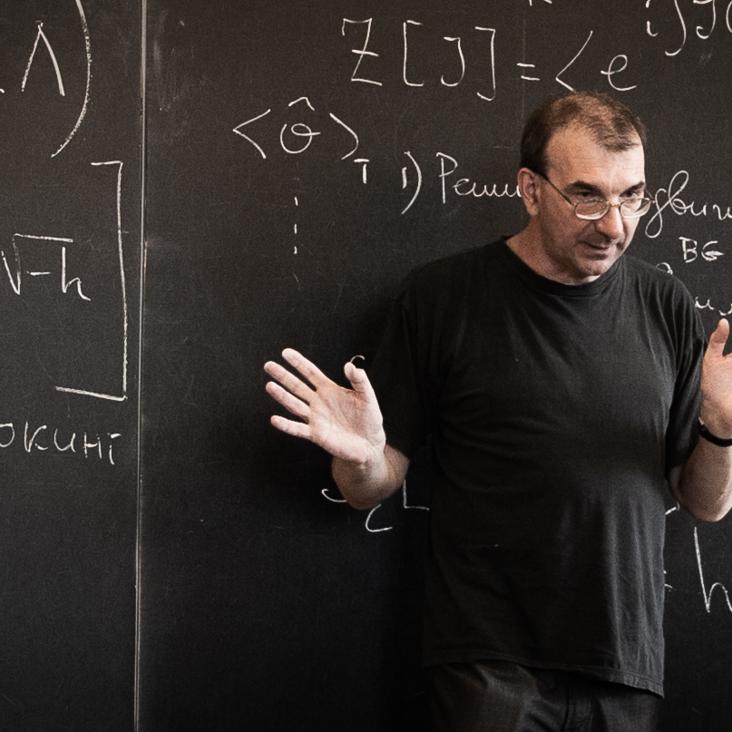
Portrait of Andrei Starinets
. Source. An accelerator physicist whose theoretical work develops magnetized electron cooling. A cold electron beam travels alongside a heavier particle beam, exchanging momentum with it and reducing its random motion. His analysis shows how guiding the electrons with a solenoidal magnetic field can increase the cooling rate and lower the equilibrium temperature. The result is useful for preparing compact ion beams for collisions.[ref]
Theory of electron cooling by Yaroslav S. Derbenev. Abstract: co-moving magnetized electron beam, enhanced cooling and ion-collider application
Hermann von Helmholtz's 1847 synthesis connected mechanical, thermal and electrical processes through conservation of energy. A modern example exposes the mathematical structure: for a particle with kinetic energy moving under a time-independent potential energy , a conservative force gives , so is constant. This derivation assumes a conservative force; the wider experimental question is how an apparent loss of mechanical energy reappears as another measurable form of energy. His essay helped organize such comparisons into a common conservation programme.[ref]
Über die Erhaltung der Kraft by Hermann von Helmholtz. 1847 monograph; conditional particle derivation expressed here in modern notation
Physicist and physiologist whose 1847 synthesis connected mechanical and other natural processes through a conservation principle.

Portrait of Hermann von Helmholtz
. Portrait by Franz von Lenbach; reproduced in Leo Königsberger, Hermann von Helmholtz (1906). Public domain (artist died 1904; reproduction published 1906); Commons PD-old/PDM. Source and usage information on the linked Wikimedia file page. Source.Julius von Mayer argued for a quantitative equivalence between mechanical work and heat. His 1842 paper connects compression of a gas with its heat capacity. In a modern ideal gas example, heating at constant pressure includes expansion work that is absent at constant volume. Because an ideal gas's internal energy depends only on temperature, its molar heat capacities satisfy , where is the molar gas constant. The heat capacity difference thus supplies a route to comparing thermal and mechanical units of energy.[ref]
Remarks on the Forces of Inorganic Nature by Julius Robert Mayer. Final compression and heat-capacity argument; ideal-gas explanation expressed here in modern notation
Physician and natural philosopher who contributed to the conservation-of-energy programme in the 1840s, including an argument for the mechanical equivalent of heat.

Portrait of Julius von Mayer
. Wellcome Library, London / Wellcome Collection. CC BY 4.0, via Wikimedia Commons. Source.Henry Cavendish used a torsion balance to infer the mean density of the Earth. Nearby lead masses exert a gravitational force on smaller masses carried by a suspended horizontal arm. The wire's restoring torque opposes the resulting angular displacement; the arm's oscillation period calibrates that response. Moving the attracting masses to opposite sides reverses the deflection. Comparing this measured gravitational force with terrestrial gravity then determines the mean density of the Earth. To reduce convection caused by uneven heating, he enclosed the apparatus and observed its scale through telescopes from outside the room.[ref]
Experiments to Determine the Density of the Earth by Henry Cavendish. 1798, pp. 469–475: apparatus, oscillation calibration, reversed positions and thermal-air-current precautions
Experimental natural philosopher who measured terrestrial gravitational attraction and inferred the mean density of Earth in 1798.

Portrait of Henry Cavendish
. Wellcome Library, London / Wellcome Collection; after a drawing by Alexander in the British Museum. CC BY 4.0, via Wikimedia Commons. Source.Frederick Lindemann related characteristic atomic oscillations to heat capacity and melting. His 1910 treatment estimated molecular eigenfrequencies and compared them with frequencies inferred from thermal and optical observations. The associated Lindemann melting criterion treats sufficiently large thermal atomic displacements relative to atomic spacing as a sign that a crystal becomes unstable. It is an approximate physical model: comparisons between independently inferred frequencies test the model, while a universal exact displacement threshold is not implied.[ref]
Über die Berechnung molekularer Eigenfrequenzen by Frederick Lindemann. 1910 original German paper, pp. 609–612, melting-point and eigenfrequency tables and heat-capacity comparison

Portrait of Frederick Lindemann, 1st Viscount Cherwell
. Photographer unrecorded; U.S. National Archives / Harry S. Truman Library, NAID 199026; 5 January 1952; existing Commons crop by Kimsaka. Public domain in the United States as a U.S. federal-government work; Commons also applies Public Domain Mark 1.0. Source.Rajarshi Roy is a physicist whose work concerns nonlinear optical systems, noise and chaos. His University of Maryland profile describes research on nonlinear dynamics and fluctuations in optical devices and lasers, including the connection between experiments and models of their behavior.[ref]
Rajarshi Roy profile by the University of Maryland. Research overview, nonlinear optical systems and noise
With Bruce McNamara and Kurt Wiesenfeld, Roy coauthored Observation of Stochastic Resonance in a Ring Laser by Bruce McNamara and others, published in 1988. Its abstract reports a bidirectional ring laser, periodic modulation of the asymmetry between counter-rotating modes, and an improved signal-to-noise ratio after external noise was injected.[ref]
Observation of Stochastic Resonance in a Ring Laser by Bruce McNamara and others. Abstract and publisher byline
The important physical feature is a nonlinear optical response whose switching can be influenced by both periodic forcing and fluctuations.An original proposed readout illustrates what must be observed. If the two propagation directions deliver powers and , defineFor , ; reversing the powers gives . Total power remains in both cases. A readout recording only their sum would lose this directional-state information. This normalization is a proposed explanatory observable, not an asserted detail of the 1988 apparatus.
To test a noise-dependent response, one could record direction-resolved signals while holding the periodic forcing and measurement convention fixed, vary the injected-noise level, and compare the coherent response with its background. Repeated trials would also test switching variability. Both numerator and denominator in a reported signal-to-noise ratio matter; an increased raw fluctuation amplitude does not by itself demonstrate better detection.
The optical experiment motivates stochastic resonance as a property of a specified system, input and readout. It does not imply that adding noise improves every measurement. Roy's documented research emphasizes precisely the interaction between fluctuations, nonlinear dynamics and optical observation.
Kurt Wiesenfeld is a physicist whose research includes stochastic resonance and collective dynamical behavior. Georgia Tech's School of Physics profile lists stochastic resonance, spontaneous synchronization and dynamical beam steering among his research topics.[ref]
He coauthored Observation of Stochastic Resonance in a Ring Laser by Bruce McNamara and others with Bruce McNamara and Rajarshi Roy. The publisher's abstract establishes the experimentally observed improvement in a periodically modulated optical system with added noise.[ref]
Observation of Stochastic Resonance in a Ring Laser by Bruce McNamara and others. Publisher byline and Abstract
A useful theoretical question is how a random transition rate can relate to the forcing period.For an original illustrative model, suppose a system has two states with a noise-dependent escape rateThis is an assumed activation-type form, of the kind represented by a Kramers escape rate; it is not a fitted law for the cited laser. If unforced dwell times have an exponential distribution, their mean is . A periodic forcing of period suggests comparing that time with , the time between alternating preferences for the two states.
Take stipulated , dimensionless , and . The mean-dwell matching condition givesAt , the mean dwell is about 22.03 seconds, far longer than the forcing half-period. At , it is about 7.39 milliseconds. The calculation explains why too little noise can prevent switching, while rapid random switching can obscure a weak preference.
Matching means is only a heuristic. Exponential dwell times have a spread as large as their mean, and periodic forcing changes the rates over the cycle. The matching calculation alone does not prove phase locking or locate the optimum signal-to-noise ratio. A proposed test records transition times relative to the forcing phase and compares the full response as noise is varied.
This distinction between a simplified rate model and an observed response is central to interpreting stochastic resonance. The example is an original calculation illustrating the theoretical issue; the joint 1988 paper supplies the verified optical observation.
Bruce McNamara coauthored the 1988 paper Observation of Stochastic Resonance in a Ring Laser by Bruce McNamara and others with Kurt Wiesenfeld and Rajarshi Roy. The publisher lists the School of Physics at Georgia Tech and gives McNamara a permanent-address footnote at the Physics Department of the University of California, Santa Cruz.[ref]
Observation of Stochastic Resonance in a Ring Laser by Bruce McNamara and others. Publisher byline, affiliations and author footnote
These publication details identify the contributor to this optical experiment.The experiment's abstract reports improved signal-to-noise ratio in a bidirectional ring laser after externally injected noise was added to periodic asymmetry modulation.[ref] Interpreting that result requires a defined output statistic: a larger optical fluctuation alone need not be a clearer periodic signal.
An original finite-trial model makes the distinction precise. Suppose a phase-referenced statistic from each independent trial isFor trials, the average has variance . Its squared-mean-to-variance detection ratio isThe statistic could be a consistently measured in-phase Fourier coefficient; its construction and phase reference must remain the same across the comparison.
For stipulated , let three injected-noise settings produce modeled pairs , and . The corresponding ratios are 4, 20 and 2.42. The middle case is best even though its output variance exceeds the first case's and its mean signal is smaller than the last case's. The response-to-background ratio determines this comparison. These invented values illustrate the statistic; they are not recovered laser data or the paper's exact spectral convention.
Independence is part of the toy model. With correlated trials,so merely collecting more adjacent records does not guarantee the same averaging gain. A proposed experimental comparison fixes observation duration, trial handling, input forcing and output statistic while changing injected noise. It measures both coherent response and background before concluding that detection improved.
The experiment connects stochastic resonance to a concrete comparison between a periodic optical response and its noise background.
Fedor Jelezko works on solid-state quantum optics and spin control in diamond. His Ulm University CV identifies him in full and lists the exact 2004 nuclear-spin paper whose first-author byline is F. Jelezko, verifying the connection between the full name and the abbreviated record.[ref]
Fedor Jelezko at Ulm University. Official CV, page1 expertise and page2 selected publications, DOI10.1103/PhysRevLett.93.130501
That experiment addressed an electron spin coupled to a single Carbon-13 nuclear spin at a nitrogen-vacancy center. A laser initialized and read out the electron-spin-dependent signal, while microwave and radio frequency pulses manipulated the coupled levels. Nuclear-state changes were detected through the electron spin. The team observed nuclear Rabi oscillations and demonstrated a conditional two-qubit gate, providing a physical test of coherent control of an individually addressed spin system.[ref]
For an original ideal pulse example, let a selected transition have resonant Rabi frequency and start entirely in one level. The two-level model gives transition probabilityA pulse gives , while a pulse gives . Scanning the pulse duration reveals an oscillation rather than a single population change. These are chosen ideal values; detuning, relaxation and readout noise limit a real measurement.

Eduardo García-Toraño is a physicist whose work includes precision measurements of radioactive decay. His 2010 coauthored study of fluorine-18 lists an affiliation with an ionizing radiation metrology laboratory in Madrid. The experiment followed radioactive decay using three systems: ionization chambers, germanium detectors, and coincidence counting with fast scintillators. Measurements extended over as many as nine half-lives, providing several instrumental routes to the same physical parameter.[ref]
The half-life of 18F by Eduardo García-Toraño and others. Byline, affiliation and Abstract, Applied Radiation and Isotopes68(7–8),1561–1565(2010)
The combined result was a half-life of , where the parenthetical notation represents in the last quoted digits. This is the result reported by that experiment; the distinction matters when comparing a historical measurement with a later evaluated half-life.[ref]
The half-life of 18F by Eduardo García-Toraño and others. Abstract: combined result from the three measuring systems
A simple model illustrates why the long observation interval is demanding. Suppose a detector's observed event rate iswhere is the radioactive decay constant and is a constant instrumental background. This illustrative model assumes stable detection efficiency and background. After nine half-lives, the decaying contribution is . An initial contribution of events per second would therefore fall to just event per second: even a small background can then noticeably distort an exponential decay fit if it is omitted. Independent detector systems make a valuable comparison because their instrumental backgrounds and responses need not behave identically.
Carl K. Ross is a physicist associated with ionizing radiation standards and water calorimetry. His 1997 paper with Norman V. Klassen identifies both authors with the ionizing-radiation standards laboratory in Ottawa and examines a fundamental problem in radiation dosimetry: deposited energy and measured heat need not be equal when irradiation also produces chemical reactions.[ref]
Water Calorimetry: The Heat Defect by Norman V. Klassen and Carl K. Ross. Printed p.63, byline, affiliation, Abstract and Introduction
Their analysis expresses the heat defect aswhere is absorbed energy, is the energy appearing as heat, is absorbed dose, and is the specific heat capacity of water. The temperature rise supplies a measurable thermal signal, while the heat defect accounts for the energy balance associated with radiolysis.[ref]
Water Calorimetry: The Heat Defect by Norman V. Klassen and Carl K. Ross. Printed p.63, Eqs1–2 and following explanation
For a hypothetical example, suppose the measured thermal quantity is and the heat defect is . The corrected absorbed dose is then . The illustrative correction is chosen for arithmetic, rather than quoted as an experimental result. A positive heat defect means that some absorbed energy does not appear as heat; a negative value means that the measured heat exceeds the absorbed energy, with the difference supplied by the accompanying chemical reactions.
Ross and Norman V. Klassen later published a correction to an input reaction rate constant in their computer simulation. Their 2002 paper provides an explicit example of revising a physical measurement model when a supporting parameter changes.[ref]
Water Calorimetry: A Correction to the Heat Defect Calculations by Norman V. Klassen and Carl K. Ross. Printed p.171, Abstract: replacement of model III by model IIIR
Norman V. Klassen is a physicist whose work with Carl K. Ross connects water calorimetry, radiolysis and absorbed dose measurement. Their 1997 study compared calculated heat defects with experimental observations, including independently measured chemical products. This comparison tests the physical model through more than its agreement with a single temperature rise.[ref]
Water Calorimetry: The Heat Defect by Norman V. Klassen and Carl K. Ross. Printed p.63, byline, Abstract and Introduction
The issue is that a water calorimeter measures a thermal response to ionizing radiation, whereas absorbed dose concerns deposited energy per unit mass. If is the thermal energy per unit mass, the heat defect relates them byA useful sensitivity calculation follows directly. Holding fixed and differentiating with respect to givesFor an illustrative , an absolute change changes the inferred absorbed dose by approximately , or . Thus improving thermometer precision alone cannot remove the contribution of an uncertain heat defect to measurement uncertainty. The example is a local sensitivity estimate, rather than an uncertainty budget for their apparatus.[ref]
Water Calorimetry: The Heat Defect by Norman V. Klassen and Carl K. Ross. Printed p.63, Eq1, from which the sensitivity calculation follows
In 2002, Klassen and Carl K. Ross reported that a literature reaction rate constant used in their earlier model was incorrect and supplied a revised model. Their correction also compared model predictions with calorimetric and chemical-product measurements. It illustrates why the inputs to a computer simulation are part of the scientific claim: agreement must be reassessed when those inputs are corrected.[ref]
Water Calorimetry: A Correction to the Heat Defect Calculations by Norman V. Klassen and Carl K. Ross. Printed p.171, Abstract and Introduction
Denis E. Bergeron is a NIST research chemist in its Radioactivity Group whose work concerns physical radioactive activity measurements and standards. His official profile identifies his work in that group; an author account in the Journal of Research of NIST documents the comparison of primary activity standards over several decades.[ref][ref]

In the 2014 coauthored review, Bergeron and colleagues examined ten fluorine-18 standardizations from 1982 to 2013. A new standard differed by about 4 percent from results obtained in1998–2008. The authors compared multiple primary measurement methods and possible sources of bias, while explicitly reporting that the older discrepancy was not fully explained.[ref]
A Review of NIST Primary Activity Standards for 18F: 1982 to 2013 by Denis E. Bergeron and others. Abstract; §4 Discussion, comparison of techniques and unresolved bias
A simple ionization chamber example shows why a calibration difference matters. Suppose measured electric current is and the response model is . A hypothetical factor gives activity . Replacing it by gives approximately for the same current, an increase of about .
These numbers are invented, not the review's calibration table. They separate the detector observation from the inferred radioactive activity. Bergeron's standards work demonstrates why cross-method comparisons and an explicit measurement uncertainty budget matter even when repeated readings are consistent.
M. P. Unterweger coauthored a 2000 study of measurement calibration for water standards containing tritium. The paper combined measurements using a proportional counter with liquid scintillation counting comparisons. It also followed massic activity data spanning 38 years to estimate a tritium half-life of days, with the uncertainty specified as one standard deviation.[ref]
The long time record makes a useful distinction visible. A reference sample's radioactive activity changes through radioactive decay even when its chemical identity is unchanged. In an ideal closed sample with constant half-life ,Measurements made at different times must therefore be related to a common time before differences can be interpreted as inconsistent standards. A half-life determination and a detector comparison address related but distinct parts of that problem.
P. R. Moran authored a 1982 paper describing flow-sensitive phase modulation for magnetic resonance imaging. The method adds information about motion to spatial encoding: the abstract describes imaging a joint distribution of position and velocity, rather than treating the signal solely as a map of stationary material.[ref]
A flow velocity zeugmatographic interlace for NMR imaging in humans by P. R. Moran. 1982 indexed byline and abstract: phase modulation, joint spatial/flow spin density and reconstructed flow measures
The physical idea is magnetic resonance velocity encoding. Motion through a magnetic field gradient changes accumulated signal phase under a specified pulse sequence. Appropriate measurements can therefore distinguish moving spin populations that occupy similar positions. The cited abstract describes reconstructing flow-related quantities from complex image data; it does not establish a unique molecular or material identity from signal phase alone.
A synthetic model shows why a distribution of velocities can matter. At one location, suppose two equally weighted contributions with velocities and acquire phases and . Their combined complex signal isIt is real even though neither population is stationary. For , , compared with for two stationary contributions in this model. A zero imaginary component alone consequently does not prove zero motion. This is an explanatory phase-summation example, not a numerical result reported in the 1982 paper.
The verified source byline supplies initials only. No expanded given name, personal dates or portrait is inferred from similarly named researchers.
James W. Deardorff was an atmospheric scientist whose numerical work helped establish large eddy simulation as a way to study turbulence. His 1970 study integrated three-dimensional equations for turbulent channel flow while representing subgrid effects through coefficients tied to resolved deformation. The primary paper identifies his affiliation as the National Center for Atmospheric Research.[ref]
A numerical study of three-dimensional turbulent channel flow at large Reynolds numbers by James W. Deardorff. Printed p. 453, byline, affiliation and abstract
The calculation used 6720 uniform grid intervals and compared computed flow statistics with experimental measurements. The reported agreement ranged from good to marginal. This made the unresolved-motion model testable against quantities beyond the appearance of an evolving flow: the paper examined eddy structure and the kinetic energy balance as well as statistical averages.[ref]
A numerical study of three-dimensional turbulent channel flow at large Reynolds numbers by James W. Deardorff. Printed p. 453, abstract: grid, comparison, eddy shapes and energy balance
An elementary example explains why those separate statistics matter. Two equally likely velocities and have mean and variance . A prediction that always returns has the correct mean but zero variance. Matching a mean velocity profile alone therefore cannot establish that a model captures turbulent fluctuations or their transport.
Deardorff's study illustrates a productive compromise: compute evolving resolved structures, model the missing influence with a subgrid-scale model, and compare predicted statistics with observations. Finer resolution and a different closure can change the prediction, so agreement remains a property of a specified calculation and test.
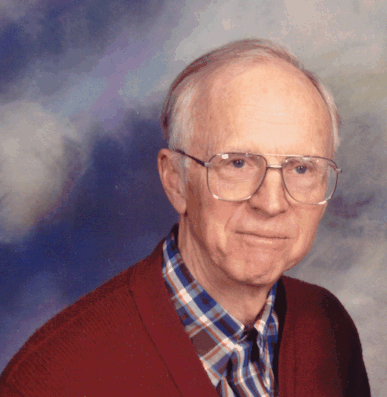
I. H. McLaren coauthored with W. C. Wiley the 1955 Bendix study of time-of-flight mass spectrometry with improved mass resolving power. A notable part of their analysis was time-lag focusing: waiting between ion formation and application of an accelerating pulse lets initial velocities become position differences that can compensate some arrival-time spread.[ref]
A first-order calculation exposes the mechanism. Let be arrival time after immediate extraction for initial axial velocity and position . During a field-free delay , an ion moves to . Apart from the common delay added to all times,The partial derivatives are evaluated at and the reference position. First-order sensitivity to vanishes ifA positive delay requires opposite signs of these sensitivities. For example, and give . These values illustrate the cancellation, rather than reproducing an instrument setting from the paper.
This also reveals the tradeoff: the cancellation needs a nonzero position sensitivity, whereas ideal first-order space focusing sets . The paper's delayed-extraction condition and measured spectra therefore address competing sources of broadening, not a universal elimination of every initial-condition effect.[ref]
Time-of-Flight Mass Spectrometer with Improved Resolution by W. C. Wiley and I. H. McLaren. Printed p. 1154, equations 13–13a and discussion of the compromise between space resolution and time-lag energy focusing
W. C. Wiley worked on time-of-flight mass spectrometry at Bendix Aviation Corporation Research Laboratories. With I. H. McLaren, Wiley published a 1955 instrument study addressing the arrival-time spread of ions with the same mass-to-charge ratio. Their apparatus combined an ion-producing source, accelerating electric fields, an evacuated drift region and a collector; its analysis separated broadening from initial position and initial motion.[ref]
Time-of-Flight Mass Spectrometer with Improved Resolution by W. C. Wiley and I. H. McLaren. Printed p. 1150, byline, affiliation and instrument description; pp. 1151–1154, space and initial-energy contributions
The basic timing principle can be derived without the focusing details. An initially stationary ion of positive electric charge accelerated through an electric potential difference acquires kinetic energy . Over a field-free drift length ,For a fixed charge state and instrument setting, differentiating gives the approximate mass resolving powerFor illustration, a arrival time with a timing width corresponds to , if that width is the relevant small peak-width measure.
The focusing problem addressed by Wiley and I. H. McLaren is therefore substantive: a spread of initial conditions can broaden a peak even when the detector timing is precise. Their work on space focusing and time-lag focusing changes the ion trajectories to reduce that broadening, rather than merely measuring the same broad peak with a faster clock.
M. S. Patterson coauthored the 1989 time-resolved tissue-optics study with Britton Chance and B. C. Wilson. It used picosecond light pulses and a diffusion approximation to infer optical properties from the time dependence of transmitted or backscattered light, comparing the model with preliminary measurements and Monte Carlo simulations.[ref]
The measurement separates effects that an overall brightness reading can mix together. Repeated light scattering lengthens photon paths and broadens the arrival-time distribution, while absorption suppresses photons along those paths. A pulsed source, a sample and a time-sensitive detector therefore provide more information than a single steady illumination measurement. Inferring coefficients still depends on the geometry and the validity of the transport approximation; pulse timing does not remove the need for a physical model.
B. C. Wilson coauthored the early time-resolved tissue-optics paper with M. S. Patterson and Britton Chance, connecting pulsed measurements to a model of radiative transfer in tissue.[ref]
Time resolved reflectance and transmittance for the non-invasive measurement of tissue optical properties by M. S. Patterson and others. published byline and abstract
Brian Wilson's institutional research account describes subsequent work on optical diagnosis, image-guided interventions and light-activated treatments.[ref]An illuminating distinction is between detecting light and knowing where it originated. A fluorescence signal collected through tissue depends on excitation delivery, emission production, light scattering and absorption along the return path. Quantitative interpretation must therefore connect the instrument's signal with transport through the sample, rather than equating detector brightness directly with the amount of a fluorescent substance.

Portrait of B. C. Wilson
. Source. Xiaoge Liu is the first-listed author of the 2014 study of band nonparabolicity and the optical properties of indium tin oxide. The Stanford laboratory's alumni record also identifies Liu as a former doctoral student.[ref]
https://brongersma.stanford.edu/alumni/. Xiaoge Liu entry
[ref]The physical issue can be expressed through the Drude model relationwhere is carrier density and the relevant effective mass. If were fixed, doubling would double . A density-dependent mass changes that prediction. Combining electrical and optical measurements can therefore test a band model rather than treating every shift in plasma frequency as a direct measure of carrier density alone.
Junghyun Park coauthored the indium tin oxide study with Xiaoge Liu and collaborators. Stanford's laboratory alumni page identifies Park as a former postdoctoral researcher.[ref]
https://brongersma.stanford.edu/alumni/. Junghyun Park entry
[ref]The study's subject illustrates a useful modeling test. A parabolic conduction band has the form with constant effective mass. Adding an energy-dependent correction means that electrons occupying higher-energy states need not respond as though they have the same mass. Optical and transport behavior can then change together as the band fills. A model fitted at one carrier concentration should consequently be tested at others, rather than assuming its parameters remain constant.
Ju-Hyung Kang coauthored the study connecting indium tin oxide's electronic-band shape with its optical response. The laboratory alumni record lists Juhyung Kang as a former research associate, alongside the corresponding Stanford email identity.[ref]
https://brongersma.stanford.edu/alumni/. Juhyung Kang entry
[ref]One way to understand the combined measurements is to compare the Drude model's mobility and optical-frequency relations. With a characteristic momentum relaxation time , electron mobility obeys , while . A change in mobility alone cannot distinguish a change in scattering time from a change in effective mass. An independent carrier density measurement and optical response impose additional constraints. Together, these probes constrain several material parameters that a single measurement leaves entangled.
Hongtao Yuan researches electronic and optoelectronic behavior at material interfaces. His Nanjing University profile describes electric-field control of charge, spin and orbital behavior in low-dimensional systems and records his earlier Stanford work with Yi Cui and Harold Hwang.[ref]
He also coauthored the indium tin oxide study of band nonparabolicity.[ref]
Quantification and impact of nonparabolicity of the conduction band of indium tin oxide on its plasmonic properties by Xiaoge Liu and others. published byline
A basic experimental distinction in this field is between changing the number of carriers electrically and changing a material's chemical composition. Both can alter conductivity, but their structural effects and reversibility need not be the same. Comparing transport and optical response helps identify what has changed beyond a single resistance value.
Portrait of Hongtao Yuan
. Source. Yi Cui develops nanomaterials and methods for studying their structure and behavior, with applications including lithium-ion batteries, catalysis and environmental technologies. His Stanford research description identifies this combination of material design and characterization.[ref] He also coauthored the indium tin oxide study cited here.[ref]
A useful geometric motivation for nanoscale design is that a sphere's surface-area-to-volume ratio is . Reducing its radius tenfold increases that ratio tenfold, changing how much material lies near an interface. In an electrode, small dimensions can also shorten transport distances, while a greater exposed surface can increase unwanted reactions. Useful material design must therefore test the complete device behavior rather than assuming smaller features improve every property.

Harold Hwang studies electronic phenomena in oxide materials and their interfaces. His Stanford publication record includes work on electronic reconstruction and emergent states at oxide interfaces, where local symmetry and charge distribution can differ from those of either bulk material.[ref]
https://profiles.stanford.edu/harold-hwang. Publication entry, Emergent phenomena at oxide interfaces, 2012
He also coauthored the indium tin oxide study of band nonparabolicity.[ref]
Quantification and impact of nonparabolicity of the conduction band of indium tin oxide on its plasmonic properties by Xiaoge Liu and others. published byline
The broader experimental idea is that an interface is a physical region with its own structure and boundary conditions. Measuring a conducting layer at a boundary therefore raises questions about charge location, thickness and the adjoining materials, rather than being fully described by averaging the two bulk conductivities. Local structural and electronic measurements can test those distinctions.
Portrait of Harold Hwang
. Source. Mark Brongersma develops nanostructured materials and devices for manipulating light, particularly in plasmonics. His Stanford profile describes research on electronic and photonic devices at the nanoscale.[ref] He coauthored the indium tin oxide study that links optical behavior to band nonparabolicity.[ref]
A central design tradeoff is between concentrating an optical field and dissipating its energy. Strong confinement can make a small region interact intensely with light, but absorption and finite carrier mobility can limit how long that energy persists. A useful device description therefore needs both its mode geometry and its loss mechanisms. Treating a material's optical response as fixed while changing its carrier population can miss another part of that tradeoff.

Portrait of Mark Brongersma
. Source. Randall P. Wagner is a physicist at the US National Institute of Standards and Technology whose research includes acoustic measurement. In 2011, Wagner and colleagues described improved microphone reciprocity calibration for laboratory-standard microphones.
The method measures pairs of microphones coupled through air-filled cavities, using reciprocity to determine pressure sensitivity. Comparing long and short coupling cavities tests corrections rather than assuming one apparatus geometry is exact. The reported service covered 31.5 hertz to 20 kilohertz and reduced stated measurement uncertainty relative to the previous service. This supports a traceable conversion from electric potential difference to sound pressure.[ref]
Institutional profile: www.nist.gov/people/randall-p-wagner.
M. Jullière reported an early experiment on spin-dependent quantum tunnelling between ferromagnetic films in 1975. The study compared the electrical conductance of iron–germanium–cobalt junctions when the film magnetizations were parallel or antiparallel.[ref]
Tunneling between ferromagnetic films by M. Jullière. Physics Letters A 54, pp. 225–226, abstract and junction comparison
The associated Jullière model relates the change in conductance to spin-dependent density of states in the two electrodes. Changing their relative magnetic orientation changes the available tunnelling channels, providing a physical basis for tunnel magnetoresistance. The experiment made magnetic configuration an electrical readout variable, rather than treating the barrier alone as the determinant of tunnelling. The author name here retains the primary-paper byline.
J. Kurchan coauthored a 1993 analytical study of relaxation in a long-range spin glass with Leticia Fernanda Cugliandolo. They solved the long-time behaviour of correlation and response functions in a spherical model with interactions involving several spins.[ref]
The solution exhibits aging in nonequilibrium systems: the response after a disturbance depends on how long the system has already been evolving, rather than only on elapsed time since the disturbance. It supplies an explicit model in which slow history-dependent dynamics can be studied analytically. The initials are those printed in the primary-paper byline.
Peter H. Yoon studies the kinetic theory of plasmas, including the electron velocity distributions observed in the solar wind. His 2014 paper relates the Kappa distribution, with its comparatively large high-velocity tail, to a self-consistent description of weak plasma turbulence.
The paper extends the calculation to electrostatic fluctuations associated with Langmuir waves, often called quasi-thermal noise. It thereby connects a particle distribution to the fluctuations with which the particles interact, rather than simply choosing an empirical tail and leaving the field unspecified. The author affiliations identify the University of Maryland and Kyung Hee University.[ref]
Electron kappa distribution and quasi-thermal noise by Peter H. Yoon. 2014, author affiliations and abstract: steady-state weak-turbulence solution and electrostatic fluctuations
Yair Margalit is an experimental physicist credited as first author of a detailed realization of a complete Stern-Gerlach interferometer. In this experiment, gradients of a magnetic field generated by an atom chip split atomic wave packets according to their internal spin state and then recombined them coherently.
Recombination matters: separating two paths shows state-dependent motion, whereas recovering quantum interference tests preservation of the relative phase. The reported arrangement used controlled microscopic field sources; it should not be confused with the original macroscopic-magnet Stern-Gerlach experiment.[ref]
Alexander Zhiboedov is a theoretical physicist who, with Andrew Strominger, connected gravitational memory to the Soft graviton theorem. Their 2014 preprint considers arrays of detectors before and after passage of a gravitational radiation pulse near future null infinity.
The resulting relative displacement reproduces gravitational memory, while its formula is related to the low-energy limit described by the Soft graviton theorem. This unites a lasting change in detector separation with an apparently different statement about emission of very low-energy gravitons.[ref]
Gravitational Memory, BMS Supertranslations and Soft Theorems by Andrew Strominger and Alexander Zhiboedov. Abstract and §4; preprint submitted 21 November 2014
Institutional profile: theory.cern/roster/zhiboedov-alexander.

Andrew Strominger studies quantum gravity, string theory and black holes. His work with Alexander Zhiboedov relates gravitational memory to the Soft graviton theorem through the behaviour of detectors and radiation near future null infinity.
A pulse need not leave only a passing oscillation: it can produce a lasting relative displacement between freely moving detectors. Their calculation links that displacement to the radiation energy flux, making a measurable classical effect part of a broader relationship with low-energy quantum emission.[ref]
Institutional profile: www.physics.harvard.edu/people/facpages/strominger.

C. W. F. Everitt led the Gravity Probe B experiment, which tested general relativity using four cryogenic gyroscopes in Earth orbit. The instrument measured slow changes in spin-axis direction relative to a stellar reference, separating the geodetic effect from frame dragging.
The 2011 final-results paper reported a geodetic drift of milliarcseconds per year and a frame dragging drift of milliarcseconds per year, compatible with the predicted values within the reported uncertainties. The latter effect was much smaller, illustrating why identifying and modelling instrument drifts was central to the test.[ref]
Gravity Probe B: Final Results of a Space Experiment to Test General Relativity by C. W. F. Everitt and others. Abstract: four-gyroscope results and comparison with relativity predictions

C. W. F. Everitt receiving an award in 2011
. Everitt is on the left, as identified in the Stanford Gravity Probe B mission account of the 4 May 2011 presentation.Daniel Z. Freedman is a theoretical physicist whose work includes supergravity and the stability of fields in Anti-de Sitter spacetime. With Peter Breitenlohner, he derived the condition known as the Breitenlohner-Freedman bound.
Under the appropriate boundary conditions, a scalar field in Anti-de Sitter spacetime can be stable even when its mass-squared parameter is negative, provided it remains above the bound. Curved background geometry changes the stability criterion familiar from flat spacetime.[ref]
Stability in gauged extended supergravity by Peter Breitenlohner and Daniel Z. Freedman. 1982, scalar-field stability result
His MIT profile also identifies his 1976 collaborative construction of supergravity.[ref]Peter Breitenlohner was a theoretical physicist whose work with Daniel Z. Freedman established the Breitenlohner-Freedman bound for fields in Anti-de Sitter spacetime.
For a scalar field in -dimensional Anti-de Sitter spacetime with curvature radius , the familiar form is , with stability also requiring suitable boundary conditions. The negative right-hand side explains the surprising feature: a negative mass-squared parameter alone does not establish instability in this curved background. Their result links field dynamics to the geometry and boundary conditions of spacetime.[ref]
Stability in gauged extended supergravity by Peter Breitenlohner and Daniel Z. Freedman. 1982, stability analysis; formula uses d boundary spacetime dimensions and radius L
Ian Stevens is an astrophysicist whose research includes massive stars and stellar winds. He coauthored an analysis of X-ray observations of the galactic wind in the starburst galaxy M82.
The team compared diffuse emission with models of a freely expanding wind and of clouds heated by shocks. The observations favoured shocked clouds over the simple free-wind model, showing how radiation can identify which component of an outflow is being measured.[ref]
ROSAT Observations of the Galactic Wind in M82 by Dave Strickland and others. Abstract, model comparison; 1996 preprint, 1997 journal article
Institutional profile: research.birmingham.ac.uk/en/persons/ian-stevens/.
Articles were limited to the first 100 out of 309 total.
Articles by others on the same topic

A physicist is a scientist who specializes in the field of physics, which is the study of matter, energy, and the fundamental forces of nature. Physicists seek to understand the underlying principles that govern the behavior of the universe, from the smallest particles, like atoms and subatomic particles, to the largest structures, such as galaxies and the cosmos itself.