Magnetostriction is a change of a material's shape or dimensions associated with its magnetization. A magnetic field can therefore produce strain without a contact force. The resulting magnetoelastic coupling lets a ferromagnet convert changes of magnetic state into mechanical motion; a constraint can instead turn the preferred deformation into stress. James Prescott Joule published his study of iron and steel bars in 1847.[ref]
The surprising point is that reversing the magnetization need not reverse the deformation. A material can prefer a longer axis along either or : an axis has no arrow. Isotropic linear magnetostriction vanishes excludes one particular linear constitutive term, while saturated isotropic magnetostrictive strain supplies a nonzero response with a quadratic dependence on the magnetic direction. The pulsed-field optical magnetostriction experiment shows how an actual length change can be resolved, and quadratic magnetostriction and frequency doubling separates an illustrative response law from a measured material curve.
Coupling in which a magnetic material's preferred strain transfers mechanical stress to a piezoelectric constituent, producing an electrical response. It depends on interfaces, elastic load sharing and electrical boundary conditions; a composite's measured voltage is not by itself an intrinsic single-phase magnetoelectric coefficient.
A magnetostrictive actuator uses magnetostriction to produce displacement or force. Its free motion and its blocked stress are different boundary conditions, as shown in free strain and blocked magnetostrictive stress.
Magnetostrictive strain is the preferred strain associated with a specified magnetic state relative to a stated reference. The measured strain also depends on mechanical constraints.
Volume magnetostriction is the relative volume change associated with a magnetic-state change. To first order it is the trace of the magnetostrictive strain. Zero trace is an additional restriction, not a consequence of isotropy alone.
In the saturated isotropic magnetostrictive strain convention, saturation magnetostriction is the longitudinal relative length change from a random-domain reference to alignment. A parallel-to-perpendicular length difference instead equals in that model.
Under proper rotations a third-rank isotropic tensor is proportional to the Levi-Civita symbol. Its contraction with a field vector is antisymmetric in the two stress indices. A physical symmetric stress therefore vanishes in this linear constitutive model. Under the full orthogonal group an ordinary isotropic third-rank tensor is already zero; the orientation-sensitive Levi-Civita tensor requires the usual pseudotensor distinction.
Consider a mechanically free isotropic model of a saturated ferromagnet, at fixed temperature and fixed magnitude of magnetization. Let be a unit vector, where is the saturation magnetization. The magnetostrictive strain is an infinitesimal strain tensor, measured relative to a reference with randomly oriented magnetic domains. This reference convention matters: it sets the orientational average of the preferred strain to zero. Define , the saturation magnetostriction, as the longitudinal relative length change in this model.
Rotational symmetry permits a symmetric second-rank tensor made from of the form , where is the Kronecker delta. If we restrict attention to a change of shape with zero first-order volume change, its trace gives . Requiring the longitudinal component to equal gives . HenceThe tensor product is symmetric and unchanged under . It uses two copies of the magnetic direction, so the third-rank isotropic tensor obstruction in isotropic linear magnetostriction vanishes does not apply. More generally, a small-magnetization expansion can contain ; isotropy alone does not require its trace to vanish. The displayed saturated formula isolates the volume-preserving orientational contribution, rather than asserting that every material has zero volume magnetostriction.
Along a measuring unit vector , with , the fractional length change isFor a stipulated and reference length , alignment gives and a perpendicular orientation gives . Rotating from perpendicular to parallel therefore changes the length by , even though the saturated longitudinal value relative to the random reference is . A negative reverses these elongation and contraction signs.
The eigenvalues of this infinitesimal strain tensor are , so to first order. This is not exact finite incompressibility: using the illustrative deformation gradient givesA finite-deformation law would need higher-order corrections if exact volume conservation were required.
A full reversal leaves saturated isotropic magnetostrictive strain unchanged. A rotation generally changes it. In the simplest unconstrained orientation average over magnetic domains, replace by , not by . Equal populations pointing along and have zero net magnetization but the same preferred strain as a single domain along . An isotropic orientation distribution instead has and zero average preferred strain. Elastic compatibility between real magnetic domains can modify the macroscopic response.
Reversing an applied magnetic field does not guarantee that all microscopic orientations retrace the same path. Hysteresis, magnetic domain-wall pinning, and changes in domain populations can alter the measured curve. The reversal identity concerns the same pair of magnetic states with opposite local magnetization; it is not a universal prediction that an arbitrary experimental sweep is a single-valued even function of applied magnetic field.
A single crystal of gadolinium antimonide carried a fibre Bragg grating cyanoacrylate-bonded along its axis. The pulsed magnetic field paralleled that axis. Broadband light, a circulator and a spectrometer resolved reflected-wavelength shifts at . Pre-pulse readings measured noise; low fibre thermal expansion reduced thermal background. A residual post-pulse shift indicated possible heating. Spectral distortion checked bond uniformity, while the fibre's smaller cross-section limited loading; bonding was not assumed force-free. Longitudinal strain showed a kink near .[ref]
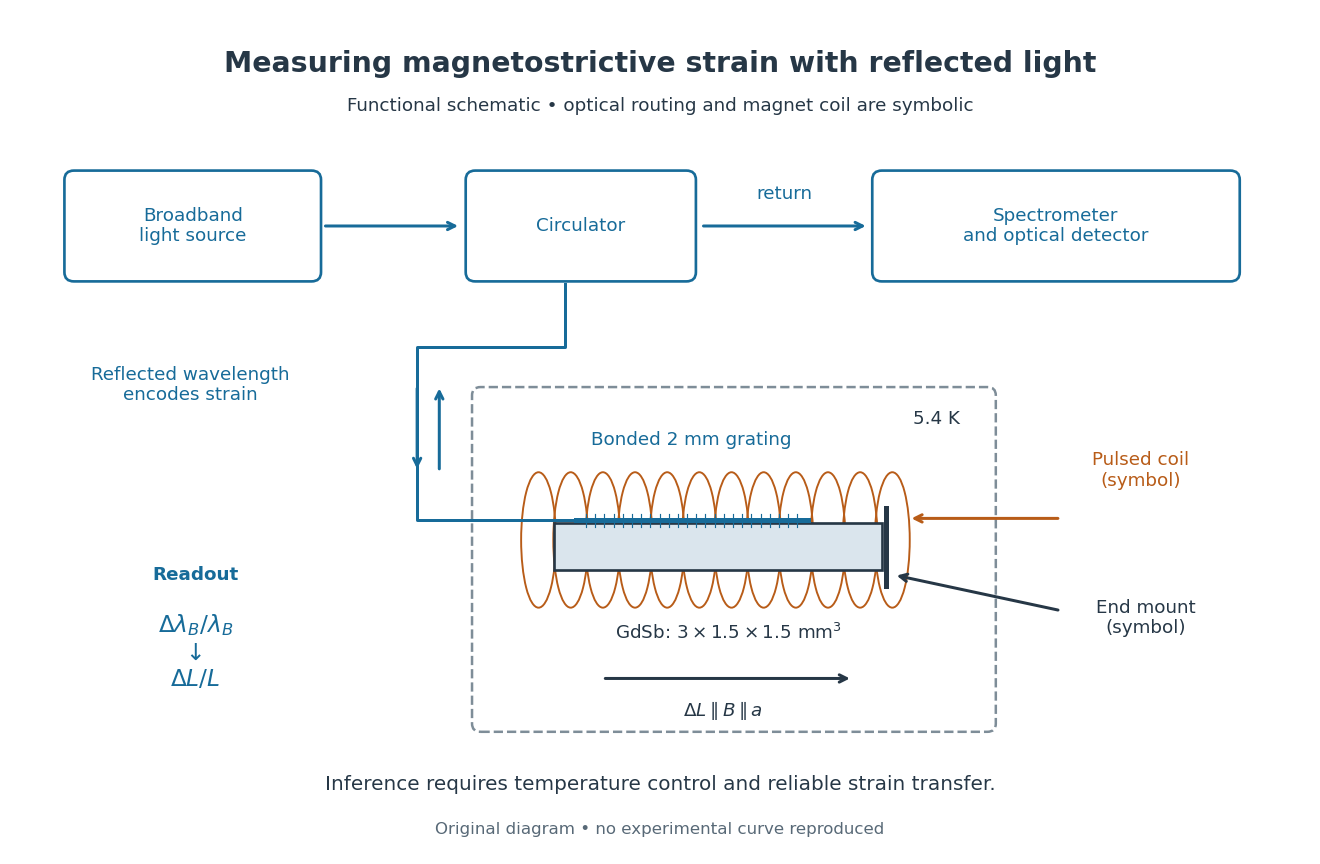
Functional optical chain for measuring magnetostrictive strain
. Original schematic of the bonded-sensor experiment. The magnet coil and optical routing are functional symbols, not a reconstruction of winding geometry or instrument placement.[ref]High resolution magnetostriction measurements in pulsed magnetic fields using Fibre Bragg Gratings by Ramzy Daou and others. PDF Fig. 1 and methods
Details.The distinction between readout and inference is essential. The fibre Bragg grating senses a change of reflected wavelength; interpreting this as the specimen's strain requires good strain transfer and a controlled temperature. A useful independent control would compare a bonded sensor with a nearby unloaded sensor through the same pulse. Another would vary bond stiffness or specimen cross-section to test loading. These are proposed checks, not additional procedures claimed for the experiment above. The pulsed magnet's winding details were not specified in the inspected account.
This experiment measures one longitudinal component of strain. Establishing the first-order volume change would require three orthogonal normal components under the same conditions. GdSb also has its own antiferromagnetism and field-dependent magnetic structure: this measured curve does not establish the simple saturated isotropic law. Its role here is to make the measurement chain and its limitations concrete.
As an original stipulated low-field model, take the axial magnetic field intensity in and prescribeAll strain components are dimensionless, and their trace vanishes. This is an even, quasistatic, unsaturated toy law with a fixed measuring axis. It is distinct from the fixed-magnitude directional model in saturated isotropic magnetostrictive strain. In particular, one must not replace local unit magnetization by normalized net magnetization in a many-domain specimen and assume this law follows.
For , , and , a trigonometric identity givesThe axial strain ranges from zero to , with mean and a component of amplitude . The cosine coefficient is negative with the chosen time origin. For the length ranges from zero to relative to . There is no term in this unbiased model.
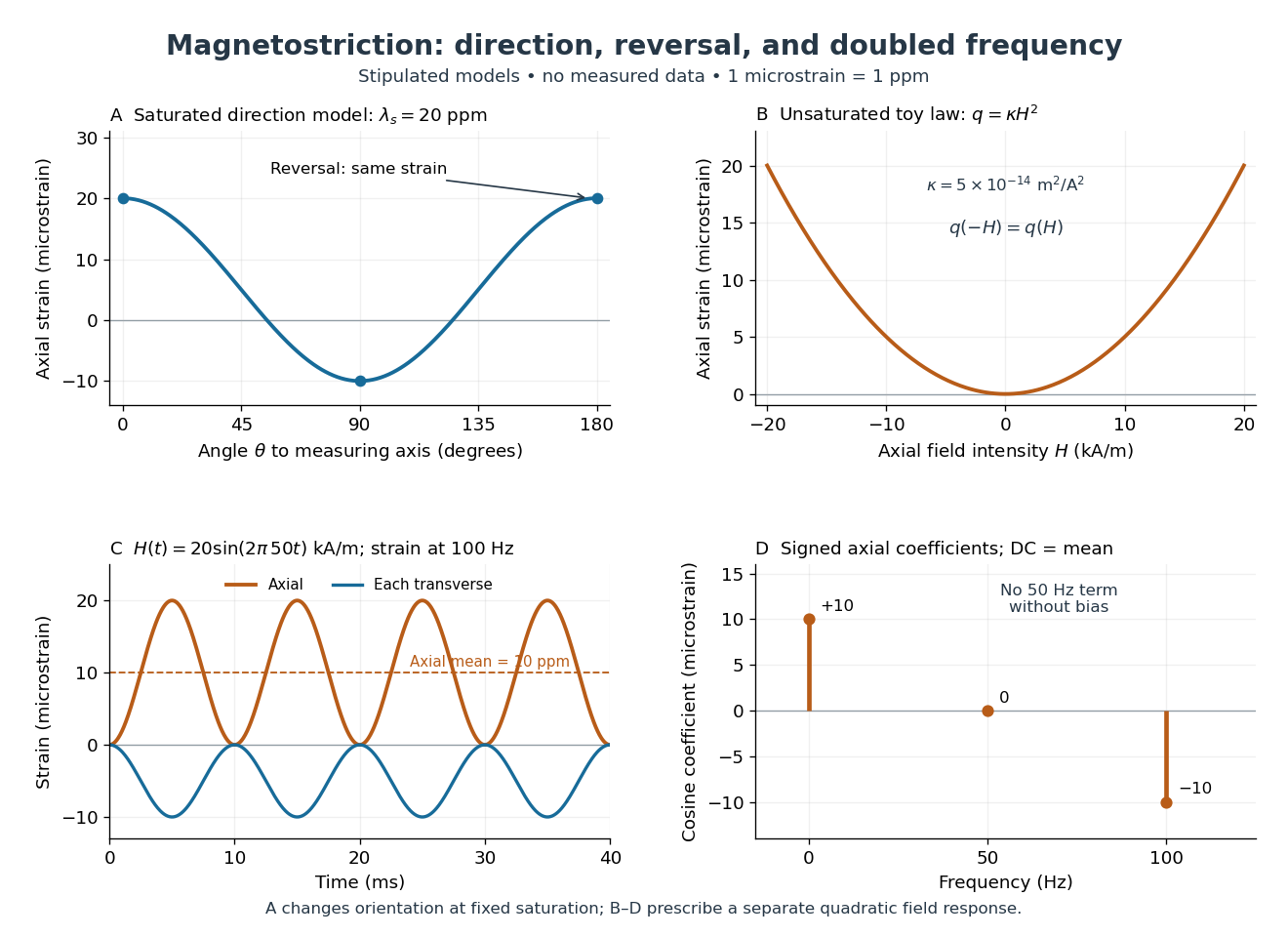
Stipulated angular, reversal, and frequency responses of magnetostrictive strain
. Original calculations, not experimental data: the angular panel uses a saturated isotropic model with positive saturation magnetostriction; the other panels use a separately stipulated quadratic field law. Microstrain denotes a relative length change of one part per million. Details.A static bias changes the conclusion. Expanding produces a fundamental-frequency term as well as the doubled-frequency term. This is an incremental linear response about a state with a chosen magnetic axis; it does not contradict isotropic linear magnetostriction vanishes at an unbiased isotropic reference. Real hysteresis, thermal expansion from Joule heating, and mechanical resonance can add further components or change their phases. Frequency alone cannot identify the cause of motion: Joule heating also contains an even-in-electric current contribution.
An eigenstrain is the deformation a material would prefer locally without applied stress. In a one-dimensional linear elasticity model, let be Young's modulus, take tension as positive stress, and write . A free rod has and follows . A perfectly blocked rod has and . Thus positive preferred elongation produces compressive stress when blocked.
For stipulated , cross-sectional area , and , blocking gives and axial force . This idealization ignores changes of magnetization caused by the load itself. A real magnetostrictive actuator therefore needs both magnetic and mechanical constitutive information: a free-length measurement alone does not determine its loaded motion.
Articles by others on the same topic



Magnetostriction is a phenomenon in which a material changes its shape or dimensions in response to an applied magnetic field. This effect occurs in ferromagnetic and ferrimagnetic materials, where the arrangement of magnetic moments (magnetization) affects the lattice structure of the material. Essentially, as the magnetic domains within the material align in the presence of a magnetic field, the resulting changes in magnetization can lead to a mechanical strain.