
Boris J. P. Kaus Created 2026-10-25 Updated 2026-11-05
Boris J. P. Kaus coauthored three-dimensional models testing how transform fault stresses affect adjacent detachment fault formation, beyond a simple weak-boundary explanation.[ref]
How transform fault shear influences where detachment faults form near mid-ocean ridges by Jana C. Schierjott and others. Abstract: three-dimensional models and the stress mechanism for inside-corner detachment faulting
Garrett Ito Created 2026-10-25 Updated 2026-11-05
Garrett Ito coauthored a study of how magmatism and transform fault stresses influence the asymmetric formation of detachment faults near slow-spreading ridges.[ref]
How transform fault shear influences where detachment faults form near mid-ocean ridges by Jana C. Schierjott and others. Abstract: three-dimensional models and the stress mechanism for inside-corner detachment faulting
Jana C. Schierjott Created 2026-10-25 Updated 2026-11-05
Jana C. Schierjott coauthored three-dimensional ridge-transform models that favour excess lithospheric tension from transform fault shear as an explanation of asymmetric detachment fault formation.[ref]
How transform fault shear influences where detachment faults form near mid-ocean ridges by Jana C. Schierjott and others. Abstract: three-dimensional models and the stress mechanism for inside-corner detachment faulting
Javier Escartín Created 2026-10-25 Updated 2026-11-05
Javier Escartín coauthored a study linking detachment faults near ridge-transform junctions to shear stress and the resulting tension in adjacent lithosphere.[ref]
How transform fault shear influences where detachment faults form near mid-ocean ridges by Jana C. Schierjott and others. Abstract: three-dimensional models and the stress mechanism for inside-corner detachment faulting
Mark D. Behn Created 2026-10-25 Updated 2026-11-05
Mark D. Behn coauthored models coupling magmatic accommodation of seafloor spreading with faulting, testing how transform-generated stresses favour long-lived detachment faults.[ref]
How transform fault shear influences where detachment faults form near mid-ocean ridges by Jana C. Schierjott and others. Abstract: three-dimensional models and the stress mechanism for inside-corner detachment faulting
A lies on the continuation of the offset outside the two ridge tips: it is the fracture zone, whose two sides are carried in the same overall plate direction. A bathymetric step can remain because the two sides have different ages and thermal histories, without continuing plate-boundary strike-slip faulting.
B is the black segment connecting the two white spreading ridges. Construct the plate motion from divergence away from those ridge axes. Between their tips, the upper side of B belongs to the plate west of the right-hand ridge and moves approximately west-northwest; the lower side belongs to the plate east of the left-hand ridge and moves approximately east-southeast. Looking across B from either side, the opposite side moves to the observer's left. B is therefore a left-lateral strike-slip faulting on a transform fault. The offset preserved outside the active segment must not be read as the sense of present slip.
The grey arrows in the source image are pointers to detachment faults, not plate-motion vectors. The original publication identifies white lines as spreading ridges, black lines as transform faults, and arrows as pointers to detachments. Its Figure 1b is the unlettered source of the exam's Figure 3.[ref]
C lies on the white spreading ridge extending down from the left-hand ridge-transform intersection. Relative motion there is extensional, so its tectonic faults have normal slip. Dike intrusion also accommodates extension at a spreading ridge; “normal slip” is the appropriate category among the four offered, not a claim that all spreading is achieved by a single normal fault.
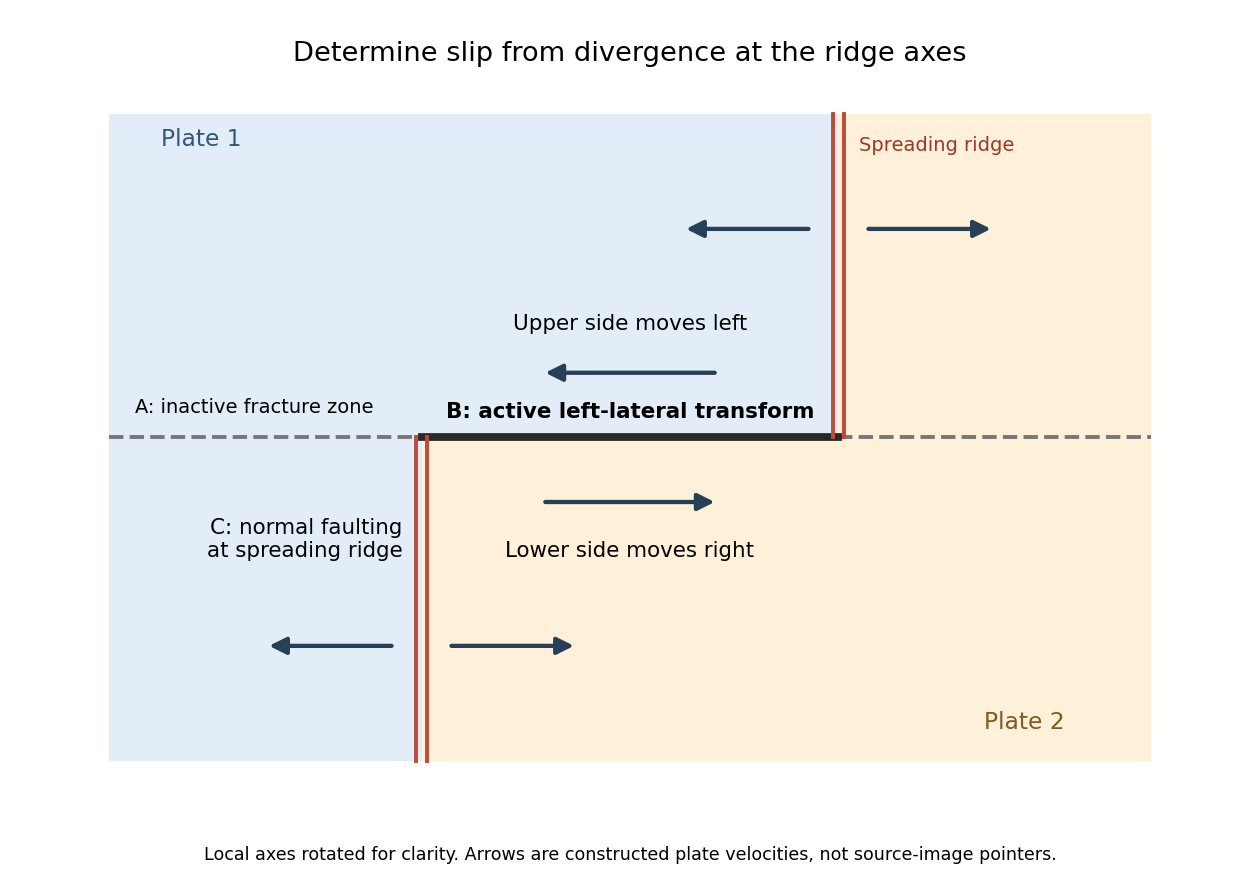
Why the active transform in the supplied geometry is left lateral
. Original idealized plan-view construction using the supplied ridge arrangement and relative motion directions. It illustrates the kinematic test, rather than reproducing the exam bathymetry. Details.
Thomas Morrow Created 2026-10-25 Updated 2026-11-05
Thomas Morrow coauthored a comparison of ridge-transform geometry with models of detachment fault formation, investigating why the faults favour one side of a junction.[ref]
How transform fault shear influences where detachment faults form near mid-ocean ridges by Jana C. Schierjott and others. Abstract: three-dimensional models and the stress mechanism for inside-corner detachment faulting
Xiaochuan Tian Created 2026-10-25 Updated 2026-11-05
Xiaochuan Tian coauthored numerical experiments separating the effects of boundary friction and transform-generated tension on the formation of detachment faults near spreading ridges.[ref]
How transform fault shear influences where detachment faults form near mid-ocean ridges by Jana C. Schierjott and others. Abstract: three-dimensional models and the stress mechanism for inside-corner detachment faulting