An internal direct product finds independent coordinates already present inside a group. Let be normal subgroups of withThen the multiplication mapis a group isomorphism. Thus every element of has a unique factorization into one element of each subgroup. Conversely, the embedded factors and inside an external direct product of groups satisfy these conditions.
For a concrete example, take the additive cyclic group and its subgroups and . They are normal subgroups because is an abelian group. Their intersection is , and the sums give every residue class exactly once. For instance, . The table makes the unique decomposition visible.
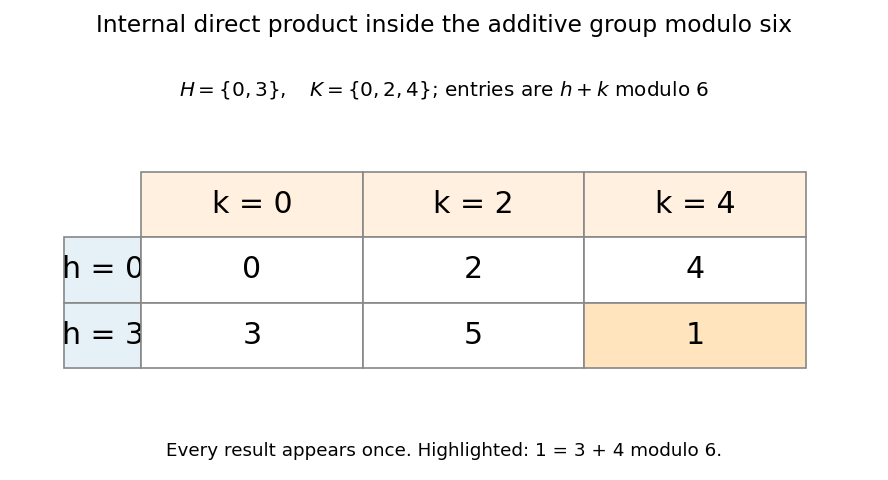

The proof explains each hypothesis. Normality puts the group commutator in both and , so it is the identity element. Therefore the factors commute, and preserves the group operation. The condition makes it surjective. If , then belongs to the intersection, forcing both to be the identity element; thus its group kernel is trivial and it is injective.
Normality cannot simply be omitted. In the symmetric group , take and . Their intersection is trivial and , but is not a normal subgroup. With permutations composed right to left, while , so the factors do not commute. The setwise decomposition is unique, but its multiplication map is not a group homomorphism from . An independent-coordinate interpretation requires the group operations to agree, not merely a bijection of the underlying sets.
Articles by others on the same topic
There are currently no matching articles.