In interrupt-driven input-output, a device signals an interrupt when attention is needed, letting the CPU avoid repeatedly checking an idle device. The interrupt handler determines what happened and arranges the required work; notification itself does not move the payload. DMA can supply that separate data-transfer mechanism.
For a toy comparison, let events occur at times . Ideal interrupt notification happens at those same times, while polled input-output at detects them at . The polling delays are ; ideal notification delays are all zero. Events are assumed to remain pending, with a simultaneous event visible to a poll. The chart is a model, not a measurement: it excludes interrupt delivery and dispatch latency, interrupt handler service time, and polling overhead. Its zero-delay row is not a real-hardware guarantee.
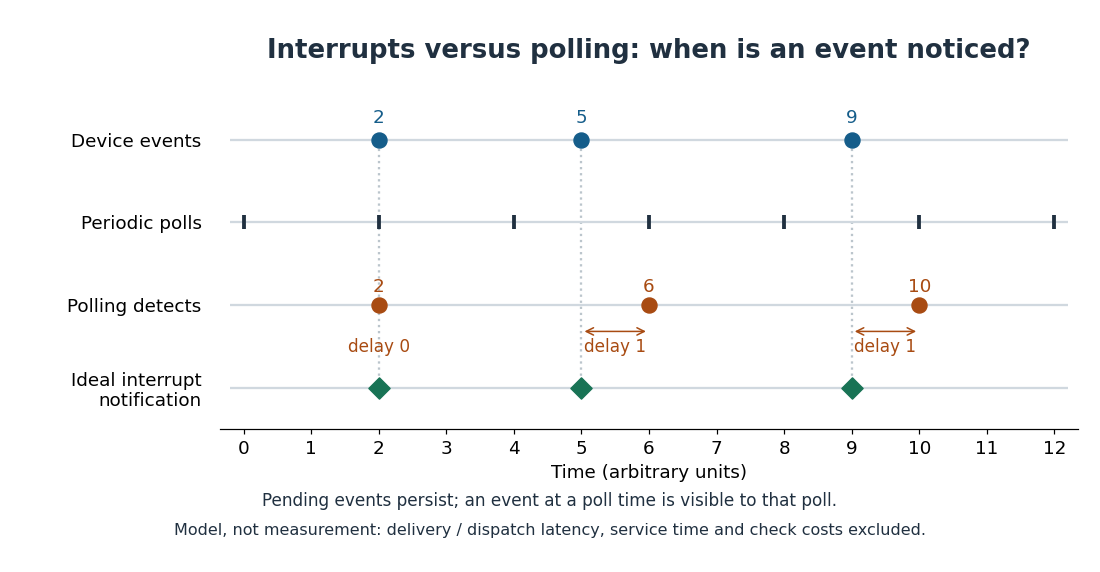

The useful idea is to spend attention when something changes. Sparse events can leave long stretches for useful CPU work instead of busy checks. At high event rates, repeated entry and service overhead can consume that saving. Batching notifications can reduce their frequency while delaying some events; switching to polled input-output during active periods is another option. No strategy is universally faster. [ref]
https://pages.cs.wisc.edu/~remzi/OSTEP/file-devices.pdf. Arpaci-Dusseau and Arpaci-Dusseau, OSTEP chapter 36, section 36.4: interrupt costs and coalescing
The Linux kernel's NAPI mechanism is a concrete combination: an interrupt normally schedules event processing, which polls for work with a receive budget. Further interrupts remain masked during that polling, and are enabled again when polling finishes. NAPI also supports busy polling; the exact processing context and configuration vary. This is a documented Linux kernel design, not a requirement on every operating system. [ref]
https://docs.kernel.org/networking/napi.html. Linux kernel documentation, NAPI: basic operation, datapath API, scheduling and IRQ masking
Articles by others on the same topic
There are currently no matching articles.