An isosbestic point is a wavelength, wavenumber or frequency at which a sample's total absorbance remains unchanged during a specified chemical or physical transformation. It is a property of the observed spectra and transformation, rather than proof of a particular reaction mechanism.[ref]
IUPAC Compendium of Chemical Terminology, fifth edition (Gold Book) by International Union of Pure and Applied Chemistry. isosbestic point, I03310, definition and stoichiometric qualifications
For a simple conversion between two species and , assume additive Beer-Lambert law response, fixed optical path length and constant total concentration . ThenAt a wavelength where ,independent of the conversion fraction. For example, stipulated values , and give constant absorbance .
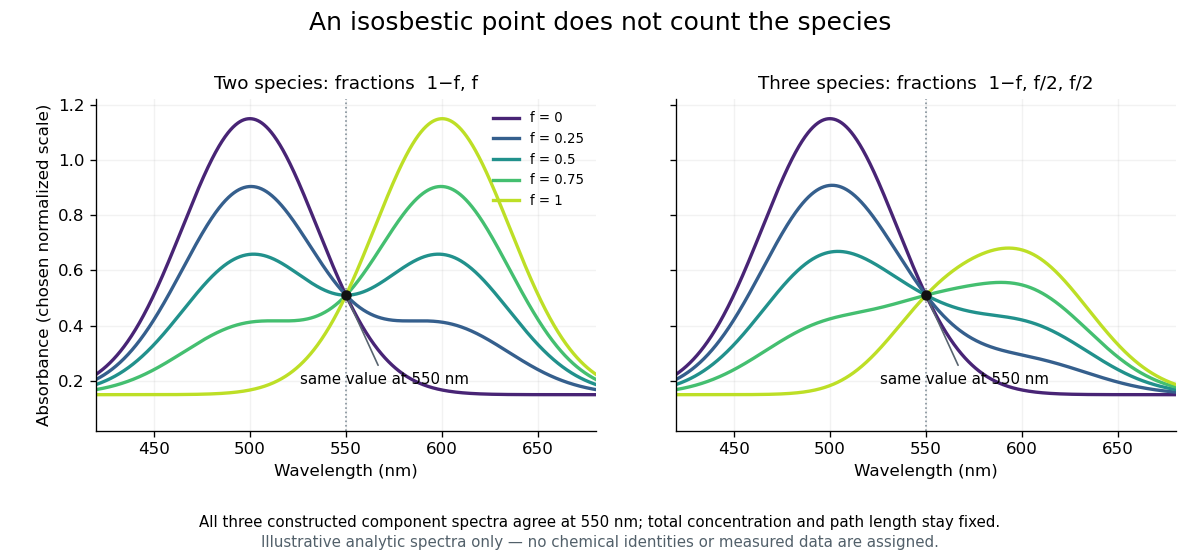
An isosbestic point does not establish that exactly two species exist. Three species could all have the same absorption coefficient at ; every mixture with the same total concentration would then give the same absorbance there. More generally, constant stoichiometric combinations of coefficients can produce an invariant signal. Conversely, dilution, changing path length, background absorption or changing spectra can remove a crossing without demonstrating a new reaction intermediate.
In an experimental test, record multiple full spectra while controlling total concentration, path length and background. Inspect the stability of the common intersection relative to measurement uncertainty, rather than selecting one pair of curves that happens to cross. The invariant wavelength alone cannot determine composition in the two-species model: its response has deliberately lost sensitivity to the conversion fraction. Measurements away from that wavelength carry the separating information, a distinction also useful in co-oximetry.
Articles by others on the same topic


An isosbestic point is a specific wavelength in a spectroscopic measurement where the absorbance (or transmittance) of the light remains constant, regardless of the concentration of the absorbing species involved in a chemical equilibrium. This phenomenon often occurs in systems where two or more species are interconverting, such as in acid-base reactions, conformational changes, or the binding of ligands to a receptor. In a typical situation involving a chemical equilibrium between two forms (e.g.