
At chemical equilibrium, a reversible chemical reaction has equal forward and reverse reaction rates, so its macroscopic composition stays constant. Individual molecules can keep changing identity: the reaction has not stopped. This dynamic balance is the definition described by the [ref]. Equal reaction rates also need not mean equal concentrations. A small population converting rapidly can balance a large population converting slowly.
This distinction gives two useful questions. Which composition is favored at the specified temperature and other constraints? Thermodynamics answers through chemical potentials and an equilibrium constant. How quickly does a prepared mixture approach that composition? Chemical kinetics answers through reaction rates. Knowing the destination does not determine the journey's duration. A composition that barely changes during observation may reflect extremely slow chemical kinetics, so constancy alone does not establish chemical equilibrium.
Consider the idealized elementary chemical reactionAssume a well-mixed closed system at fixed temperature and volume, with first-order law of mass action rates in both directions and no competing chemical reactions. Write and for concentrations in . The total is conserved because each conversion replaces one molecule by one molecule. This conservation is special to the chosen stoichiometry.
The forward and reverse reaction rates, measured as conversions per unit volume per unit time, are and . HenceSetting this derivative to zero givesWith and , solving the ordinary differential equation yieldsAt , these are approximately and . Initially and . At chemical equilibrium, both are , while the net reaction rate is zero. The persistent exchange is visible in the lower panel even after the upper panel has nearly flattened.
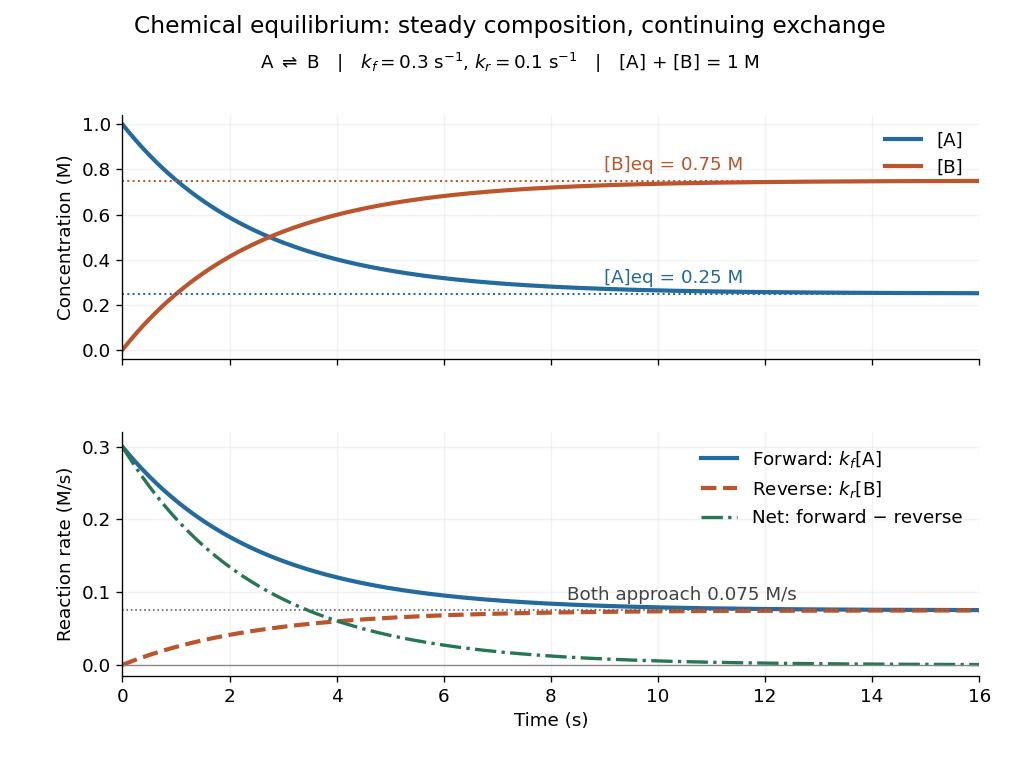
Constant equilibrium composition with continuing molecular conversion
. The idealized chemical reaction starts entirely in A. Upper panel: concentrations. Lower panel: forward, reverse and net reaction rates. The equilibrium rates coincide at a positive value. Details.Why does chemical equilibrium also involve a free energy minimum? For a closed system at fixed temperature and pressure, without imposed non-expansion work, stable equilibrium minimizes Gibbs free energy over compositions allowed by conserved elemental inventories. See W. C. Carter, MIT thermodynamics notes, sections 2-1.14 and 2-1.19. This is constrained Gibbs minimization for chemical equilibrium: freely minimizing over unrelated species amounts would change the inventory. At fixed temperature and volume, the appropriate potential is Helmholtz free energy. In either setting, varying an allowed extent of reaction gives the corresponding free energy slope , with molar chemical potentials and signed stoichiometric vector entries. An interior equilibrium has zero slope; stability requires a minimum. For A converting to B, this says .
The beauty of this connection is that molecular exchange, a macroscopic composition, and a geometric minimum describe the same balance. In the ideal concentration model, let and choose the standard molar chemical potential difference consistent with . Up to a composition-independent constant, the fixed-volume Helmholtz free energy then obeyswhere is the conserved total amount of substance and the molar gas constant. Its derivative is , vanishing at . Its second derivative is inside , so this balance is the unique minimum. The mixing entropy terms explain why the favored composition still contains A.

Chemical equilibrium is a state in a reversible chemical reaction where the rates of the forward and reverse reactions are equal, resulting in no net change in the concentrations of the reactants and products over time. At this point, the concentrations of all species remain constant, although they are not necessarily equal. Key characteristics of chemical equilibrium include: 1. **Dynamic Condition**: Even though the concentrations of reactants and products remain constant, the reactions are still occurring.


New to topics? Read the docs here!