In a local exponential chart, the mixed second differential of the group commutator defines a bilinear map on the tangent space at the identity. Inversion after swapping the two group elements proves antisymmetry. Differentiating conjugation gives ; applying naturality of the Lie bracket to the Adjoint representation of a Lie group then proves the Jacobi identity. For a matrix group this recovers by expanding through the mixed term.
Use the cross-product Lie algebra convention , , , so . Put and , using the matrix exponential. The finite group commutator isHere and big O notation refers to any fixed matrix norm. Active rotation matrices act on column vectors from right to left: first rotate about by , then about by , then about by , and finally about by . Swapping and replaces the product by its inverse and changes the leading Lie bracket to .
Writing and , direct matrix multiplication givesFor radians, , whereas . Thus the residual is a positive rotation about to leading order; at finite it also has smaller components. The Lie bracket captures the leading effect of the four moves rather than their entire finite motion. See Etingof, Section 7.2, Proposition 7.11.
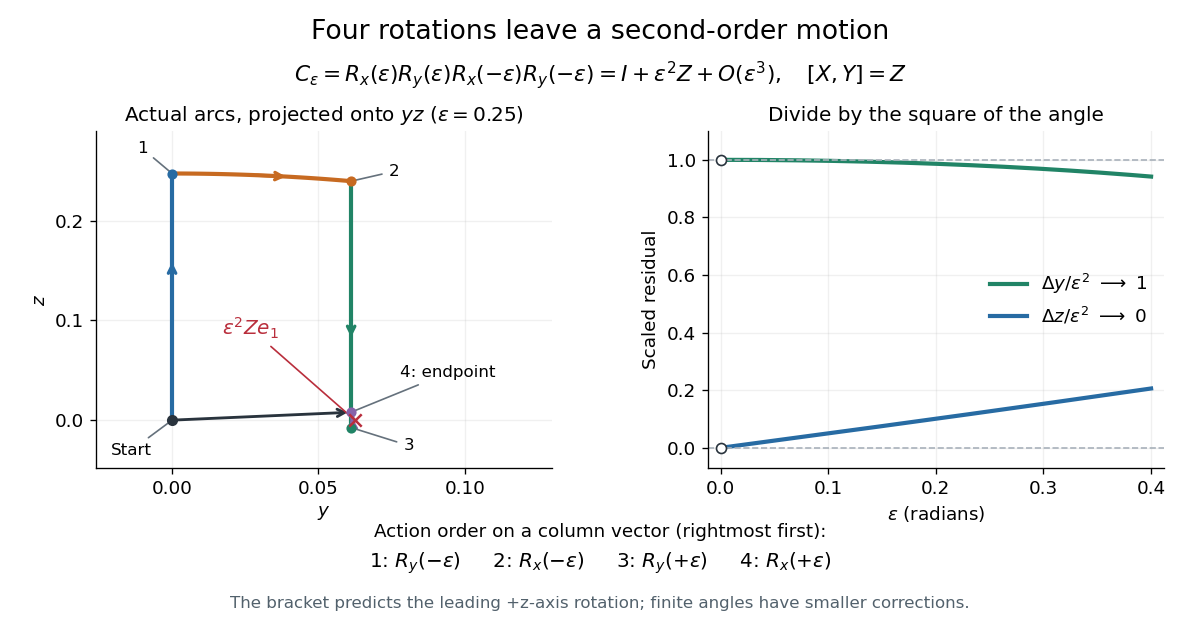

The left panel projects the actual four arcs onto the -plane for ; the start and endpoint are close but distinct. The right panel divides the residual coordinates by , making the limit visible. This is a numerical picture of in the SO(3) Lie algebra.
Articles by others on the same topic
There are currently no matching articles.