The Lie bracket is the product in a Lie algebra: a bilinear map with an Alternating Lie bracket and the Jacobi identity. Bilinearity means, for ,Unlike matrix multiplication, a Lie bracket need not satisfy associativity. In the sl2 matrix commutator example, but . The replacement compatibility law is the Jacobi identity, which makes bracketing with a fixed element a derivation of a Lie algebra.
For Matrix Lie groups, the Lie bracket is the matrix commutator on their tangent space. For the cross-product Lie algebra, it is . Both products measure a failure of infinitesimal motions to commute. In a real Lie group, a zero Lie bracket means that the two corresponding one-parameter subgroups commute for all real parameters.
A Lie bracket is alternating when for every . This condition is imposed in every characteristic of a field. Bilinearity gives , hence antisymmetry of a Lie bracket. Requiring alternation directly keeps the definition correct in characteristic two.
The relation for a bilinear map proposed as a Lie bracket. An Alternating Lie bracket always satisfies it. Conversely, setting gives , so antisymmetry implies alternation over a field of characteristic different from two.
In characteristic two, the sign disappears and this relation just says . It does not force , even when the Jacobi identity holds. For example, on a two-dimensional vector space with basis , set and every other basis bracket to zero, then extend bilinearly. Every nested bracket vanishes, so the Jacobi identity holds, and the product is symmetric. Nevertheless it is not a Lie algebra, because .
In a local exponential chart, the mixed second differential of the group commutator defines a bilinear map on the tangent space at the identity. Inversion after swapping the two group elements proves antisymmetry. Differentiating conjugation gives ; applying naturality of the Lie bracket to the Adjoint representation of a Lie group then proves the Jacobi identity. For a matrix group this recovers by expanding through the mixed term.
Use the cross-product Lie algebra convention , , , so . Put and , using the matrix exponential. The finite group commutator isHere and big O notation refers to any fixed matrix norm. Active rotation matrices act on column vectors from right to left: first rotate about by , then about by , then about by , and finally about by . Swapping and replaces the product by its inverse and changes the leading Lie bracket to .
Writing and , direct matrix multiplication givesFor radians, , whereas . Thus the residual is a positive rotation about to leading order; at finite it also has smaller components. The Lie bracket captures the leading effect of the four moves rather than their entire finite motion. See Etingof, Section 7.2, Proposition 7.11.
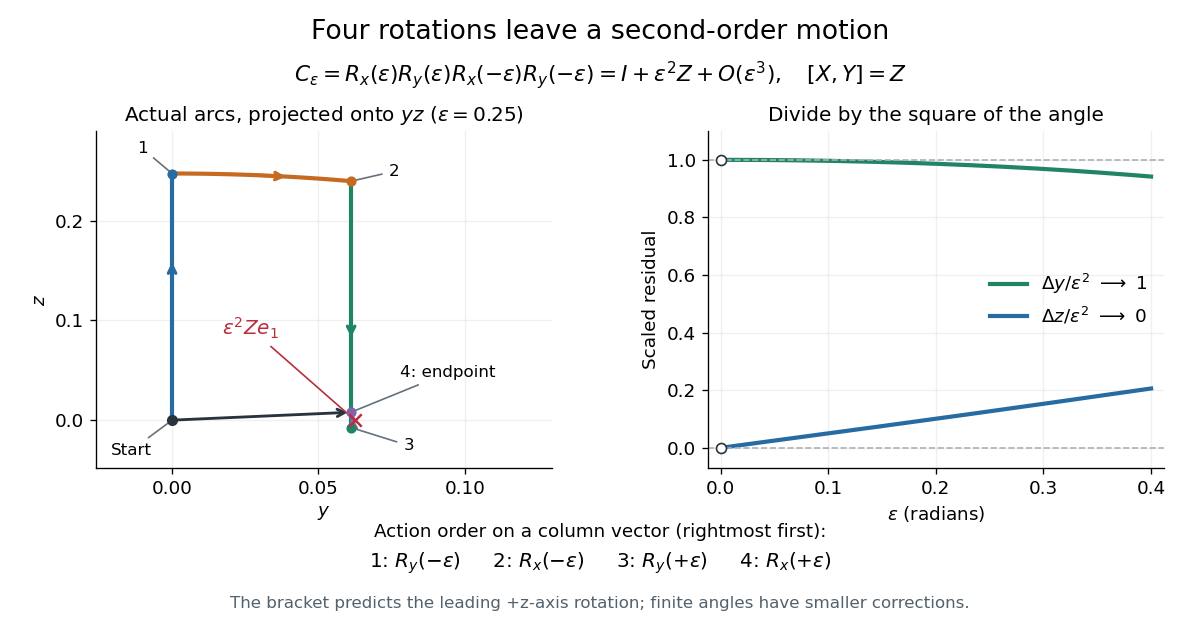
The left panel projects the actual four arcs onto the -plane for ; the start and endpoint are close but distinct. The right panel divides the residual coordinates by , making the limit visible. This is a numerical picture of in the SO(3) Lie algebra.
The commutator of two elements of an associative algebra over a field isIt measures how much the order of multiplication matters: exactly when . It is a bilinear map, it is alternating since , and associativity makes it satisfy the Jacobi identity. Hence every associative algebra becomes a Lie algebra on the same vector space when equipped with this product. This holds in every characteristic of a field.
For square matrices, this is the matrix commutator, and it is defined even for singular matrices. The group commutator of invertible matrices is instead : it equals the identity element when the matrices commute, whereas equals the zero matrix. The Lie bracket from local group commutators explains how differentiation connects the two constructions.
Over a field , the trace-zero matrices form the special linear Lie algebra . The matrix trace of a commutator is zero, so this is a Lie subalgebra of the general linear Lie algebra. A basis isIn fact , uniquely. The individual products areSubtracting in the stated order givesFor characteristic different from two, this is the standard sl2 triple; see Etingof, Section 11.4. The products remain valid in characteristic two, but there is central and , so the familiar characteristic zero structure changes.
The following table gives all nine basis brackets. Each entry is ; the diagonal vanishes by alternation, and exchanging row and column reverses the sign.
Bilinearity now computes any commutator, for exampleThe three structure constants of a Lie algebra relations encode all of this multiplication. They also show why the sl2 triple is useful in Lie algebra representations: the actions of and move between eigenvalues of the action of in steps of two.
For real-linear operators and a nonzero vector with , induction gives , hence the displayed formula. Applying to a nontrivial finite dependence with highest term leaves , a contradiction. Thus are linearly independent, and their span is invariant under both operators. Characteristic zero is essential to the factorial argument.
For bounded linear operators, or formally in an associative algebra,Differentiate the two exponentials using the product rule: the result is . Induction gives the th derivative , and the Taylor series at zero proves the formula. For bounded operators convergence follows from . For unbounded quantum operators, use a common invariant domain and justify the series there, or use the finite-dimensional system of commutators when their span closes.
For finite-dimensional complex linear operators with commuting with both and , differentiating gives the constant derivative . Hence , and conjugating the matrix exponential gives . Since , multiplication by proves the identity. The commutator order determines the minus sign.
The matrix trace of is zero, since . This obstructs a matrix with nonzero trace from being a single commutator.
Expand both sides using the definition of a commutator: the middle terms cancel, leaving . Thus commutation with a fixed operator is a derivation of an algebra. In particular, , which gives a short way to derive a Lie algebra representation from generator actions on an underlying algebra.
The Jacobi identity is the compatibility condition on a Lie bracketTogether with an Alternating Lie bracket, it defines a Lie algebra. Unlike associativity, it relates three cyclic bracketings rather than equating two bracketings. Equivalently, using antisymmetry of a Lie bracket,Thus the linear map is a derivation of a Lie algebra: acting on a bracket is the sum of acting on each argument. This makes infinitesimal symmetries act consistently on each other's products. It also gives , the identity that makes the Adjoint representation of a Lie algebra a Lie algebra representation.
For the commutator in an associative algebra, the cancellation is directly visible:Each word occurs once with each sign. This proves the Jacobi identity without a restriction on the characteristic of a field.
For a computed check in the sl2 matrix commutator example,Here the last two terms are individually nonzero over characteristic zero; the identity records their cancellation. In the cross-product Lie algebra, the same cyclic cancellation is the vector triple product identity.
The historical connection is unusually concrete: Lie and Engel's volume I expands nested commutators of differential operators into twelve terms and cancels them cyclically, in Chapter 5, §26, equation (7). See Lie and Engel, §26, in Merker's translation, pp. 105–106.

