A Lie algebra over a field is a vector space with a bilinear map , called the Lie bracket, that is alternating and satisfies the Jacobi identity. Explicitly, for all ,This definition applies in every characteristic of a field, including characteristic two; the distinction between an Alternating Lie bracket and antisymmetry of a Lie bracket matters there. See Pavel Etingof, Lie Groups and Lie Algebras, Definition 8.4 and Remark 8.5.
The motivating question is how to describe very small symmetries. For a real Matrix Lie group , the Lie algebra of a matrix Lie group is its tangent space at the identity element. An element specifies the initial velocity of the one-parameter subgroup , using the matrix exponential. The Lie bracket records the first nonzero effect of changing the order of two small transformations. Even when first-order motions cancel, a second-order motion can remain: the small rotation commutator below leaves a rotation about a third axis.
This turns local symmetry questions into computations with linear maps. A basis and its structure constants of a Lie algebra determine every Lie bracket by bilinearity. For example, three matrices suffice for the sl2 matrix commutator example, while the familiar cross product describes the SO(3) Lie algebra. These descriptions help calculate rotations in three dimensions and build Lie algebra representations; the same bracket structure underlies angular momentum commutation relations. The striking feature is that a nonlinear family of motions has a local description by a vector space and one product. Global information still needs care: the Lie algebra alone does not distinguish the circle group from the additive real line.
Historically, the connection with differential equations is visible in Sophus Lie's Theorie der Transformationsgruppen, volume I (1888), prepared with Friedrich Engel. Chapter 6 interprets first-order differential operators as infinitesimal transformations, linking their action on functions to the transformations those functions admit. See Lie and Engel, Chapter 6, §27, in Joël Merker's English translation; the original volume is available at the [ref]
https://gdz.sub.uni-goettingen.de/id/PPN585383391. Göttingen digitization
.For a finite-dimensional Lie algebra over a field of characteristic zero, Cartan's criterion characterizes a solvable Lie algebra by vanishing of its Killing form on , and a semisimple Lie algebra by nondegeneracy of that form. The Cartan solvability criterion and Cartan criterion for semisimplicity state the two distinct tests.
The algebraic loop algebra of a Lie algebra over a field consists of finite Laurent polynomials with coefficients in . Its Lie bracket is , extended bilinearly. Alternation and the Jacobi identity follow from those of , since the Laurent polynomial ring is commutative. Appropriate smooth or formal completions give other loop-algebra variants; the affine current algebra adds a central extension to these Fourier modes. For the affine extension, see Kac and Wakimoto, Section 0.2.
The affine current algebra is the one-dimensional central extension of the loop algebra of a finite-dimensional Lie algebra, with central element acting as the level . A restricted module has for all sufficiently large for each vector ; this makes the Sugawara construction finite on each vector after normal ordering. In a compact unitary positive-energy representation, the nontrivial integrable levels are positive integers in the standard basic normalization.
The Lie algebra over a commutative ring generated by a set subject only to bilinearity, alternation and the Jacobi identity. Every map from to the underlying set of an -Lie algebra extends uniquely to a Lie algebra homomorphism. It can be constructed from bracketed words by quotienting by those identities; elements are represented by Lie polynomials.
A finite linear combination of iterated Lie brackets in formal variables. It evaluates naturally in every Lie algebra, and every Lie algebra homomorphism preserves its evaluation. The homogeneous terms of the Baker--Campbell--Hausdorff formula are rational Lie polynomials; this permits the group law to be reconstructed from the bracket wherever the series converges.
If is a Lie algebra homomorphism into the derivations of a Lie algebra, the semidirect product has underlying vector space and bracket . The homomorphism and derivation identities ensure the Jacobi identity. The first factor is an ideal; the second is a subalgebra whose action records the twisting. The diamond Lie algebra arises by letting a one-dimensional algebra act on a Heisenberg Lie algebra.
// Target: linear-algebra.bigb
The Chevalley-Eilenberg complex consists of alternating maps from to a Lie algebra representation , with differential built from the bracket and module action. For trivial real coefficients, a two-cocycle is an alternating bilinear form satisfying . Coboundaries have the form , up to the differential's sign convention. Their quotient is and classifies central extensions of a Lie algebra.
For trivial real coefficients, a Lie algebra two-cocycle is an alternating bilinear form satisfying . Adding a form does not change its Lie algebra cohomology class. The bracket defines a central extension of a Lie algebra by precisely when this cocycle identity holds. The constant discrepancy in a moment-map equivariance obstruction is such a cocycle.
A real Lie algebra is compact when it is the Lie algebra of some compact Lie group. Equivalently, it has a positive-definite invariant bilinear form on a Lie algebra. It is a direct sum of an abelian center and a compact semisimple Lie algebra. For its semisimple part, the compactness criterion from the Killing form is negative-definiteness of the Killing form. This definition concerns the algebra; a global group with that algebra can still have a noncompact central covering direction.
A Lie algebra over the p-adic integers whose underlying module is free of finite rank and whose Lie bracket satisfies , where for odd and for . Finite freeness is part of this convention: merely requiring a small Lie bracket on a torsion module would not correspond to uniform pro-p groups.
On the set underlying a uniform pro-p group, define scalar multiplication by , and define addition and the Lie bracket byRoots are the unique roots in the appropriate power layers. The limits give a powerful Lie lattice. In a suitable complete normed group algebra, the p-adic logarithm identifies these operations with ordinary addition and the associative-algebra commutator.
The Baker--Campbell--Hausdorff formula converges integrally on a powerful Lie lattice. A degree- Lie term has bracket divisibility ; the standard integral coefficient bound loses at most powers of . The remaining valuation tends to infinity. Associativity follows from the formal exponential identity, the identity is zero, the inverse is , and . The resulting pro-p group is a uniform pro-p group, with power subgroups .
The vector space with the cross product as Lie bracket, . Bilinearity and give an Alternating Lie bracket; the vector triple product identity proves the Jacobi identity because the three expressions cancel cyclically, using the symmetric dot product.
Its relation to the SO(3) Lie algebra is explicit. For a vector , define the skew-symmetric matrixThen : acting on , the left side is . Every real skew-symmetric matrix occurs uniquely, so this hat map is a Lie algebra isomorphism. With the standard basis vectors ,and their matrix commutators are , , . With active rotation matrices acting on column vectors, rotates through angle about the oriented axis when . In particular , fixing the positive-angle convention used in the small rotation commutator.
The map is also a Lie algebra isomorphism to the compact real SU(2) Lie algebra, using the Pauli matrix commutator identity. These two identifications concern Lie algebras; they do not identify the corresponding Lie groups globally.
The real Lie algebra is a semidirect product of planar translations with infinitesimal rotations. One orientation convention is , , . Its translation space is a two-dimensional abelian ideal of a Lie algebra.
In the ordered basis of the Euclidean motion Lie algebra in two dimensions, the Killing form has matrix . Its radical is the translation ideal, and the algebra is solvable rather than semisimple.
A graded Lie algebra has a graded Lie bracket preserving total degree, with and for homogeneous vectors in the indicated degrees. A Gerstenhaber algebra uses this sign rule after shifting degrees by one.
For a positively graded Lie algebra over , finite-dimensional in each degree, its cochain algebra is free graded commutative on the graded dual of , with differential dual to the Lie bracket and its Koszul signs. The Jacobi identity gives . A Lie element of degree contributes a cochain generator of degree . Its cohomology computes with total grading; the standard free enveloping-algebra resolution gives this identification. For a free graded Lie algebra, the tensor-algebra augmentation has a length-one free resolution, explaining the square-zero cohomology of a rational wedge sum of spheres.
For a positively graded vector space , the free graded Lie algebra receives a linear map from and extends every graded linear map uniquely to a Lie homomorphism. Over , it is the Lie subalgebra generated by inside the tensor algebra , using . Its universal enveloping algebra is : both have the same universal property for maps from into associative algebras. The primitives of the tensor Hopf algebra with primitive generators are exactly .
The bracket on a graded Lie algebra is a bilinear operation satisfying graded antisymmetry and the graded Jacobi identity. For homogeneous elements of degrees , . A Gerstenhaber bracket uses this convention on the shifted degrees and .
A central extension is a Lie algebra surjection whose kernel commutes with every element of the larger algebra. The Virasoro central extension adds a central generator to the Witt algebra.
The Witt algebra is the Lie algebra of vector fields on a circle with Laurent-polynomial coefficients. Its nontrivial central extension of a Lie algebra is the Virasoro algebra.
For an element of a Lie algebra , its centralizer is the Lie subalgebra , equivalently the kernel of in the Adjoint representation.
In a complex semisimple Lie algebra whose rank of a semisimple Lie algebra is , a root vector satisfies . To see this, select roots whose images form a basis of the real root span modulo , where . Take the highest endpoints of the root strings through both signs of each selected root. Their distinct root spaces commute with . Together with and , these give independent vectors in the Lie algebra centralizer.
A Lie algebra generator is an element of a chosen spanning or generating set for a Lie algebra. In a matrix representation, an infinitesimal group transformation has the form in terms of generator matrices .
For a Matrix Lie group , its tangent space is closed under the matrix commutator. Indeed, for , the group commutatorlies in , and the mixed derivative at of its matrix logarithm is . Thus belongs to .
If the matrix logarithm identifies a neighborhood of the identity in a Matrix Lie group with a neighborhood of zero in its tangent subspace, the logarithm of the displayed group commutator belongs to that subspace. Divide it by and take the limit. Finite-dimensional linear subspaces are closed, proving closure under the matrix commutator without attempting to give a nonsmooth square-root reparametrization a velocity.
The endomorphisms of a vector space form a Lie algebra under the commutator . It is the Lie algebra of the general linear group; the Jacobi identity follows by expanding associative products.
The real Lie algebra of the unitary group is , of real dimension . Differentiating unitarity gives necessity; exponentiating any skew-Hermitian matrix gives a curve in the group, proving sufficiency.
The real Lie algebra of the special unitary group consists of traceless skew-Hermitian matrices. Differentiating unitarity and determinant one gives the two constraints; exponentiating any such matrix proves their sufficiency. The commutator is again skew-Hermitian and traceless. Its real dimension is , and its complexification is .
With the defining two-dimensional matrix trace and inner product , the displayed Pauli matrix basis is orthonormal. The Pauli matrix multiplication law gives the indicated structure constants of a Lie algebra. With the alternative form , the orthonormal basis is and the structure constant is one. The bracket and inner-product normalizations must be kept consistent in projected gauge-field formulas.
The compact real Lie algebra consists of traceless anti-Hermitian matrices. Physicists often specify Hermitian generators instead, so the genuine Lie algebra elements are . The compact real algebra and its complexification should be distinguished.
Each root of the SU(3) Lie algebra defines an SU(2) Lie algebra generated by and in the root-length-one convention. They obey and . These subalgebras explain root strings, Weyl group reflections and the integer Dynkin labels of highest weights.
// Target: lie-theory.bigb
A real basis of the unitary Lie algebra is , and for , where are matrix units. These separately span the imaginary diagonal and real and imaginary upper off-diagonal entries.
A Lie algebra isomorphism is a bijective linear map satisfying . Its inverse automatically preserves the Lie bracket.
The normalizer of a Lie subalgebra isIt is the largest Lie subalgebra of in which is an ideal of a Lie algebra.
A derivation of a Lie algebra is an algebraic derivation, namely a linear map satisfyingEvery adjoint map is a derivation.
Over a field of characteristic zero, a nilpotent operator which is a derivation of a Lie algebra exponentiates to a Lie algebra automorphism. The iterated rulefollows by induction using Pascal's identity. Regrouping the finite expansion of by total degree gives . The inverse is . This factorial construction must not be reduced naively to small positive characteristic.
An inner derivation of a Lie algebra is . The Jacobi identity makes this a derivation of a Lie algebra. For every derivation of a Lie algebra , , so the inner derivations form an ideal of a Lie algebra in the derivation Lie algebra. The kernel of is the center of a Lie algebra.
The derivations of a Lie algebra form a Lie subalgebra of with the commutator bracket. The identity makes the inner derivations an ideal of a Lie algebra. For a complex semisimple Lie algebra, the Weyl complete reducibility theorem and the vanishing center of a Lie algebra imply .
Every nonzero finite-dimensional nilpotent Lie algebra over a field of characteristic zero has a derivation outside its adjoint image. This remains true for characteristically nilpotent Lie algebras: all their derivations may be nilpotent, but they cannot all be inner.
If is a derivation of a Lie algebra, then its generalized eigenspaces satisfyApply a sufficiently large power of and use the binomial theorem together with the derivation rule.
A bilinear form on a Lie algebra is invariant whenFor a symmetric form this says that every adjoint map is skew-adjoint with respect to .
For a symmetric bilinear form on a Lie algebra, invariance is the displayed identity. It equivalently says that each Adjoint representation endomorphism is skew-adjoint with respect to . The Killing form has this property by cyclic invariance of the trace.
A positive invariant metric is a positive-definite real symmetric invariant bilinear form on a Lie algebra. Each adjoint map is skew-adjoint. Invariance gives , so the algebra splits orthogonally into its Abelian center and its derived algebra. The latter has zero center, and is strictly negative for nonzero . Thus it is compact semisimple; the whole algebra is compact reductive. Conversely, a compact semisimple summand has metric and the center can carry any positive metric. The Killing form alone vanishes on the center.
A Lie superalgebra is a Z2-graded vector space with a graded-antisymmetric bracket satisfying the graded Jacobi identity. The bracket of two odd elements is symmetric and is conventionally written as an anticommutator.
A Lie superalgebra representation acts on a parity-graded vector space by linear operators preserving the graded brackets. Odd generators reverse parity, and their brackets are represented by anticommutators.
The Jacobi identity of a Lie superalgebra includes parity signs. In particular, for odd and even it gives .
The Lie bracket is the product in a Lie algebra: a bilinear map with an Alternating Lie bracket and the Jacobi identity. Bilinearity means, for ,Unlike matrix multiplication, a Lie bracket need not satisfy associativity. In the sl2 matrix commutator example, but . The replacement compatibility law is the Jacobi identity, which makes bracketing with a fixed element a derivation of a Lie algebra.
For Matrix Lie groups, the Lie bracket is the matrix commutator on their tangent space. For the cross-product Lie algebra, it is . Both products measure a failure of infinitesimal motions to commute. In a real Lie group, a zero Lie bracket means that the two corresponding one-parameter subgroups commute for all real parameters.
A Lie bracket is alternating when for every . This condition is imposed in every characteristic of a field. Bilinearity gives , hence antisymmetry of a Lie bracket. Requiring alternation directly keeps the definition correct in characteristic two.
The relation for a bilinear map proposed as a Lie bracket. An Alternating Lie bracket always satisfies it. Conversely, setting gives , so antisymmetry implies alternation over a field of characteristic different from two.
In characteristic two, the sign disappears and this relation just says . It does not force , even when the Jacobi identity holds. For example, on a two-dimensional vector space with basis , set and every other basis bracket to zero, then extend bilinearly. Every nested bracket vanishes, so the Jacobi identity holds, and the product is symmetric. Nevertheless it is not a Lie algebra, because .
In a local exponential chart, the mixed second differential of the group commutator defines a bilinear map on the tangent space at the identity. Inversion after swapping the two group elements proves antisymmetry. Differentiating conjugation gives ; applying naturality of the Lie bracket to the Adjoint representation of a Lie group then proves the Jacobi identity. For a matrix group this recovers by expanding through the mixed term.
Use the cross-product Lie algebra convention , , , so . Put and , using the matrix exponential. The finite group commutator isHere and big O notation refers to any fixed matrix norm. Active rotation matrices act on column vectors from right to left: first rotate about by , then about by , then about by , and finally about by . Swapping and replaces the product by its inverse and changes the leading Lie bracket to .
Writing and , direct matrix multiplication givesFor radians, , whereas . Thus the residual is a positive rotation about to leading order; at finite it also has smaller components. The Lie bracket captures the leading effect of the four moves rather than their entire finite motion. See Etingof, Section 7.2, Proposition 7.11.
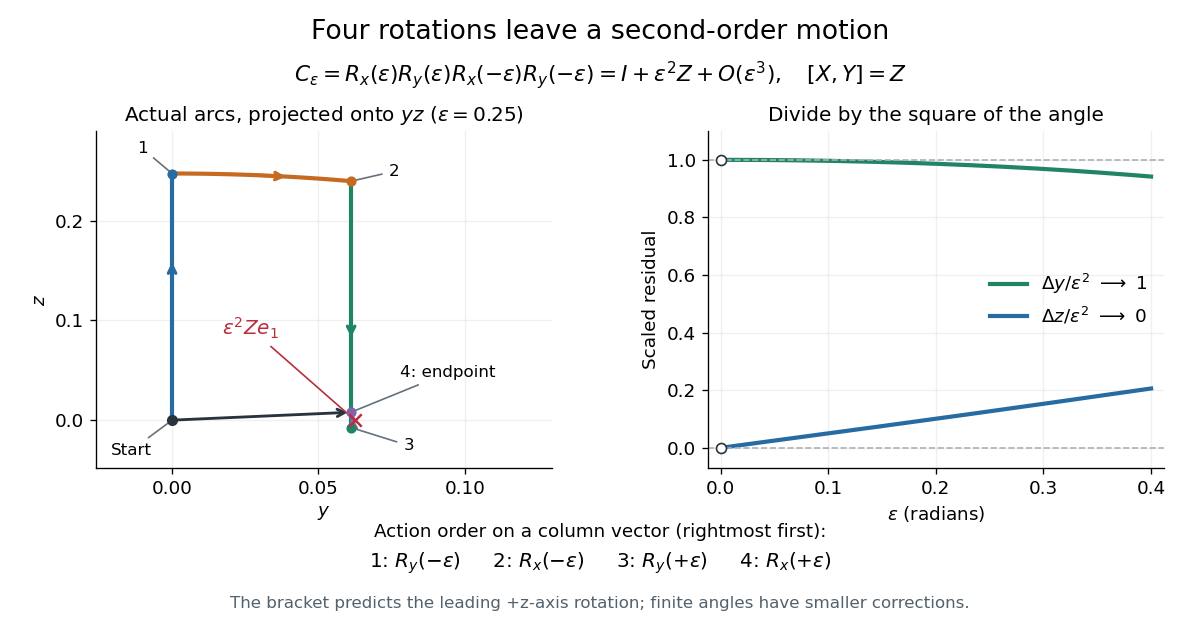
The left panel projects the actual four arcs onto the -plane for ; the start and endpoint are close but distinct. The right panel divides the residual coordinates by , making the limit visible. This is a numerical picture of in the SO(3) Lie algebra.
The commutator of two elements of an associative algebra over a field isIt measures how much the order of multiplication matters: exactly when . It is a bilinear map, it is alternating since , and associativity makes it satisfy the Jacobi identity. Hence every associative algebra becomes a Lie algebra on the same vector space when equipped with this product. This holds in every characteristic of a field.
For square matrices, this is the matrix commutator, and it is defined even for singular matrices. The group commutator of invertible matrices is instead : it equals the identity element when the matrices commute, whereas equals the zero matrix. The Lie bracket from local group commutators explains how differentiation connects the two constructions.
Over a field , the trace-zero matrices form the special linear Lie algebra . The matrix trace of a commutator is zero, so this is a Lie subalgebra of the general linear Lie algebra. A basis isIn fact , uniquely. The individual products areSubtracting in the stated order givesFor characteristic different from two, this is the standard sl2 triple; see Etingof, Section 11.4. The products remain valid in characteristic two, but there is central and , so the familiar characteristic zero structure changes.
The following table gives all nine basis brackets. Each entry is ; the diagonal vanishes by alternation, and exchanging row and column reverses the sign.
Bilinearity now computes any commutator, for exampleThe three structure constants of a Lie algebra relations encode all of this multiplication. They also show why the sl2 triple is useful in Lie algebra representations: the actions of and move between eigenvalues of the action of in steps of two.
For real-linear operators and a nonzero vector with , induction gives , hence the displayed formula. Applying to a nontrivial finite dependence with highest term leaves , a contradiction. Thus are linearly independent, and their span is invariant under both operators. Characteristic zero is essential to the factorial argument.
For bounded linear operators, or formally in an associative algebra,Differentiate the two exponentials using the product rule: the result is . Induction gives the th derivative , and the Taylor series at zero proves the formula. For bounded operators convergence follows from . For unbounded quantum operators, use a common invariant domain and justify the series there, or use the finite-dimensional system of commutators when their span closes.
For finite-dimensional complex linear operators with commuting with both and , differentiating gives the constant derivative . Hence , and conjugating the matrix exponential gives . Since , multiplication by proves the identity. The commutator order determines the minus sign.
The matrix trace of is zero, since . This obstructs a matrix with nonzero trace from being a single commutator.
Expand both sides using the definition of a commutator: the middle terms cancel, leaving . Thus commutation with a fixed operator is a derivation of an algebra. In particular, , which gives a short way to derive a Lie algebra representation from generator actions on an underlying algebra.
The Jacobi identity is the compatibility condition on a Lie bracketTogether with an Alternating Lie bracket, it defines a Lie algebra. Unlike associativity, it relates three cyclic bracketings rather than equating two bracketings. Equivalently, using antisymmetry of a Lie bracket,Thus the linear map is a derivation of a Lie algebra: acting on a bracket is the sum of acting on each argument. This makes infinitesimal symmetries act consistently on each other's products. It also gives , the identity that makes the Adjoint representation of a Lie algebra a Lie algebra representation.
For the commutator in an associative algebra, the cancellation is directly visible:Each word occurs once with each sign. This proves the Jacobi identity without a restriction on the characteristic of a field.
For a computed check in the sl2 matrix commutator example,Here the last two terms are individually nonzero over characteristic zero; the identity records their cancellation. In the cross-product Lie algebra, the same cyclic cancellation is the vector triple product identity.
The historical connection is unusually concrete: Lie and Engel's volume I expands nested commutators of differential operators into twelve terms and cancels them cyclically, in Chapter 5, §26, equation (7). See Lie and Engel, §26, in Merker's translation, pp. 105–106.
For a Lie algebra representation of on , the semidirect product is the vector space with bracketThe subspace is an abelian ideal of a Lie algebra.
For a Lie algebra ideal , the quotient vector space has Lie bracket . The ideal condition makes this independent of representatives. Its Lie algebra ideals correspond to the ideals of containing , by inverse image under the quotient Lie algebra homomorphism.
The derived algebra is the linear span of all Lie brackets in a Lie algebra. The Jacobi identity makes it an ideal of a Lie algebra. Its quotient is the largest abelian Lie algebra quotient of .
A finite-dimensional complex Lie algebra is a solvable Lie algebra exactly when its derived algebra is a nilpotent Lie algebra. The forward direction follows from the Lie theorem in the Adjoint representation and lifting nilpotence through its central kernel. The reverse direction follows because the derived series of a Lie algebra after its first term is the derived series of a Lie algebra of the derived algebra.
The four-dimensional diamond Lie algebra is the semidirect product of Lie algebras of the three-dimensional Heisenberg Lie algebra with a derivation having eigenvalues zero, one and minus one. With basis , its nonzero brackets are , , . Its derived series of a Lie algebra has dimensions four, three, one and zero. The symmetric form with and all other basis pairings zero is a nondegenerate bilinear form and invariant. The alternating tensor is the volume form on , verifying invariance.
The two-dimensional Lie algebra of infinitesimal dilations and translations of a line has a basis with . Its derived algebra is the abelian line spanned by , but every nontrivial term of its lower central series of a Lie algebra is that same line. It is solvable and not nilpotent.
The solvable radical of a finite-dimensional Lie algebra is its largest solvable ideal of a Lie algebra. A Lie algebra is semisimple exactly when its solvable radical is zero.
Every finite-dimensional complex representation of a solvable Lie algebra has a common eigenvector. Equivalently, an irreducible finite-dimensional complex representation is one-dimensional; iterating gives simultaneous upper triangularization.
The solvable Lie algebra , with , has an infinite-dimensional Irreducible Lie algebra representation on : and . Indeed . An invariant subspace is an ideal because it is invariant under multiplication by . Shift invariance gives , hence and is constant. This shows why the Lie theorem needs finite-dimensional representations, even when the algebra itself is finite-dimensional.
A Lie algebra representation is simultaneously upper triangular precisely when it preserves a complete flag, with . A basis adapted to the invariant flag makes every representing matrix upper triangular. For a complex finite-dimensional representation of a solvable Lie algebra, the Lie theorem provides a common eigenvector; iteration on the quotient representations constructs the flag.
In a field of characteristic , take a basis , and let with indices modulo , while . Then , so is a solvable Lie algebra, but the distinct eigenvalues of force any common eigenvector to be a coordinate vector, and cyclically permutes those vectors. There is consequently no common eigenvector, even over an algebraically closed field.
A complex Lie subalgebra is solvable iffor every and . For an abstract Lie algebra, this is equivalent to .
For in the derived algebra of a complex matrix Lie algebra , define by multiplication by on each generalized eigenspace of . Polynomial interpolation and adjoint compatibility of additive Jordan decomposition make a polynomial in with zero constant term, so . Trace orthogonality of and forces the displayed sum to vanish. Thus is a nilpotent endomorphism, and the Engel theorem implies solvability. The auxiliary and the Jordan components are not required to lie in .
Like the center of a group, the Lie-algebra center consists of elements commuting with every element; here commutation means vanishing of the Lie bracket.
The center is .
A central ideal is a linear subspace of the center of a Lie algebra. It is a Lie algebra ideal because its Lie bracket with every element is zero. Passing to the quotient Lie algebra removes this central subspace. For in characteristic , the identity matrix has zero trace and spans a central ideal.
Every Adjoint representation operator raises the lower central series of a Lie algebra filtration. In a basis adapted to that finite filtration, all adjoint operators are strictly triangular. Their products have zero trace, so the Killing form vanishes. Consequently its radical of the Killing form is the whole algebra. For strictly upper triangular matrices the filtration can be seen directly by the gap between the column and row indices.
// Target: algebra.bigb
Each term is the preimage of the center of a Lie algebra after quotienting by the preceding term. Equivalently, . A Lie algebra is nilpotent exactly when this series reaches the whole algebra after finitely many steps. For the Heisenberg Lie algebra, the series is .
Over an algebraically closed field, a finite-dimensional Lie algebra is nilpotent exactly when every two-dimensional Lie subalgebra is abelian. A nonnilpotent Adjoint representation matrix has a nonzero eigenvalue with eigenvector , so generates a nonabelian two-dimensional subalgebra. Conversely a subalgebra of a nilpotent Lie algebra is nilpotent, while a nonabelian two-dimensional algebra has a basis with and a nonnilpotent adjoint matrix. Algebraic closure is what guarantees the required eigenvector.
Every proper Lie subalgebra of a finite-dimensional nilpotent Lie algebra is properly contained in its normalizer. Choose the first term of the lower central series contained in ; the preceding term contains an element outside that normalizes it.
A finite-dimensional Lie algebra is nilpotent if and only if every adjoint map is nilpotent. A Lie algebra of nilpotent endomorphisms can be simultaneously represented by strictly upper triangular matrices.
First prove the Engel lemma by induction on the dimension of a Lie algebra of nilpotent endomorphisms. If , then on the endomorphism algebra has , since left and right multiplication commute. Thus a proper Lie subalgebra acts nilpotently on , and induction gives a nonzero class normalized by . This proves the Engel normalizer lemma.
For a maximal proper , its normalizer is all of , so is an ideal. Maximality then forces , since every line in a Lie algebra is a subalgebra. Induction gives a nonzero common annihilator of in the representation space. Ideality makes stable under . A generator of is nilpotent on and has nonzero kernel there, providing a vector killed by all of . In the possibly nonfaithful quotient actions, apply induction to the image, whose dimension is at most .
Repeatedly apply this common-kernel statement to quotient representation spaces to obtain a complete flag with . Hence the operators are simultaneously strictly upper triangular. Applying this to the Adjoint representation shows that a finite-dimensional Lie algebra whose every adjoint map is nilpotent has terminating lower central series. Conversely, termination of that series immediately makes every adjoint map nilpotent. This proves Engel theorem.
// Target: semisimple-lie-algebra.bigb
A finite-dimensional Lie algebra representation in which every representing endomorphism is nilpotent has a nonzero vector annihilated by the entire Lie algebra. Applying this to the Adjoint representation is the key step in Engel theorem.
If is a finite-dimensional Lie algebra of nilpotent endomorphisms, every proper Lie subalgebra is strictly contained in its normalizer of a Lie subalgebra. The Adjoint representation of on consists of nilpotent maps by nilpotence of commutation by a nilpotent endomorphism. In the inductive proof of Engel theorem, the lower-dimensional Engel lemma gives a nonzero class with . A maximal proper is consequently an ideal of a Lie algebra of codimension one.
For a connected simply connected source Lie group, every Lie algebra homomorphism integrates uniquely to a Lie group homomorphism. Along a path from the identity, transport its left logarithmic velocity by and solve the corresponding left-invariant differential equation in the target. The Maurer-Cartan equation and preservation of brackets make the endpoint invariant under fixed-endpoint homotopies. Simple connectedness removes path dependence, and path concatenation proves multiplicativity.
For a connected source, first integrate on its universal covering Lie group. The resulting map descends to the original group exactly when it kills the discrete kernel of the covering map. For the circle group, a real-linear map integrates to a circle endomorphism exactly when , since must map into itself. This is a global period condition invisible to the zero bracket of the circle's Lie algebra.
For a smooth homomorphism of Lie groups, naturality gives . Therefore locally. Apply this to the group commutator and differentiate its two curve parameters to obtain the displayed identity for the Lie bracket from local group commutators. In particular the differential of a group representation is a Lie algebra representation.
The representation ring of finite-dimensional modules for a complex semisimple Lie algebra is the abelian group generated by module classes, with , and multiplication . Weyl complete reducibility theorem makes the classes of irreducible representations a free integral basis. The formal character map identifies this ring with the Weyl group invariant part of the group ring of a weight lattice. Injectivity follows from distinct highest weights; surjectivity follows by subtracting the character with each maximal dominant weight, whose highest-weight coefficient is one, from a Weyl-invariant finite sum.
// Target: semisimple-lie-algebra.bigb
For a Lie subalgebra , its defining representation is its given action on the vector space . The Lie bracket identity verifies the representation property. For the special linear Lie algebra, diagonal trace-zero matrices have coordinate weights of a representation on the standard basis; for a Special orthogonal Lie algebra, the same action preserves the defining symmetric bilinear form.
For a unitary derived representation , its generators are anti-Hermitian. Define Hermitian observables ; then their ordinary operator commutator is . Thus real Lie algebra structure constants and Hermitian-operator commutation relations differ by an . Products in a universal enveloping algebra require one conversion factor for every generator. In particular, the abstract bilinear Pauli-Lubanski element has representation image minus the pseudovector formed from the Hermitian physical generators.
Articles were limited to the first 100 out of 466 total.
Articles by others on the same topic

A Lie-* algebra, also known as a star algebra or a *-algebra, is an algebraic structure that combines features of both Lie algebras and *-operations (involution). The concept of a Lie-* algebra typically arises in the context of functional analysis, quantum mechanics, and representation theory. ### Key Components 1.


Like everything else in Lie groups, first start with the matrix as discussed at Section "Lie algebra of a matrix Lie group".
Intuitively, a Lie algebra is a simpler object than a Lie group. Without any extra structure, groups can be very complicated non-linear objects. But a Lie algebra is just an algebra over a field, and one with a restricted bilinear map called the Lie bracket, that has to also be alternating and satisfy the Jacobi identity.
Because of the Lie group-Lie algebra correspondence, we know that there is almost a bijection between each Lie group and the corresponding Lie algebra. So it makes sense to try and study the algebra instead of the group itself whenever possible, to try and get insight and proofs in that simpler framework. This is the key reason why people study Lie algebras. One is philosophically reminded of how normal subgroups are a simpler representation of group homomorphisms.
To make things even simpler, because all vector spaces of the same dimension on a given field are isomorphic, the only things we need to specify a Lie group through a Lie algebra are:Note that the Lie bracket can look different under different basis of the Lie algebra however. This is shown for example at Physics from Symmetry by Jakob Schwichtenberg (2015) page 71 for the Lorentz group.
- the dimension
- the Lie bracket
As mentioned at Lie Groups, Physics, and Geometry by Robert Gilmore (2008) Chapter 4 "Lie Algebras", taking the Lie algebra around the identity is mostly a convention, we could treat any other point, and things are more or less equivalent.