stress is a linear causal functional of deformation history: in simple shear, . Superposition holds and complex viscoelastic modulus is amplitude-independent within the small-deformation regime.
The characteristic time for a delayed strain response to approach equilibrium under a step in stress. For a Kelvin-Voigt model with elastic modulus and viscosity , the equation gives , where . A relaxation time instead describes decay of stress after an imposed strain; the two times need not coincide in a standard linear solid model.
A four-element linear viscoelasticity model with a spring , a Kelvin-Voigt model branch , and a free dashpot in series. Adding their strains under common stress gives the displayed creep compliance, with . There is an instantaneous elastic response, a delayed recoverable response and steady viscous flow.[ref]
https://docs.itascasoftware.com/pfc600/common/models/burgers/doc/modelburgers.html. Burgers Model, PFC 6.0 documentation, Figure 1 and equations (1)–(2), (5): Kelvin and Maxwell units in series
Named after Johannes Martinus Burgers, it extends a Maxwell model with a delayed elastic branch, or a standard linear solid model with a free dashpot.For a load maintained for time , the two recoverable contributions behave as in recovery after a finite-duration stress load, while the free dashpot retains . HenceThis residual response models viscous flow; it does not by itself establish a plastic yield threshold or a damage mechanism in a real specimen.
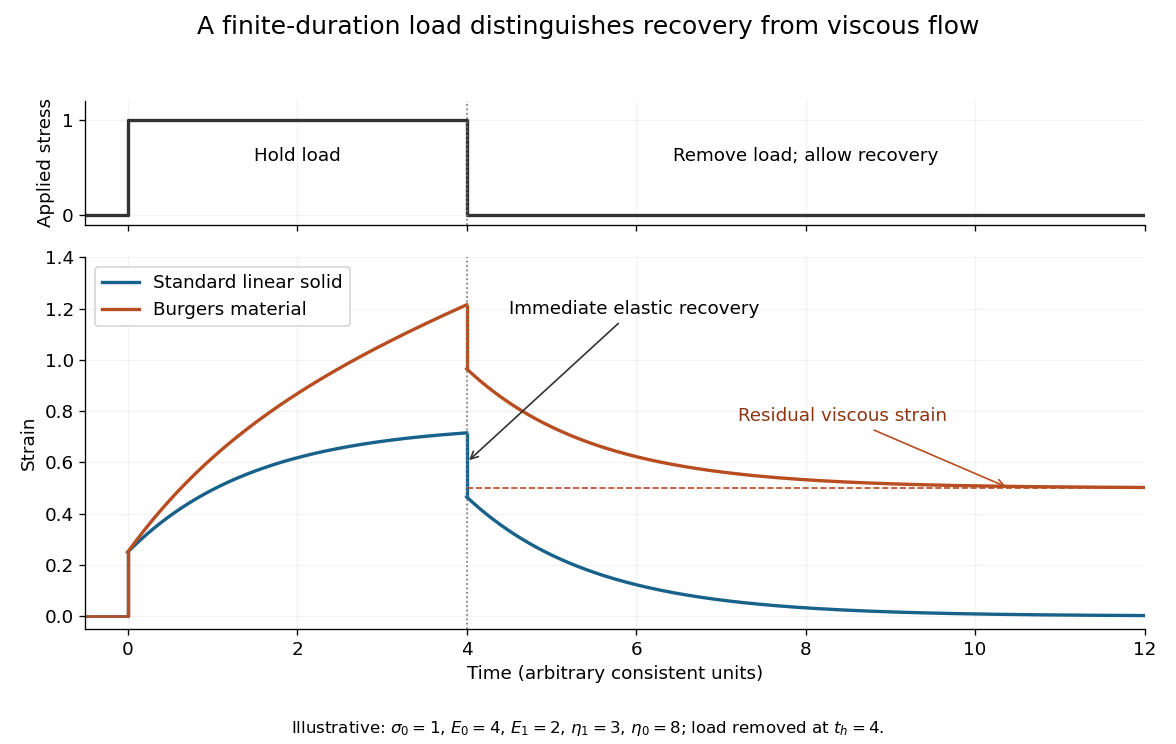
Immediate recovery, delayed recovery and residual viscous strain
. Original predictions for a standard linear solid and a Burgers material under the same finite-duration load. Dimensionless illustrative parameters; no experimental rubber or wood data are fitted. Details.
Articles by others on the same topic
There are currently no matching articles.