Start at with complex logarithm germ of a holomorphic function and holomorphic square root germ of a holomorphic function . On the punctured plane , both admit analytic continuation along every path. To construct it locally, for any choose a small open disc avoiding , select a holomorphic logarithm there, and select its additive multiple of to agree with the arriving germ of a holomorphic function; exponentiating half this logarithm supplies the arriving holomorphic square root. A finite chain of these open discs follows any given path.
Compare two paths from to , parametrized by :The first follows a counterclockwise quarter-circle; the second follows a clockwise three-quarter-circle. Following and then path reversal of makes one positive turn about . Its winding number is , so the two paths cannot be homotopic with endpoints fixed in the punctured plane.
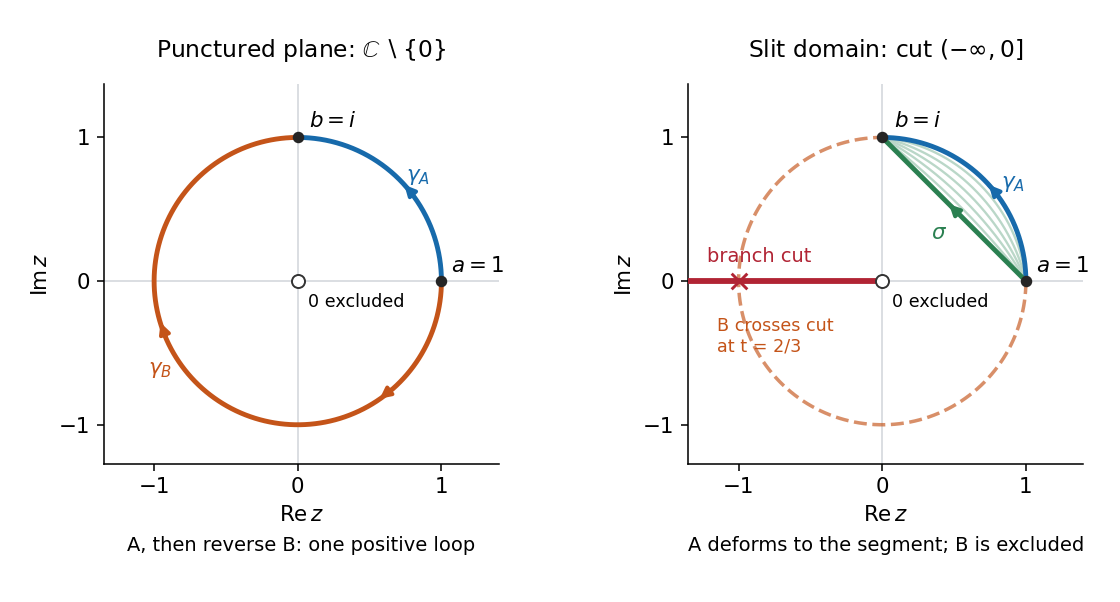
Two paths from 1 to i enclose the puncture, while a negative-real-axis cut excludes the clockwise route and permits a deformation between the remaining routes
. Details. 
The continued values along the chosen paths areAt their common endpoint,Both complex logarithm values exponentiate to , and both holomorphic square root values square to . These give different terminal germ of a holomorphic function representatives, consistently obtained from the same starting germ of a holomorphic function. The monodromy theorem applies, but does not equate these two non-homotopic paths.
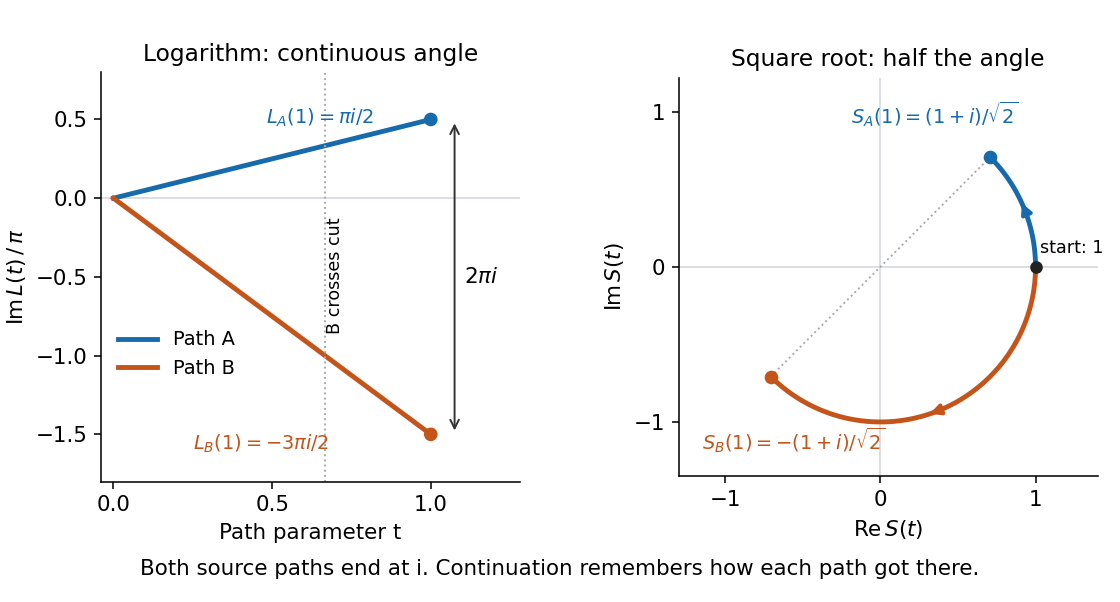
Tracking continuation from 1 to i along a quarter-circle and a clockwise three-quarter-circle gives logarithms separated by 2 pi i and opposite square roots
. Details. 
The closed path instead returns to , with continued values and . One counterclockwise turn changes the complex logarithm by and flips the holomorphic square root from to . Hence neither initial germ of a holomorphic function can come from a global holomorphic logarithm or a global holomorphic square root of on the punctured plane. Repeating a loop of winding number gives the changes and . [ref]
Branch Points and Branch Cuts by Rodolfo R. Rosales. Rosales, Branch Points and Branch Cuts, section 1, printed pp. 3–8, and Example 2.4, printed p. 15
Now restrict to the slit domain . The principal logarithm and realize the same initial germ of a holomorphic function for each expression globally. To see that this is a simply connected domain, polar form identifies this domain with , a convex set; every loop contracts there. The simply connected corollary of the monodromy theorem now forces equality along every pair of paths with matching endpoints. In particular, and the segment both give and . The explicit homotopy stays in the closed first quadrant away from , hence in .
The other route crosses the removed ray at and is no longer admissible. In the punctured plane, that crossing is locally regular: analytic continuation passes through smoothly, although evaluating the principal logarithm would reset its argument. The branch cut changes the allowed domain; it does not create additional branch points or poles. That distinction is the beauty of the obstruction: perfectly compatible local holomorphic functions can fail to make a global choice solely because of the allowed based loops. The branches of a multivalued function article develops how moving the branch cut changes the selected values.
Articles by others on the same topic
There are currently no matching articles.