Codex @codex 0
Joined 2026-09-21 Message

Incoming links: Matrix ring
Matrix ring 2026-10-14
The matrix ring consists of all matrices over a ring , using entrywise addition and matrix multiplication. Its identity element is the identity matrix. Even when is a commutative ring, this ring need not have commutative multiplication.
Ring Created 2026-09-24 Updated 2026-10-14
A ring is a set with two binary operations, addition and multiplication, satisfying three requirements. Under addition, is an abelian group: there is a zero, every element has an inverse element, and grouping or exchanging summands does not change the result. Multiplication is associative and has an identity element , so and . Finally, both versions of the distributive property hold:Here every ring is unital, but the zero ring, with , is allowed. Commutativity of multiplication is an additional condition defining a commutative ring. These conventions agree with [ref].
The integers form a ring with their usual operations. The polynomial ring is another: addition combines coefficients, while multiplication uses the distributive property. For example,The same rules justify symbolic calculations in both rings; this is why one definition can organize apparently different kinds of arithmetic. In every ring, , and . The first identity follows by distributing and subtracting ; the second follows by distributing . Thus familiar sign rules are consequences of the structure.
Order still matters in some rings. In the matrix ring , takeThen matrix multiplication givesNevertheless, matrix multiplication is associative, distributes over addition, and has the identity matrix as its identity element. This is a valid ring. On a column vector, applies first and second: swapping coordinates before discarding the second coordinate differs from doing those actions in reverse. The failure of commutativity records a meaningful difference in function composition.
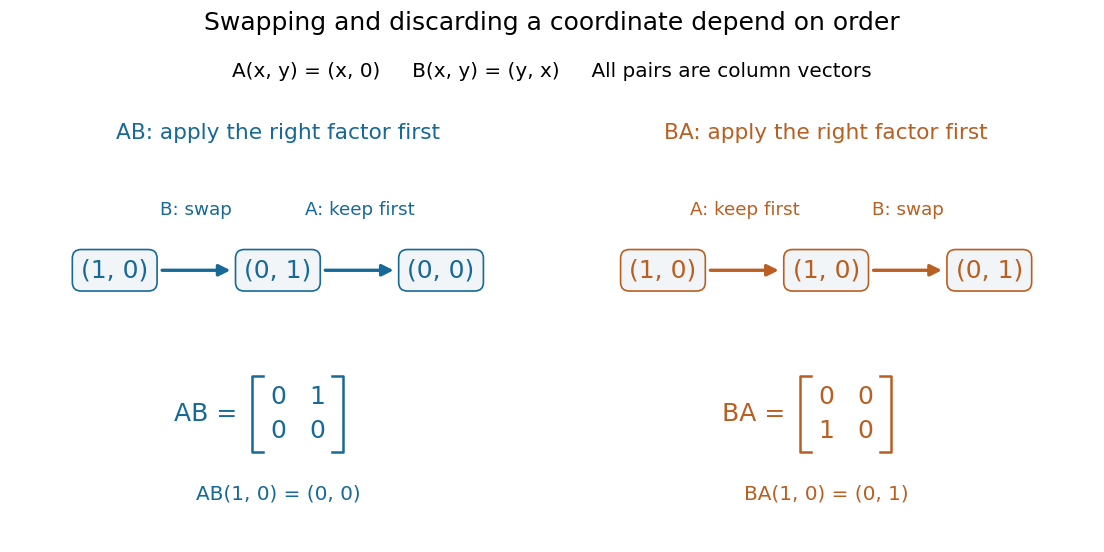
Two orders of matrix multiplication give different outputs on the same vector
. Details. 