Let be the memory page size, the aligned starting file offset, the mapping length and its base virtual address. A valid displacement with corresponds to file offsetHere is the relative memory page index, the floor function selects its integer part, and Euclidean division gives the within-page displacement . The backing page begins at . This identifies file contents; the page table separately selects a resident page frame and enforces permissions.
Take , and bytes in a file of at least 12288 bytes. A has a shared file mapping at . B has a shared file mapping at and a private file mapping at . These bases are illustrative chosen results, not requested fixed addresses. All three mappings cover the same two backing pages: file offsets 4096–8191 and 8192–12287. Displacement selects relative page 1, within-page displacement 37 and file offset . Thus A's
0x10001025, B's shared 0x20001025 and B's private 0x30001025 initially identify the same byte. The adjacent displacement 4134 identifies file offset 8230. Different virtual addresses can reach the same backing contents.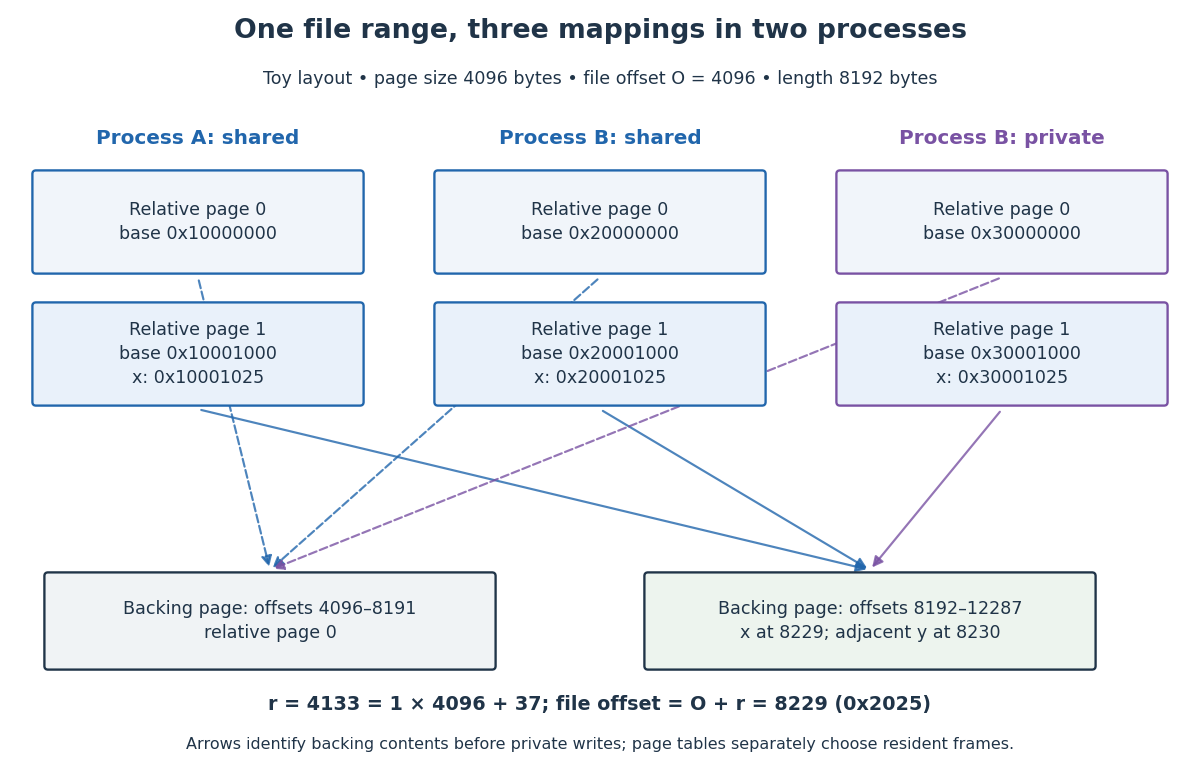
Two operating-system processes map two backing pages at different virtual addresses; displacement 4133 identifies file offset 8229
. Details. 
To access a requested file offset that is not aligned, choose and displacement . Mapping enough bytes to cover that displacement plus the requested length makes the desired data start inside the aligned mapping. Do not pass the unaligned directly as the Linux kernel
mmap offset. For example, uses and displacement 37; that one-page start differs from our two-page mapping's . Articles by others on the same topic
There are currently no matching articles.