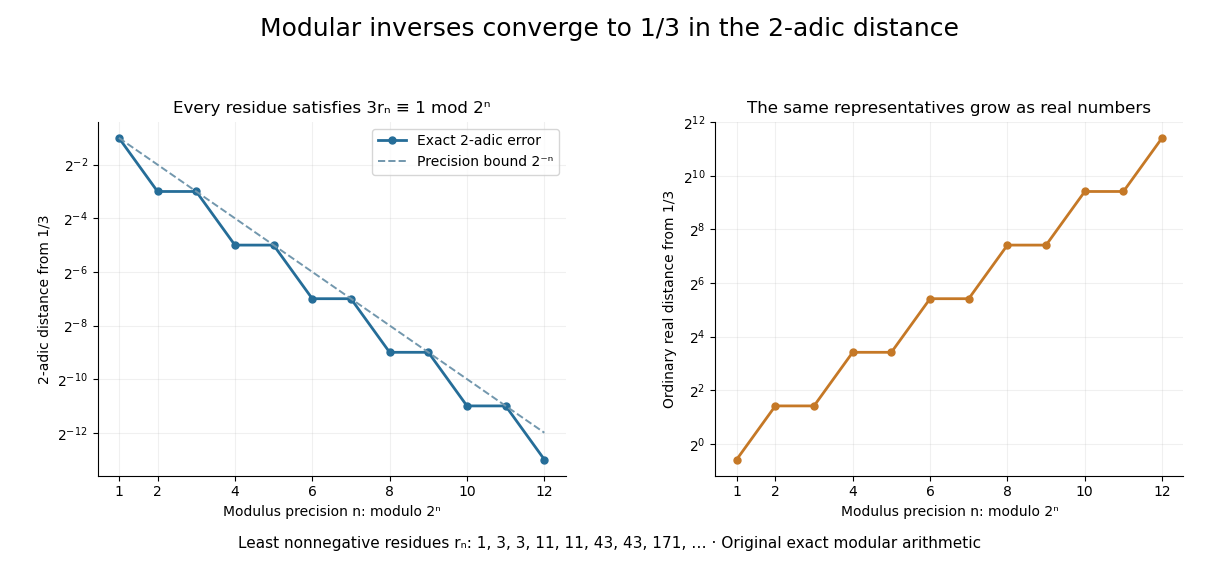
Let be an integer not divisible by . Its modular inverse modulo has a unique least nonnegative representative . Reducing the inverse equation modulo shows that the representatives are compatible. Since is a p-adic unit,so the sequence converges to the inverse in . This computes a fraction through finite integer operations.
For and , the first eight representatives are . Each satisfies . The resulting expansion isThe geometric series has ratio , whose 2-adic absolute value is , and its sum is . In the ordinary real number absolute value, the representatives grow. Different metrics impose different meanings of a good approximation. The periodic digits here are a specific instance of the rational expansions studied in Conrad's authored note.[ref]

Articles by others on the same topic
There are currently no matching articles.