The p-adic integers retain arithmetic information modulo arbitrarily high powers of one prime number . They form the subringof the P-adic numbers. Their p-adic absolute value bounds the allowed denominators: belongs to , while does not. The name therefore describes a local arithmetic ring, not just the ordinary integers.[ref]
P-adic numbers by Jan-Hendrik Evertse. §3, printed pp. 6–7: definition of Zp, rational denominators and units
A concrete description gives an element by a compatible sequence of congruence classes:The inverse limit condition says that gaining more precision must preserve the digits already determined. Each is a residue modulo ; choosing its least nonnegative integer representative gives . The ordinary integer gives residues modulo .
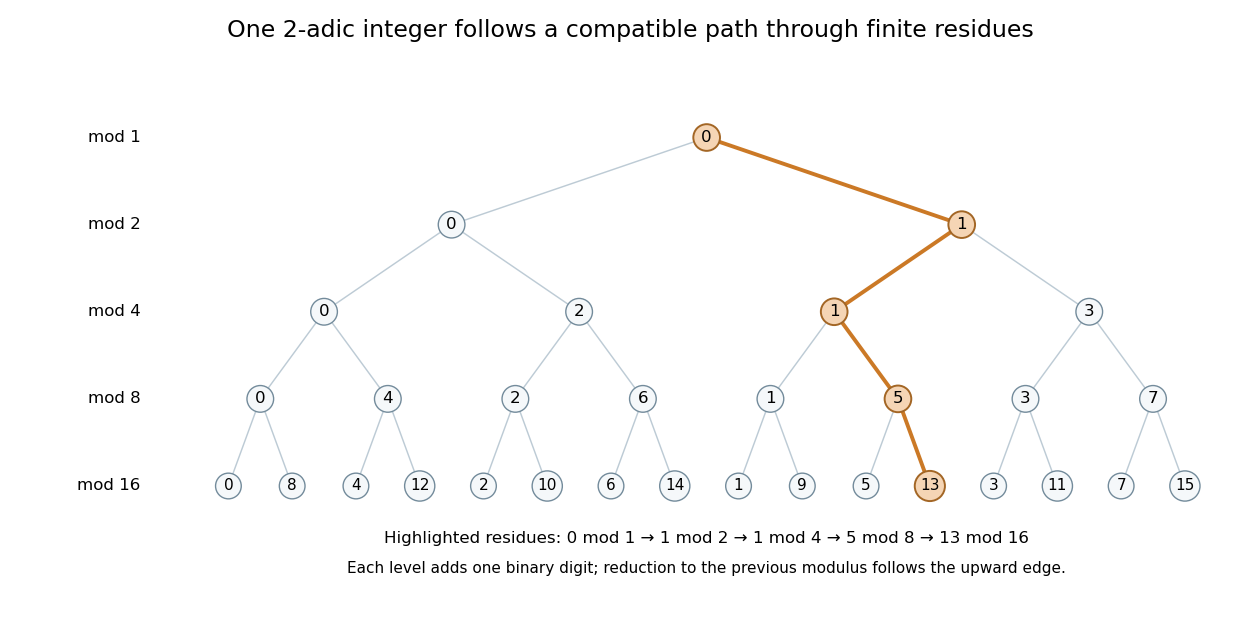

The useful feature is that one exact object organizes an unlimited family of finite modular arithmetic calculations. Addition and multiplication are performed modulo each , and the results remain compatible. A p-adic digit expansion makes this concrete:The expansion is unique and converges in the p-adic metric; its higher powers have smaller p-adic absolute value. The digit agreement and p-adic distance criterion tells exactly which finite digits a precision bound preserves.[ref]
The p-adic digits are the unique coefficients in for a p-adic integer . Taking least nonnegative representatives of its congruence classes,so each new residue determines one more p-adic digit. For in , the low-to-high digits are , giving . A finite prefix describes a whole coset, not a unique infinite expansion.
Two p-adic integers agree in their first low-order p-adic digits precisely when their difference is divisible by . Equivalently,If the first differing digit has index , the remaining leading coefficient is nonzero modulo , giving exact P-adic valuation and p-adic metric . If no digit differs, the two elements are equal and their distance is zero. Truncating at therefore gives , with a stricter bound possible when further digits are zero.
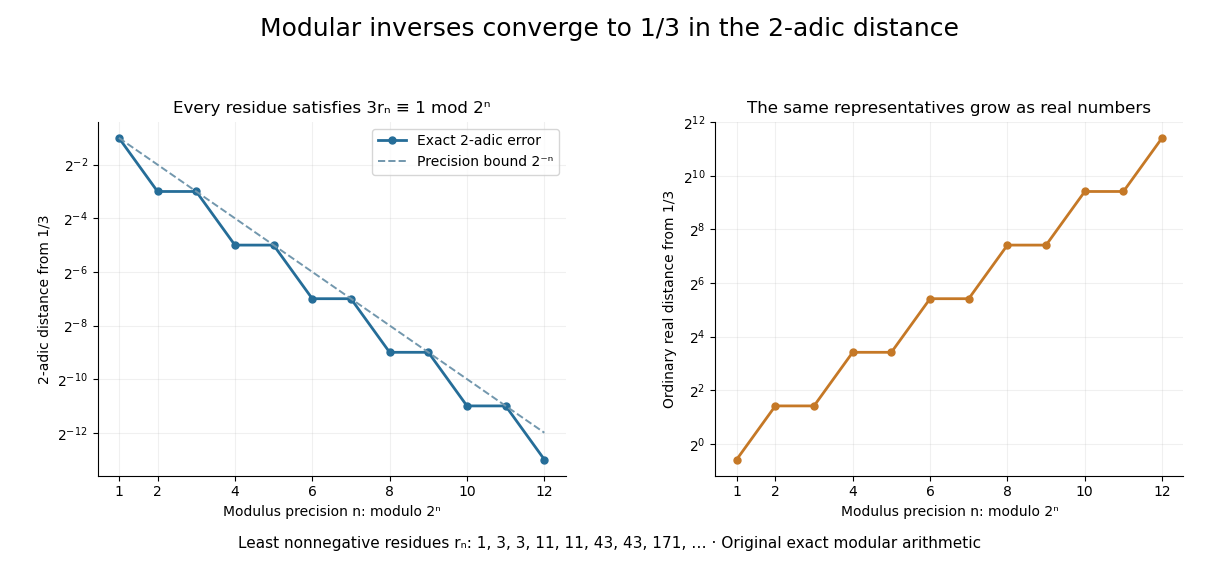
Let be an integer not divisible by . Its modular inverse modulo has a unique least nonnegative representative . Reducing the inverse equation modulo shows that the representatives are compatible. Since is a p-adic unit,so the sequence converges to the inverse in . This computes a fraction through finite integer operations.
For and , the first eight representatives are . Each satisfies . The resulting expansion isThe geometric series has ratio , whose 2-adic absolute value is , and its sum is . In the ordinary real number absolute value, the representatives grow. Different metrics impose different meanings of a good approximation. The periodic digits here are a specific instance of the rational expansions studied in Conrad's authored note.[ref]

The p-adic integers form a complete metric space and a discrete valuation ring. Every nonzero is uniquely with and a p-adic unit. The prime is a uniformizer, and reduction modulo gives the residue field . The element has no inverse inside , so the ring is not a field.
For a short ideal-classification outline, take a nonzero ideal and choose an element of smallest P-adic valuation , which exists by the well-ordering principle. Its unit factor is invertible, so the ideal contains . Every other element is divisible by , proving that the ideal is . Completeness follows because is a closed subset of the complete metric space . The zero ideal is separate from this nonzero-ideal classification.
The cosets form a neighborhood basis in the additive group of p-adic integers. An open subgroup contains for some , so has finite index. Conversely, if the index is , the finite quotient is annihilated by , giving . Multiplication by the unit part of is bijective, so is open. This proof applies to abstract subgroups without assuming beforehand that they are closed.
A 7-adic integer is an element of the p-adic integers for , equivalently a compatible sequence of residues modulo . Its p-adic digits lie in . For example, has low-to-high digits .
A 2-adic integer is an element of the p-adic integers for , equivalently a compatible sequence of residues modulo . Its binary p-adic digits begin with its parity. The highlighted residue-tree path for begins , while modular inversion converges to a p-adic inverse computes the infinite expansion of .
An element topologically generates the additive group of exactly when , equivalently when is a p-adic unit. In that case its image generates every cyclic quotient .
Articles by others on the same topic
There are currently no matching articles.