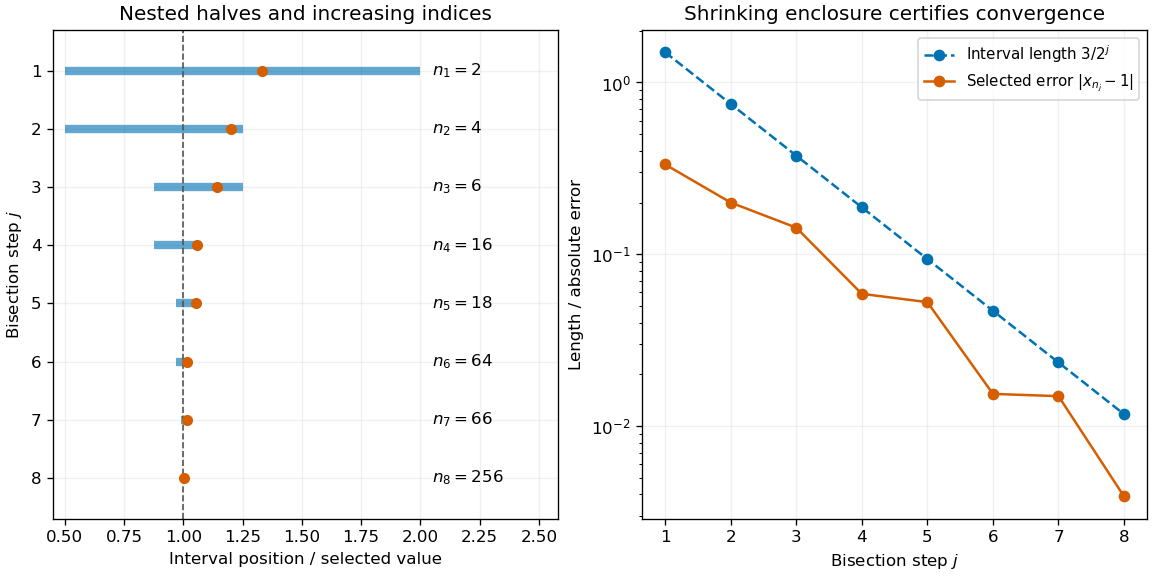
Begin with a closed interval containing the entire bounded sequence. Split the interval at its midpoint. At least one of the two closed halves contains infinitely many indexed terms; choose such a half and repeat. This gives nested intervals with lengths . The nested interval theorem, using completeness of the real numbers, supplies their unique common point .
Choose with . Infinitely many indexed terms in guarantee that the next index can be chosen. Both and belong to , soThis is a short existence proof, not necessarily a finite algorithm for an arbitrary input sequence: deciding which half contains infinitely many future terms may require mathematical knowledge about that sequence.

Articles by others on the same topic
There are currently no matching articles.