The splitting of one-nucleon energy levels by their spin-orbit interaction. With , the identity gives, in a state of definite ,The second branch requires . For the illustrative Hamiltonian operator with , the shifts are and . Thus the strong negative coefficient lowers the aligned branch. Its capacity is ; the raised partner holds . Together they still hold identical nucleons: the interaction rearranges states rather than creating them.
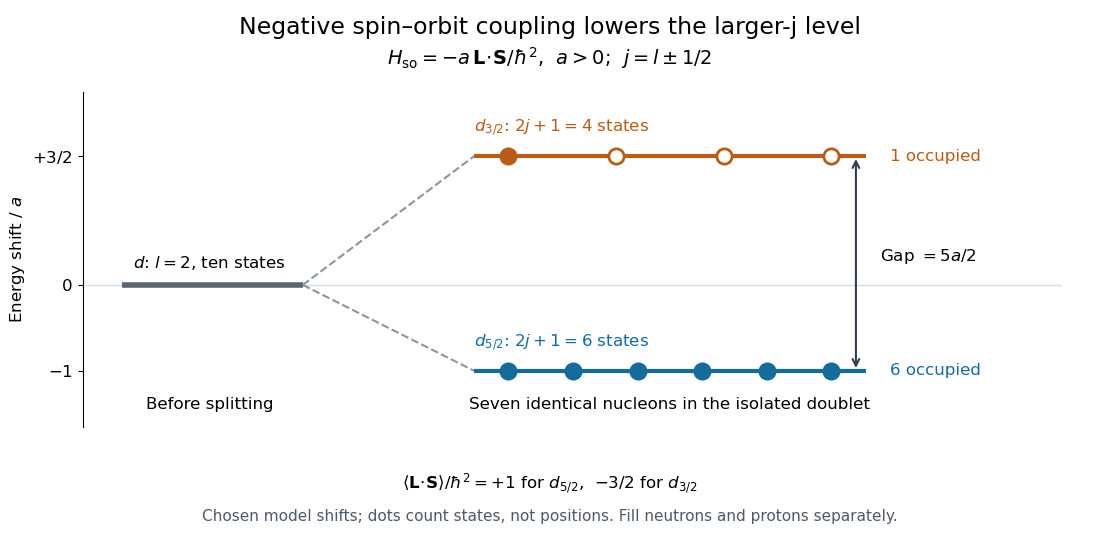

In this example the and shifts are and , respectively, so the gap is . The capacity-weighted mean shift vanishes:This is a useful check on both the sign and state counting. A seventh identical particle cannot occupy another substate of the already full lower level. In a real atomic nucleus, other radial and orbital angular momentum levels can interleave with this doublet, and a radial coupling need not give the same effective for every orbital.
Articles by others on the same topic
There are currently no matching articles.