Why should adding one neutron be easy for one atomic nucleus and much less favorable for its neighbor? In the nuclear shell model, nucleons occupy discrete energy levels in a nuclear mean field. Filling all available states below a sufficiently large gap produces a nuclear shell closure. This connects nuclear separation energies with the counting of quantum states, and connects the spin of an odd atomic nucleus with its last unpaired nucleon.
The starting point is an approximate Hamiltonian operatorwhere is a confining potential energy, specifies nuclear spin-orbit splitting, and contains interactions left out of the nuclear mean field. This is an effective organization of the nuclear many-body problem, rather than a derivation of the nuclear force. In a spherical approximation, addition of angular momentum combines the orbital angular momentum with spin to give ; for , only exists.
A level labelled has magnetic substates . The Pauli exclusion principle permits one neutron in each such state and, separately, one proton. Thus a level holds eight neutrons, or eight protons; it does not hold sixteen identical neutrons. Here counts radial levels of the same , starting with the lowest; it is not the hydrogenic principal quantum number. The letters mean .
In the simplest nuclear shell model of an odd-mass number nucleus, paired nucleons contribute zero total angular momentum and magnetic dipole moment. The last unpaired nucleon supplies the nuclear spin and the stretched-state moment , where is the Landé g-factor and the nuclear magneton.
Using addition of angular momentum with givesFor , this reduces to . For , it givesThe free-nucleon orbital factors are for a proton and for a neutron. Residual nuclear interactions and configuration mixing can shift measured moments away from this ideal prediction. A single hole in an otherwise closed shell has the same stretched-state moment as a particle in that shell: removing the particle leaves total and moment .
A nuclear shell groups single-particle energy levels for protons or neutrons in a nuclear mean field. Filling all states below a sufficiently large gap gives a nuclear shell closure. These shells describe quantum-state occupation rather than thin spatial layers. Their discrete filling effects explain departures from the smooth semi-empirical mass formula.
An effective one-nucleon potential energy representing the average influence of the other nucleons. The nuclear shell model treats motion in this field first, then includes residual interactions. The field experienced by a proton also includes the repulsive Coulomb potential; proton and neutron energy levels need not have identical spacings.
A proton number or neutron number associated with a pronounced nuclear shell closure. The traditional sequence isThese count either species separately, rather than their sum . Calling a number magic summarizes a structural pattern; it does not promise that every isotope at that number is equally stable.
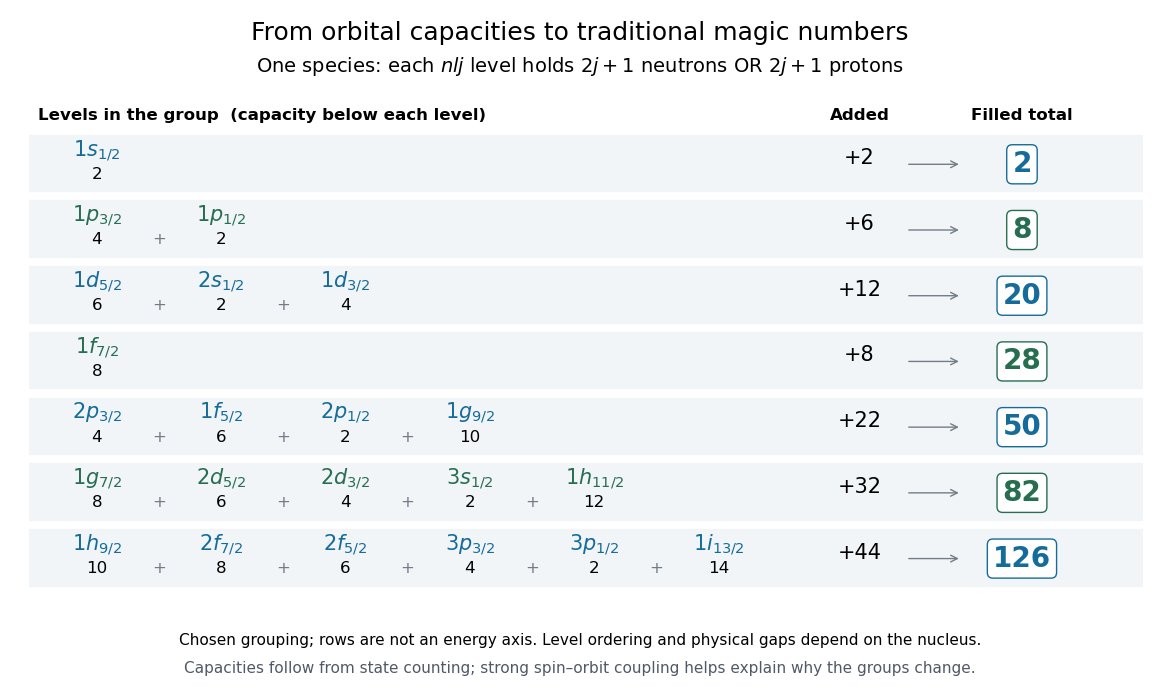
Counting states between traditional nuclear shell closures
. Original capacity diagram for a chosen spherical level scheme. Each orbital contributes states for one species. Rows show groups and cumulative totals, not measured energies or a universal ordering within each group. Details.For example, in the chosen scheme the -particle core plus the eight substates of gives . The next group contributes , giving . The following two groups contribute and , giving and . Counting verifies the capacities once the grouping has been chosen; it does not establish the physical energy gaps that justify that grouping.
Filling the accessible one-species nuclear shell model states below a substantial energy gap. A closed spherical level has all values occupied, so their sum is zero. In the independent-particle picture, a closed core therefore contributes zero total angular momentum; a single particle outside it, or a single missing particle inside it, supplies the leading spin assignment. Residual interactions can change this simple picture.
The three-dimensional isotropic harmonic oscillator alone has one-species shell capacities for oscillator index , including spin. Summing gives closures , rather than the complete traditional magic number sequence. Strong nuclear spin-orbit splitting can separate a high- level from its former neighbors. Realistic radial potential energies and residual interactions also matter: a chosen oscillator plus an arbitrary single constant is not a demonstrated explanation of every real nuclear gap.
Traditional nuclear shell closures can weaken along isotope chains far from stability, as in neutron-rich magnesium.[ref]
Magic numbers disappear and expand area of nuclear deformation by RIKEN. 20 November 2013, magnesium shell weakening
The relevant test is the actual energy gap and the correlated nuclear quantum states, rather than membership in an immutable numerical list.
The splitting of one-nucleon energy levels by their spin-orbit interaction. With , the identity gives, in a state of definite ,The second branch requires . For the illustrative Hamiltonian operator with , the shifts are and . Thus the strong negative coefficient lowers the aligned branch. Its capacity is ; the raised partner holds . Together they still hold identical nucleons: the interaction rearranges states rather than creating them.
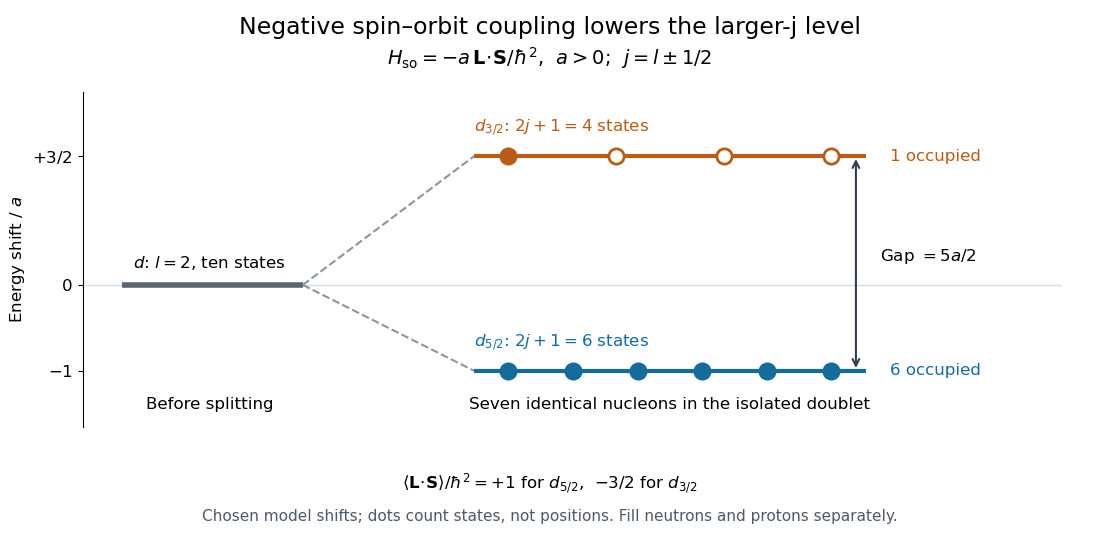
In this example the and shifts are and , respectively, so the gap is . The capacity-weighted mean shift vanishes:This is a useful check on both the sign and state counting. A seventh identical particle cannot occupy another substate of the already full lower level. In a real atomic nucleus, other radial and orbital angular momentum levels can interleave with this doublet, and a radial coupling need not give the same effective for every orbital.
The energy needed to remove specified nucleons from a bound atomic nucleus in its ground state. It compares neighboring nuclear masses, and so can reveal a nuclear shell closure more clearly than a smoothly varying total nuclear binding energy.
With bare nuclear masses, the proton separation energy is the energy needed to remove a proton. A negative value means the daughter plus proton has lower rest energy. Proton emission can still have a finite lifetime because of a Coulomb or centrifugal barrier.
A nuclear drip line marks a boundary beyond which one- or few-nucleon emission becomes energetically allowed. One- and two-particle nuclear separation energies can give distinct boundaries because of nuclear pairing.
The neutron drip line is the neutron-rich boundary at which one- or two-neutron emission becomes energetically possible. Neutrons beyond that boundary are not stably bound; the absence of a Coulomb barrier often makes their emission prompt, subject to angular-momentum barriers.
The proton drip line is the proton-rich boundary at which one- or two-proton emission becomes energetically possible. It is governed by proton separation energies, rather than the energetics of beta decay alone.
Writing positive nuclear binding energy as and nuclear mass as ,The two-neutron nuclear separation energy is . In an independent-particle example, let the last occupied energy level have and the next empty level , for a chosen positive energy unit . With an unchanged core and no residual interactions, removal from the filled level costs , whereas removing the first particle added above it costs : the drop equals the one-particle gap. These are invented model inputs, not measured nuclear values. Nuclear pairing, rearrangement of the nuclear mean field, and correlations complicate that identification in real masses; a finite difference of nuclear binding energies is not automatically a bare one-particle gap.
Correlations that favor pairs of like nucleons coupled to zero total angular momentum in the simplest spherical picture. They help explain why an unpaired nucleon often dominates an odd nucleus's spin, and why neighboring nuclear separation energies show an odd-even staggering. Nuclear pairing belongs to the residual-interaction physics beyond merely filling independent energy levels. Mixing different occupations and deformation can also be necessary; the closed-core picture is most useful near suitable nuclear shell closures.
Isotope abundance, nuclear separation energies, spin and nuclear magnetic moments supply complementary tests: abundance concerns which atomic nuclei survive and accumulate, removal energy concerns binding, and magnetic properties test the angular momentum assignments. Agreement across these observables is more informative than fitting one list of numbers.
In her 1963 lecture, Maria Goeppert Mayer recalled excess abundances at and . She contrasted the strong binding of the last neutron in oxygen isotope with the weaker extra neutron in oxygen isotope , and displayed beta decay energies near and . These are compiled empirical patterns, rather than readings from an apparatus she built.[ref]
Her 1949 letter compared observed spins and nuclear magnetic moments with orbital assignments. For example, lead isotope was assigned a neutron hole near , whereas bismuth's odd proton began the next shell as . The moments tested orbital character as well as spin.[ref]
On Closed Shells in Nuclei. II by Maria Goeppert Mayer. p. 1970, discussion and Table II
A useful comparison holds fixed when comparing neighboring isotopes, and examines odd-even staggering separately from a shell discontinuity. Abundance additionally depends on production and decay history. Neither the abundance pattern nor a successful spin assignment directly images orbiting particles; neither fixes a unique nuclear mean field. The experimental techniques themselves include mass spectrometry and nuclear magnetic resonance, whose preparation and readout differ. The Hofstadter nuclear electron scattering experiment separately constrains nuclear size and nuclear charge distributions, rather than measuring these occupancies.
A 2013 RIKEN experiment used a fast calcium beam on beryllium, selected radioactive aluminium and silicon fragments, then struck carbon to produce magnesium isotopes with . Emitted gamma rays supplied excitation energies; comparison across these isotopes supported deformation extending beyond the region toward . This tests the limits of traditional magic numbers, not merely their arithmetic. The inferred shape depends on nuclear-structure interpretation of the energy levels, rather than direct imaging.[ref]
Magic numbers disappear and expand area of nuclear deformation by RIKEN. 20 November 2013, beam preparation, gamma-ray readout and deformation inference
The 1948 empirical synthesis preceded the 1949 strong spin-orbit interaction proposals. Johannes Hans Daniel Jensen recalled developing that idea in a discussion with colleagues, independently of Maria Goeppert Mayer's work; their shared problem was to account for the observed magic numbers and spins.[ref]
Glimpses at the History of the Nuclear Structure Theory by Johannes Hans Daniel Jensen. pp. 46–48, empirical evidence and strong spin-orbit proposal
Johannes Hans Daniel Jensen emphasized that even nuclear ground states retain correlations and that independent-particle motion becomes less adequate at higher excitation. This helps explain why the nuclear shell model needs residual interactions and complementary collective descriptions.[ref]
Glimpses at the History of the Nuclear Structure Theory by Johannes Hans Daniel Jensen. pp. 48–49, correlations and configuration mixing
The 1963 Nobel Prize in Physics recognized Maria Goeppert Mayer and Johannes Hans Daniel Jensen for nuclear shell structure. Eugene Paul Wigner's share recognized his contributions to nuclear and elementary-particle theory, especially fundamental symmetry principles, a distinct award motivation.[ref]
All Nobel Prizes by Nobel Prize Outreach. 1963 Physics: separate motivations for Wigner and for Goeppert Mayer and Jensen


