The study of atomic nuclei, their structure, reactions and interactions. Nuclear forces between nucleons and nuclear binding energies connect it to the low-energy consequences of Quantum chromodynamics.
A transition between states of an atomic nucleus, potentially releasing a gamma ray or transferring energy to a bound electron by internal conversion.
Nuclear symmetry energy is the energy cost associated with proton-neutron imbalance in nuclear matter or finite nuclei. A finite-nucleus semi-empirical mass formula includes the positive asymmetry term . The Pauli exclusion principle and strong-interaction dynamics both contribute.
The mean orientation of nuclear spin angular momentum in a chosen direction. For nuclei with nonzero spin quantum number , the vector-polarization component is and lies between and . Equal populations of all projections give ; complete alignment gives .
Nuclear fission induced before the incident neutron has slowed to thermal energies. It allows otherwise non-thermal-fissile fuel constituents such as uranium-238 to contribute to fission power. A change in their fission fraction need not mean a change in total power.
A nuclide formed in or descended from nuclear fission. The inventory includes unstable species and their decay products and evolves with irradiation and elapsed time.
A sequence in which particles released by one nuclear reaction induce further reactions. In a neutron-driven fission chain, neutron capture, leakage and non-fission absorption compete with neutron production. A sustained chain requires an effective reproduction factor of one; whether material is fissile material cannot be determined from a single positive fission Q value.
Material convertible into a fissile material by neutron capture followed by nuclear transformations. A central example is uranium-238 capturing a neutron and undergoing two beta-minus decays to plutonium-239. Fertile does not mean that thermal-neutron capture immediately causes fission.
Material capable of sustaining a nuclear chain reaction with slow neutrons in a suitable configuration. Fissility involves capture and fission probabilities, neutron production and losses, rather than positive fission Q value alone. Uranium-235 and plutonium-239 are common examples; fissile is more specific than fissionable by sufficiently energetic neutrons.
In a simple compound-nucleus picture, compare the neutron-capture excitation energy to the fission barrier of the capture product. If its neutron separation energy already exceeds the barrier, slow-neutron capture can lead to prompt fission without a positive kinetic-energy threshold. If it lies below, finite neutron kinetic energy is needed for appreciable over-barrier fission; sub-barrier tunnelling and detailed resonance widths soften a literal sharp-threshold picture.
The yield of fragments as a function of fragment mass number or mass fraction. Low-excitation actinide nuclear fission commonly gives two peaks, corresponding to complementary lighter and heavier fragments. Smooth liquid-drop fission energy by itself does not predict this yield: nuclear-shell structure and the dynamics of the descent toward scission matter. Increasing excitation can weaken shell effects and change the distribution. A two-peaked illustrative curve is therefore not a universal measured spectrum.
Nuclear fission without an incoming particle supplying the activation energy. A metastable atomic nucleus can tunnel through a fission barrier along collective deformation coordinates. The rate depends exponentially on a barrier action involving its height, width and collective inertia, so positive liquid-drop fission energy alone does not imply an observable rate.
The increase in a nucleus's collective deformation potential energy between a local minimum and a saddle on a path toward separated fragments. A positive final-state Q value does not remove this intermediate barrier. A nucleus can cross it after sufficient excitation energy, or undergo quantum tunnelling. The relevant barrier for neutron-induced fission belongs to the compound nucleus formed after capture, not automatically to the target before capture.
For two spherical fragments with the same proton fraction as the parent, let and . In the semi-empirical mass formula without nuclear pairing, nucleon rest energies, the volume term and the nuclear symmetry energy cancel in the parent-minus-fragment mass difference. The remaining Q value is the displayed competition between increased surface energy and reduced nuclear Coulomb energy. Its symmetric value is positive whenThis is an energy-release condition, not the disappearance of a fission barrier or a prediction of a short mean lifetime.
Ignore nuclear pairing and use the continuous proportional-fragment model of liquid-drop fission energy. Put , and . As runs from zero to , rises from to . The identity with and givesThe derivative changes sign at most once, from negative to positive. Thus the global maximum on the closed continuous interval occurs at either the no-split endpoint or the symmetric split. If positive fission energy is available, the symmetric value is the global maximum. This qualification matters: symmetry alone makes stationary but does not make it a maximum for all parameters. In fact, requires ; below that value the symmetric split is a local minimum. Real discrete fragments and nuclear-shell corrections are outside this continuous smooth model.
A self-sustaining neutron balance in which production offsets absorption and leakage. In a steady one-group neutron diffusion equation, criticality is a compatibility condition between material parameters and the allowed spatial mode.
Escape of neutrons from a specified region before they participate in further reactions there. A leakage fraction depends on the region's geometry, surrounding materials and energy-dependent transport and absorption, rather than its dimensions alone.
A nuclear reactor on the side of a specified moderation optimum where adding moderator increases neutron multiplication. Removing water then tends to reduce reactor reactivity, under the comparison's other fixed conditions. The optimum and the derivative depend on composition, geometry and operating state.[ref]
Nuclear Physics and Reactor Theory, Volume 2 by the United States Department of Energy. Module NP-03, pp.24–25, Moderator Effects
A constituent that absorbs neutrons and thereby reduces their availability for a nuclear fission chain reaction. Effectiveness depends on isotope, neutron spectrum and spatial distribution, not just one thermal cross section.
The reduction of reactor reactivity caused by neutron absorption by xenon-135. In a simplified model its abundance is fed by radioactive iodine decay, while its removal is by radioactive decay and neutron capture. Changes in these pathways can delay its response to a change of neutron flux.
Energy generated in a period divided by rated power times elapsed time. At fixed efficiency, it scales annual thermal energy and fuel consumption.
The ratio of the rate of formation of fissile nuclei to the rate at which the specified fissile inventory is consumed, under stated reaction and accounting conventions. A conversion ratio below one indicates a replacement shortfall in that inventory. It is distinct from neutron multiplication: a reactor's instantaneous neutron balance and its long-term fuel-inventory balance are different questions.
A reduced time-dependent model for a neutron population amplitude coupled to delayed neutron precursor populations. Spatial and spectral shape changes are neglected or represented through prescribed effective coefficients. Such a model illustrates timescale separation without establishing the spatial behaviour or operating limits of an actual reactor.
The effective time associated with successive prompt fission generations in a specified point kinetics model. It is distinct from a macroscopic population growth period, which also depends on reactor reactivity and delayed neutrons.
A timescale-separation approximation that eliminates the rapidly adjusting neutron amplitude in favour of the slower delayed neutron precursor reservoir. It describes behaviour after the short prompt transient and need not resolve the initial adjustment.
The characteristic relation between imposed reactor reactivity and exponential growth or decay rates in a point kinetics model. Several kinetic modes can coexist; the late-time behaviour is determined by the mode with greatest real growth rate that is actually excited.
A dimensionless measure of deviation from critical neutron multiplication. Positive reactivity indicates a supercritical neutron balance; zero gives criticality. The population's actual time evolution also depends on delayed-neutron and feedback dynamics.
The change of reactor reactivity with a specified material temperature, with the other variables held as stated. Several component coefficients need not have the same sign.
The change of reactor reactivity with thermal power along a specified family of states. In a quasistatic process, the chain rule weights each temperature coefficient of reactivity by that component's temperature response to power.
The fuel-temperature derivative of reactor reactivity associated with thermal broadening of nuclear resonances, with the other state variables specified. In ordinary uranium-fueled water reactors it is negative: heating the fuel increases effective resonance capture. Its magnitude depends on spectrum, fuel state and resonance self-shielding, so its sign does not determine how its magnitude changes under a lattice redesign.[ref]
A movable neutron-absorbing component used to change reactor reactivity. Insertion can make the fission chain reaction subcritical; residual radioactive-decay heat still requires cooling.
A water-cooled and water-moderated nuclear reactor whose primary coolant is pressurized to suppress bulk boiling in the core. Heat is transferred to a secondary circuit through steam generators.
Radioactive decay is the spontaneous transformation of an unstable atomic nucleus or nuclear state. Its timing can be unpredictable for an individual atomic nucleus while a large population has a reproducible average behavior. A constant nuclear decay constant gives the familiar exponential decay law. The half-life describes how quickly the parent population falls, while radioactive activity describes its rate of transformations.[ref]
10.3 Radioactive Decay. University Physics Volume 3 by Samuel J. Ling and others; Radioactive Decay Law, equations 10.7–10.20: decay constant, half-life and activity
This connection between randomness and a regular population law makes radioactive decay useful for measuring elapsed time and for understanding sources of radiogenic heating. It also distinguishes two questions in an experiment: what the source emits, and what an instrument records. Becquerel's uranium-radiation experiment used a photographic plate; the Curie ionization-current measurement measured an electrical consequence of radiation. Their readouts reveal different aspects of the same investigation.
A succession of radioactive decays in which a daughter can itself be unstable. For a closed unit-branching chain with stable , the population rate equations are , and . They conserve . Sequential radioactive decay gives the two-member transient solution; coincident nuclear decay constants require the continuous limit containing .
The expected number of alpha decay events per bulk material volume per unit time. Its units are events per cubic metre per second, distinct from absorbed radiation dose or total activity.
Heat deposited by the radioactive decay of radioactive constituents. It persists after a reactor stops sustaining a nuclear fission chain reaction and affects spent-fuel and waste management.
A radionuclide is a species of atomic nucleus with an unstable nuclear state that undergoes radioactive decay. A sample's expected surviving population decreases with its nuclear decay constant. Carbon-14 is the radioisotope used in radiocarbon dating.
Radiometric dating estimates elapsed time from changes in radionuclide populations, using a known nuclear decay constant and assumptions about the initial composition and subsequent closure to matter exchange.
Age determination from uranium decay to lead, commonly in zircon; initial lead, inheritance and later loss or growth must be assessed.
With no initial radiogenic argon-40 and complete daughter retention, the surviving potassium-40 population is and the accumulated daughter population is . Here is the total nuclear decay constant and is the argon-producing branching fraction. Their ratio gives the displayed age. The result measures closure of the mineral's isotope system under those assumptions.
Radiocarbon dating uses the loss of carbon-14 relative to stable carbon after carbon exchange stops. It can measure either an isotope ratio by accelerator mass spectrometry or radioactive activity per fixed carbon content. Interpreting an age requires radiocarbon calibration and control of contamination and reservoir differences.
A radiocarbon age estimates elapsed time from a measured carbon-14 ratio , an assumed initial ratio and a specified nuclear decay constant . The displayed exponential decay inversion gives the age on that model's timescale. A conventional radiocarbon age uses a prescribed reference and decay convention; it is not generally a calendar age. Radiocarbon calibration accounts for changes in the atmospheric isotope ratio and maps the measurement to a calendar-age estimate.
Radiocarbon calibration converts conventional radiocarbon ages into calendar-age information using independently dated material and models of changes in reservoir isotope ratios. Conventional ages use the historical -year half-life, whereas the physical carbon-14 half-life is about years.[ref]
Radiocarbon calibration by Oxford Radiocarbon Accelerator Unit. Half-life conventions, changing atmospheric ratios and tree-ring calibration
Radioactive decay by emission of an alpha particle, leaving a daughter atomic nucleus with two fewer protons and two fewer neutrons.
The alpha preformation probability is a model-dependent nuclear-structure factor multiplying an interior assault frequency and barrier transmission probability in an alpha-decay rate estimate. It accounts for the availability of an alpha-like cluster at the matching surface. It is not fixed by the exterior Coulomb tunnelling exponent alone.
In a semiclassical escape model, an alpha-particle assault frequency is the interior rate scale multiplying the barrier transmission probability. Confinement alone gives and hence up to geometric factors. Counting encounters with either wall differs by a factor of two from returns to one wall. A stationary bound wavefunction does not itself follow a classical collisional trajectory.
In two-body alpha decay of a parent at rest, momentum conservation makes daughter and alpha momenta equal and opposite. The nonrelativistic kinetic energies therefore satisfy , givingAn excited daughter reduces the available Q value. To leading recoil order, an alpha line separation corresponds to excitation . Thus ratios of excitation energies inferred from line separations do not need the common recoil factor. These formulas assume kinetic energies small compared with rest masses; an exact relativistic two-body decay calculation can replace them when necessary.
The ground state of an even-even nucleus has , and the emitted alpha particle also has . In an alpha decay to daughter spin , addition of angular momentum permits total zero only when the relative orbital angular momentum is . Parity conservation gives , hence the daughter has natural parity, . This rule does not itself restrict to even integers. An even- sequence such as requires additional nuclear structure, for example a positive-parity ground-state nuclear rotational band.
The Geiger-Nuttall law expresses the extreme sensitivity of an alpha decay half-life to its Q value. In a restricted range of heavy nuclei, a useful local form is , where is the daughter atomic number, and the constants depend on the chosen units and nuclear family. It is named for Hans Geiger and John Mitchell Nuttall.
The Coulomb barrier outside the daughter has in natural units. Its outer turning point is . The WKB approximation gives a penetration probabilitywhere is the daughter-alpha reduced mass. The leading large-barrier exponent is , producing the approximate dependence. Finite nuclear size modifies the exponent and the slowly varying intercept. The nuclear decay constant also contains an assault frequency and an alpha-cluster formation probability. Extra orbital angular momentum raises the barrier further, and odd-nucleon structure can introduce substantial hindrance. Thus extrapolation from even-even decays gives an order-of-magnitude reference rather than a precision prediction for an odd-odd nucleus.
For ground-to-ground beta-minus decay of bare nuclei, the nuclear mass difference supplies the electron rest energy as well as the kinetic energy shared among products. Neglecting recoil and neutrino mass, . For neutral atomic masses the additional final atomic electron cancels the emitted electron rest-mass subtraction, giving up to electron-binding corrections. A daughter excitation reduces the endpoint by its excitation energy.
A kurie plot removes known electron phase-space and Coulomb factors from a beta spectrum and takes a square root. For negligible neutrino mass/recoil and constant nuclear shape factor, its ordinate is proportional to , giving a straight line whose kinetic-energy intercept is the beta endpoint. The precise factors depend on whether the measured spectrum is per momentum or per energy. Forbidden transitions generally need an additional shape correction.
If a beta spectrum has nonconstant shape factor , divide by it as well as by the Coulomb and phase-space factors before taking a square root. A leading unique first-forbidden shape contains in natural units, with Coulomb and nuclear corrections. Dividing only by a Coulomb Fermi function does not remove that shape. A straight uncorrected line must therefore be treated as an approximation, not an exact consequence of forbidden-transition selection rules.
For counts per electron momentum interval, the allowed spectrum is proportional to when recoil and neutrino mass are neglected. Thus the displayed ordinate is linear in kinetic energy under a constant-shape assumption. Counts per kinetic-energy interval instead have the factor in natural units; the Jacobian accounts for the difference. Mixing those two binning conventions changes the inferred ordinate.
A nuclear beta decay connects initial and final quantum states through vector and axial-vector parts of the weak charged current. At leading order in the lepton wavelength expansion, Fermi transitions carry lepton-pair spin , while Gamow-Teller transitions carry . If the lepton pair carries orbital angular momentum , its total angular momentum is for , or for . The nuclear states must obey , and their parities satisfy in this leading orbital classification. The least permitted labels the degree of forbiddenness. Real forbidden transitions involve several weak multipole operators; the elementary spin classification does not assert that only one operator or nuclear matrix element exists.
The product of a dimensionless beta-decay statistical phase-space factor and the partial half-life for the transition. The tabulated normally means . Factoring out this approximate phase space dependence allows comparisons of nuclear weak matrix elements. Strong superallowed Fermi transitions have small ; forbidden beta decays generally have larger values, with nuclear-structure exceptions and overlaps between categories.
A beta decay transition for which the leading lepton orbital term vanishes by the angular momentum or parity selection rules. The least contributing orbital order gives the name th forbidden. First-forbidden transitions change parity and can carry total lepton angular momentum ; second-forbidden transitions preserve parity and can carry , with Fermi-type contributions restricted to . Forbidden is suppression by higher powers of lepton momentum times nuclear size, rather than an absolute prohibition.
An th-forbidden beta decay transition with the maximal leading angular-momentum transfer . Only the spin-dependent coupling can attain that transfer at this orbital order. Thus a transition is first-forbidden unique, whereas a same-parity transition is second-forbidden nonunique. Unique refers to the leading weak multipole structure, not a claim that every correction to the decay vanishes.
Using the orbital order after 28 supplied in the simple shell model, proton counts 32 and 38 fill and , so the odd 39th proton occupies . With paired valence neutrons this gives a yttrium-91 ground-state prediction. The daughter has paired 40 protons and one neutron beyond the 50-neutron closure in , giving . The inferred ground-state beta transition is therefore first-forbidden unique. This is a stated paired-shell model deduction; an endpoint diagram alone does not determine the spin assignment or an evaluated isotope mass.
A first-forbidden unique beta decay has with a parity change. Its leading lepton shape factor contains two additional powers of momentum relative to an allowed beta decay. In the massless, no-Coulomb limit, . Thus its microscopic reduced nuclear matrix element multiplies a seventh-power phase-space factor, rather than the fifth power in the Sargent rule. A fifth-power comparison across different forbiddenness classes instead extracts convention-dependent effective strengths.
A beta decay transition whose leading lepton orbital term has . Fermi transitions allow and Gamow-Teller transitions allow , excluding a Gamow-Teller transition. Both preserve nuclear parity. Allowed describes the selection rules; cancellations in the nuclear matrix element can still make an allowed transition slow.
The approximate fifth-power scaling of an allowed beta decay rate with available energy when electron mass and Coulomb distortion are negligible and the nuclear matrix element is held fixed. It follows from . Different nuclear matrix elements or nonrelativistic electron kinematics spoil an exact universal law.
With a momentum-independent allowed nuclear matrix element, negligible nuclear recoil and negligible neutrino mass, the electron spectrum in natural units is , where . Transforming to an energy spectrum requires the Jacobian determinant .
The electron-nucleus Coulomb-distortion factor multiplying an otherwise plane-wave beta decay spectrum. It depends on daughter charge, lepton charge and lepton energy. Its energy dependence means that a pure fifth-power phase-space rule is not generally exact.
An especially strong allowed beta decay, conventionally including pure Fermi transitions between isobaric analog states. Those states have closely related spatial and spin structure, so the isospin ladder operator has a large overlap. A assignment alone fixes the allowed Fermi character, but does not establish analog-state overlap or a large rate; a small comparative half-life supplies additional evidence.
The spin-dependent axial-vector contribution to an allowed beta decay. Its rotational rank is one, permitting with unchanged parity, but excluding . Here acts on nucleon spin and on isospin. Higher-orbital spin-dependent contributions are conventionally described as Gamow-Teller-type forbidden transitions.
The spin-independent vector contribution to an allowed beta decay. The isospin operator changes a neutron into a proton or the reverse; the sign convention depends on the assigned nucleon isospin projection. Its rotational rank is zero, so and the parity is unchanged. The phrase Fermi-type forbidden contribution extends the classification to higher orbital angular momentum.
The Fermi transition operator is an isospin ladder operator. Acting between normalized members of one isospin multiplet gives the displayed squared matrix element. An edge transition in a multiplet has Fermi strength three, whereas the transition between the two mirror members has strength one. This fixes the vector contribution; nonzero-spin analogue transitions can also have a Gamow-Teller transition contribution that is not fixed by this counting.
A nuclide is beta-stable if it has no energetically allowed single beta-minus decay, beta-plus decay, or electron capture to a lower-mass neighboring nuclear isobar, with electron thresholds treated consistently. Beta stability need not imply stability against alpha decay, double beta decay, or nuclear fission.
The valley of stability is the region of nuclear masses near the minima with respect to proton-neutron imbalance. Its beta-stable band bends toward neutron excess for heavier nuclei, as nuclear Coulomb energy competes with the cost of neutron-proton asymmetry. The band is distinct from the particle-emission boundaries set by nuclear separation energies.
Double beta decay changes the atomic number of a nucleus by two while preserving its mass number. The ordinary two-neutrino process can connect even-even nuclear isobars when the intermediate odd-odd nucleus is too heavy for a single beta decay. Neutrinoless variants would violate lepton number and require additional physics.
A lepton-number-violating nuclear transformation emitting two electrons without neutrinos. A signal appears near the nuclear Q value in summed electron energy, after recoil and detector response are accounted for. Its interpretation requires the decay mechanism and nuclear matrix elements.
Two charged-current beta vertices can be connected by a virtual Majorana neutrino. With light exchanged masses relative to nuclear momentum scales, the chirality connection makes the amplitude proportional to , not an incoherent mass average. Squaring introduces the effective Majorana mass, nuclear matrix elements and phase space. Other lepton-number-violating operators can also mediate the same final state, so translating a rate into a mass requires the stated mechanism.
A contained neutrinoless event deposits approximately the nuclear Q-value in the two-electron sum, apart from recoil and losses. Ordinary two-neutrino double beta decay has a continuous electron-sum radiation spectrum. Resolution, escape losses and backgrounds broaden or mimic features, so a peak assignment requires calibrated response, sidebands and appropriate event topology. A null peak search is a limit on a decay rate under an efficiency/background model, not proof of Dirac neutrinos.
A search in which isotope-enriched detector material is also the decay source. germanium detectors combine a contained energy deposit with energy resolution, pulse information and material-background controls. Background peaks and resolution tails must be tested before assigning a signal.
The coherent electron-flavor mass combination entering the usual light-neutrino-exchange amplitude. Its phases can cancel contributions, so a null double-beta result does not imply vanishing individual masses.
In the reaction displayed here, an electron antineutrino interacts with a proton to produce a Positron and a neutron. It turns an otherwise hard-to-observe incident particle into two products with different detection signatures. A prompt Positron signal followed by neutron capture can identify a candidate much more selectively than a single energy deposit. Inverse beta decay is a weak interaction; the incident electron antineutrino is detected through its reaction products.
The neutron and Positron together have more rest mass than the initial proton, so a finite incident energy is necessary even before recoil is considered. In the proton's rest frame, use four-momentum conservation and a negligible neutrino mass. The initial squared center-of-mass energy is ; the least final squared center-of-mass energy is . Equating them gives the threshold above. At threshold the final particles share one center-of-mass velocity; they are not both at rest in the laboratory.
Writing , the result separates intoThe positive second term is the laboratory recoil correction. With rounded rest energies , and , the calculated threshold is about . These rounded inputs follow the recommended particle masses.[ref]
Fundamental Physical Constants — Complete Listing by National Institute of Standards and Technology and others. 2022 CODATA adjustment, proton, neutron and electron mass-energy equivalents in MeV
As a further ideal energy balance, suppose the Positron stops and annihilates with an electron, and all prompt annihilation gamma rays are contained. Its prompt visible energy is . Neglecting neutron recoil gives . Escaping gamma rays, detector response and recoil change that measured sum. The delayed capture signal is a separate energy deposit, not an extra contribution to the incident electron antineutrino's prompt energy reconstruction.
Clyde Cowan, Frederick Reines and collaborators tested whether a particle produced by a nuclear reactor could interact again after leaving its source. At Savannah River, water targets containing cadmium chloride lay between liquid scintillators. Opposite detectors recorded prompt positron annihilation gamma rays; Neutron moderation preceded delayed neutron capture signals in cadmium. The arrangement used two target layers and three scintillator layers, with the middle scintillator shared.[ref]
The Neutrino: From Poltergeist to Particle by Frederick Reines. Printed pp. 210–212, Figs. 4–5; individual Washington reproduction
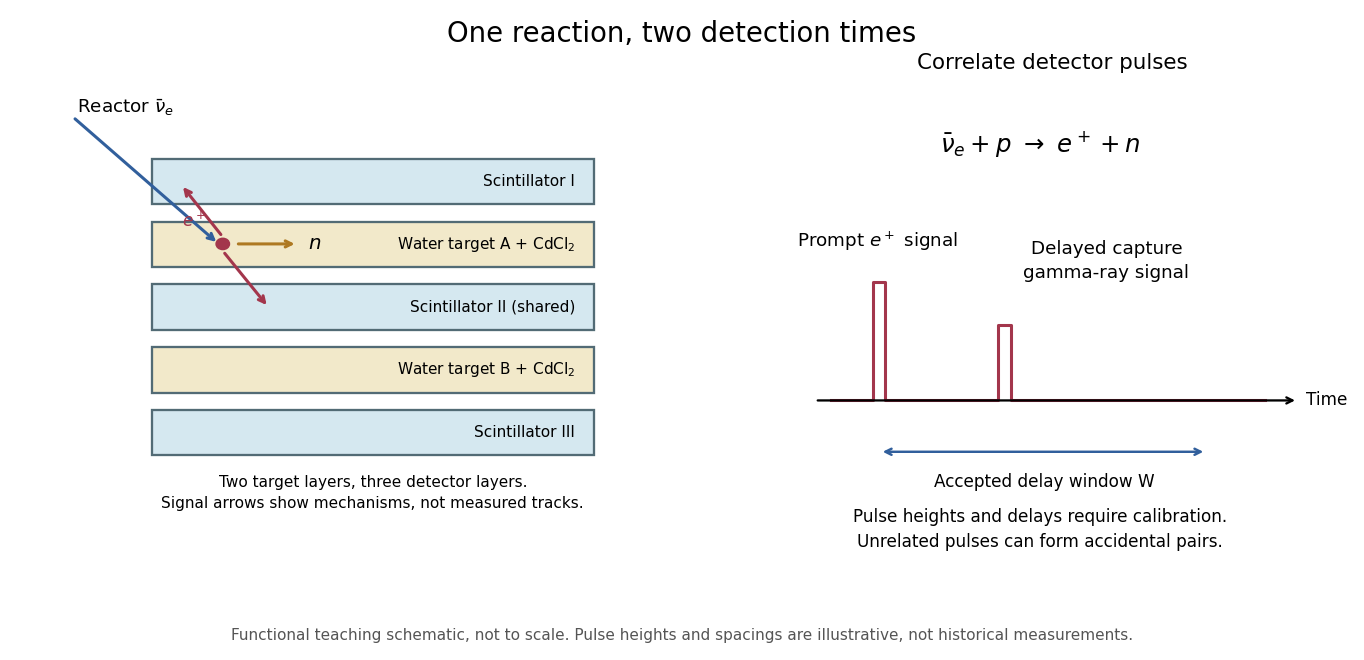
Separate prompt and delayed readouts of an antineutrino interaction
. Details. The original functional diagram separates the two signal mechanisms and their timing. It omits dimensions and phototube counts, and is not a reproduction of a historical drawing. The measured objects are detector pulses; identifying their common cause also requires calibration and background tests.
The 1956 paper describes positron-source and neutron-source calibrations, pulse-height gates and photographic pulse records. Diluting the target with heavy water halved the proton density and reactor signal while preserving neutron-detection efficiency. Changing the cadmium concentration altered capture timing; removing it removed the reactor signal. Added shielding tested competing external radiation. These interventions tested the reaction's ingredients, beyond simply observing a reactor-dependent count rate.[ref]
Detection of the Free Neutrino: a Confirmation by Clyde Cowan and others. pp. 103–104, detector analysis and Experimental Results, tests 2–5
Why not accept every delayed pulse? A longer window captures more genuine neutron capture signals, but also admits more accidental coincidences. Consider an original model with a capture waiting time following an exponential distribution of mean . Assume detection after a prompt signal accepts , with perfect time measurement and no lower cut. Integrating the normalized density givesThis assumes that moderation, competing capture channels, boundaries and electronic recovery can be represented or neglected in a single effective waiting-time model. It is not a fitted historical capture law.
Let independent prompt-like and delayed-like background streams have Poisson process rates and . The accidental coincidence pair rate in a directed window of full width is . Electronics producing at most one accepted delayed match per prompt instead give . These definitions coincide to first order when . Correlated backgrounds, such as one external neutron producing both a prompt recoil and a later capture, require separate controls; an independent-stream estimate cannot remove them.
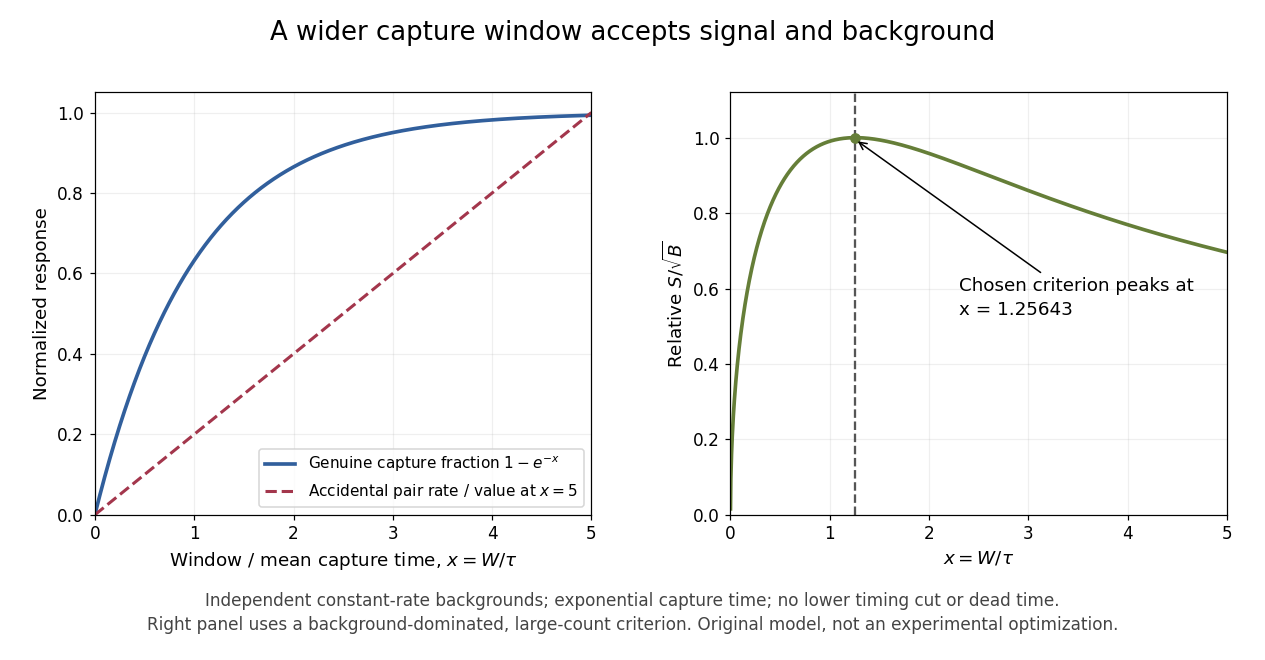
For chosen and , the accepted fraction is . With chosen and , the pair rate is , while the at-most-one rate is approximately . These are teaching parameters, not reported Savannah River rates. A measured uncorrelated background can be tested using displaced time windows; a reactor-off measurement addresses a different question and cannot by itself characterize every reactor-correlated background.
If genuine pairs arrive at rate before the timing cut, an exposure gives and expected accidental pairs . In a background-dominated large-count approximation, maximizing reduces to maximizing for . Differentiation gives the positive stationary solution , or . The endpoint solves the rearranged equation but is outside the domain of this derivative calculation; tends to zero at both positive-domain extremes.
Thus the chosen gives for this particular criterion, accepting about of genuine delayed signals. This differs from maximizing signal counts alone, which would favor longer windows. Small samples, appreciable signal fluctuations, unknown background, dead time and multiple-candidate vetoes require a fuller likelihood model. The calculation isolates a tradeoff rather than prescribing an experimental cut.
In the constant-rate mathematical model, an undecayed atomic nucleus has conditional probabilityof decaying during the next positive interval . The nuclear decay constant has units of inverse time. Its value describes a rate; it does not specify a scheduled death time for one atomic nucleus. The conditional probability is independent of the age , the memorylessness of the exponential distribution.
Take independently decaying atomic nuclei, each with lifetime drawn from an exponential distribution of rate . With no replenishment, the survivor count isEach indicator variable has success probability , so the binomial distribution givesThe smooth population law is the expected value , satisfying . One realization instead loses whole atomic nuclei at discrete times. An observed count above the smooth curve need not contradict the mathematical model.
For an original chosen example, let and half-life . Then . After , the survival probability is , givingThe standard deviation describes variation between repeated populations governed by these assumptions. It is not an uncertainty interval for a noiseless deterministic curve.
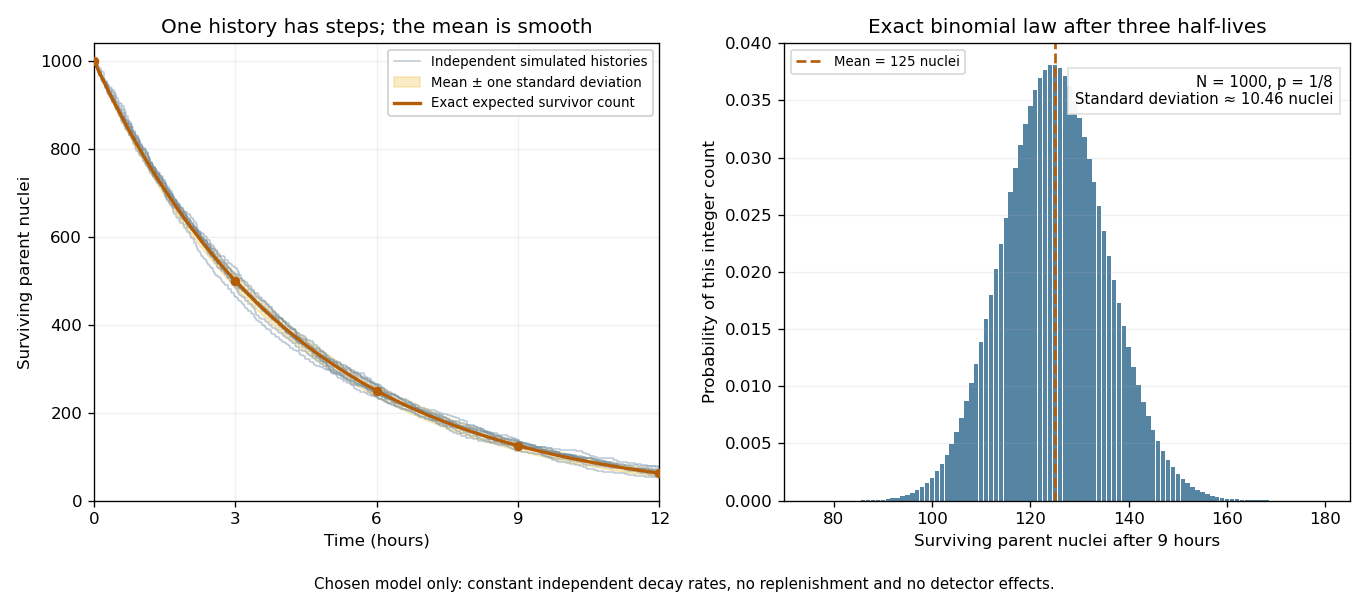
Random survivor counts and the smooth radioactive-decay law
. Original constant-rate model with independent parent atomic nuclei and a half-life. Simulated histories are compared with their exact expected value and a one-standard deviation band. The second panel shows the exact binomial distribution after three half-lives. These are model calculations, not measurements from a historical sample. Details.The half-life and the mean lifetime answer different questions:The first is the median of one lifetime, or the time when half the population survives on average. The second is the lifetime's expected value. In this example they are and approximately .
With parent atomic nuclei present, the conditional expected number of transformations in a short interval is approximately . The corresponding radioactive activity is . Averaging over the finite-population radioactive decay model gives . Its unit is the becquerel.[ref]
10.3 Radioactive Decay. University Physics Volume 3 by Samuel J. Ling and others; Equations 10.17–10.20 and the following becquerel definition
For a finite counting interval, depletion matters. Suppose each transformation is recorded independently with detection efficiency , with at most one count per transformation and no background. The expected value of the count between and isOnly when does this become approximately . A count rate therefore needs a detector model before it can be interpreted as the source's radioactive activity.
radioactive activity per volume, in . This differs from mass-specific radioactive activity, usually expressed per kilogram.
The probability that an event of a specified kind produces a registered count in a specified arrangement. For a radiation detector, geometry, intervening material and the detector response can all affect detection efficiency.
In his 2 March 1896 report, Henri Becquerel described uranium salt crystals acting on a photographic plate through opaque wrapping. A copper cross weakened the exposure behind it. Plates prepared during intermittent sunshine were left in a drawer and developed on 1 March; unexpectedly strong images prompted deliberate dark tests. He placed a plate and crystals inside two opaque boxes in a drawer; one crystal was separated from the emulsion by glass. After five hours, both produced images. The separation tested transmission without direct chemical contact.[ref]
The result challenged a dependence on immediate illumination. Henri Becquerel still considered long-lasting invisible phosphorescence a possibility, and explicitly withheld a final explanation. The photographic readout established an effect through intervening material; it did not count nuclear transformations or measure a nuclear decay constant.[ref]
Sur les radiations invisibles émises par les corps phosphorescents by Henri Becquerel. Final two paragraphs: tentative invisible-phosphorescence hypothesis and limits of the inference
Marie Curie's thesis describes powdered material on the lower plate of a capacitor, biased by a battery. Radiation made the intervening air conduct. The upper plate connected to an electrometer and a loaded piezoelectric crystal of quartz. Adjusting the load supplied a known compensating electric charge while keeping the electrometer at zero; charge divided by elapsed time determined the electric current. Voltage scans identified a collection plateau. Contact potentials affected weak-field readings; excessively strong fields could instead introduce additional ionization. Fixed geometry and plateau operation made comparisons meaningful.[ref]
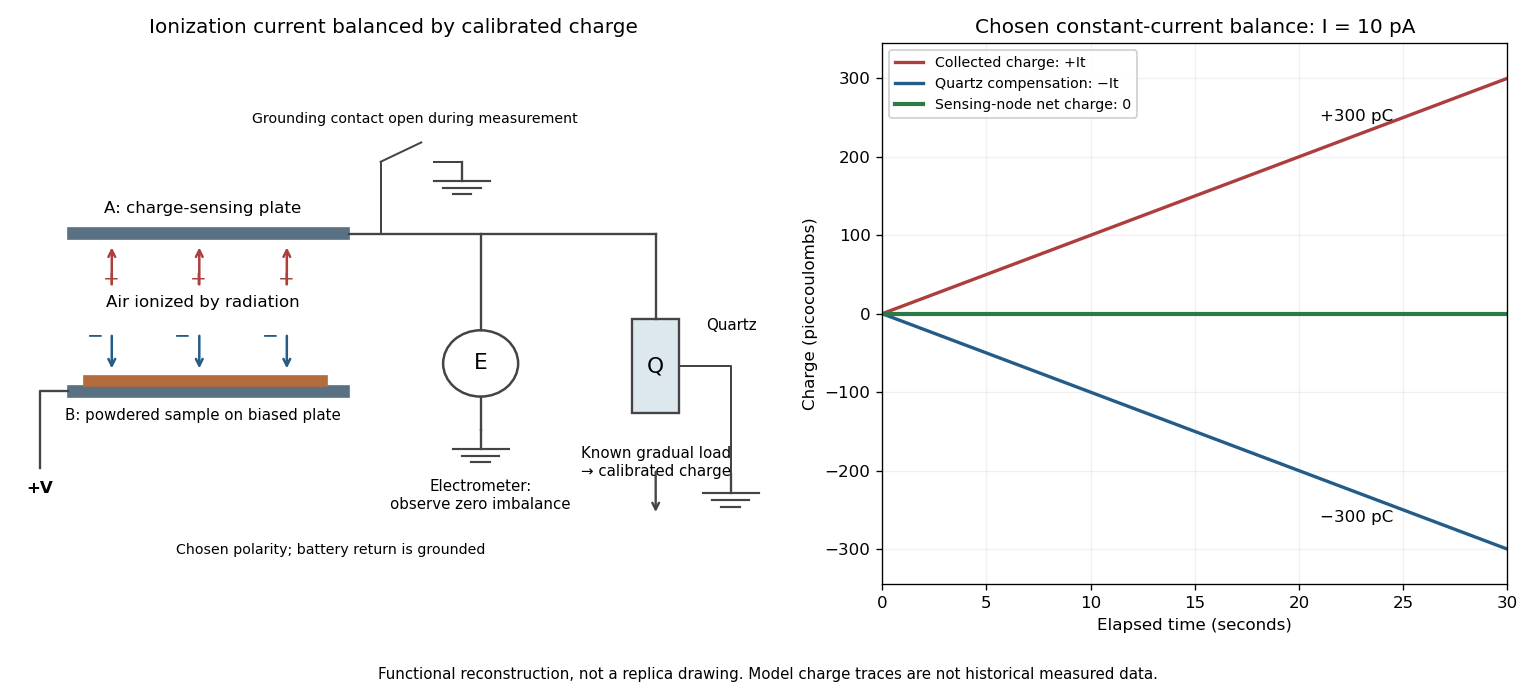
The null method turns a weak signal into a balance against a known quantity. In the diagram's chosen constant-current model, for givesSupplying over the same interval leaves zero net electric charge at the sensing node. The electrometer detects imbalance; the compensating-charge calibration supplies the numerical measurement.
This electric current measures collected charge produced by ionization. Converting it to becquerels additionally requires the energy deposition and charge-collection response per transformation. The apparatus can compare preparations without already possessing that complete source-to-signal calibration.
Radiogenic heating is thermal energy deposited by radioactive decay. If its specific heating rate is in watts per kilogram, the volumetric rate is and the heat input per horizontal area to a column of depth is . The distinction between specific and volumetric rates matters in dimensional analysis of a convective heat flux law.
In a chain with distinct decay constants, the Bateman equation expresses each population as a linear combination of the exponential functions . When two consecutive constants coalesce to , the repeated Laplace transform pole produces a term proportional to .
The Bateman equation gives the populations in a sequential radioactive decay chain. For a parent with population and an initially absent daughter, distinct decay constants give ; the first population satisfies .
A nucleus bound in a solid can emit or absorb a photon without exciting lattice vibrations, transferring momentum to the solid as a whole. The resulting recoil energy is negligible compared with the isolated-nucleus recoil, making very narrow resonant emission and absorption lines observable. The Pound-Rebka experiment uses this effect to resolve the small frequency shift from gravitational redshift.
The striking feature is the combination of a large photon energy and a tiny natural linewidth: an atomic nucleus can act as an extraordinarily selective energy filter. The Mössbauer effect supplies a narrow shared emission line and absorption line even when nuclear recoil would separate the corresponding free-nucleus lines. A slow mechanical motion can then tune their overlap through the Doppler effect. The Pound-Rebka experiment is an application to general relativity; the discovery experiment below concerns the recoil-free process itself.
A recoil-free nuclear transition emits or absorbs a gamma ray while leaving the internal vibrational state of the surrounding solid unchanged. It belongs to the elastic part of the process: no phonon is created or destroyed. The photon still carries momentum , where is the speed of light. The emitting solid takes momentum ; the absorbing solid takes . Conservation of momentum holds for each event.
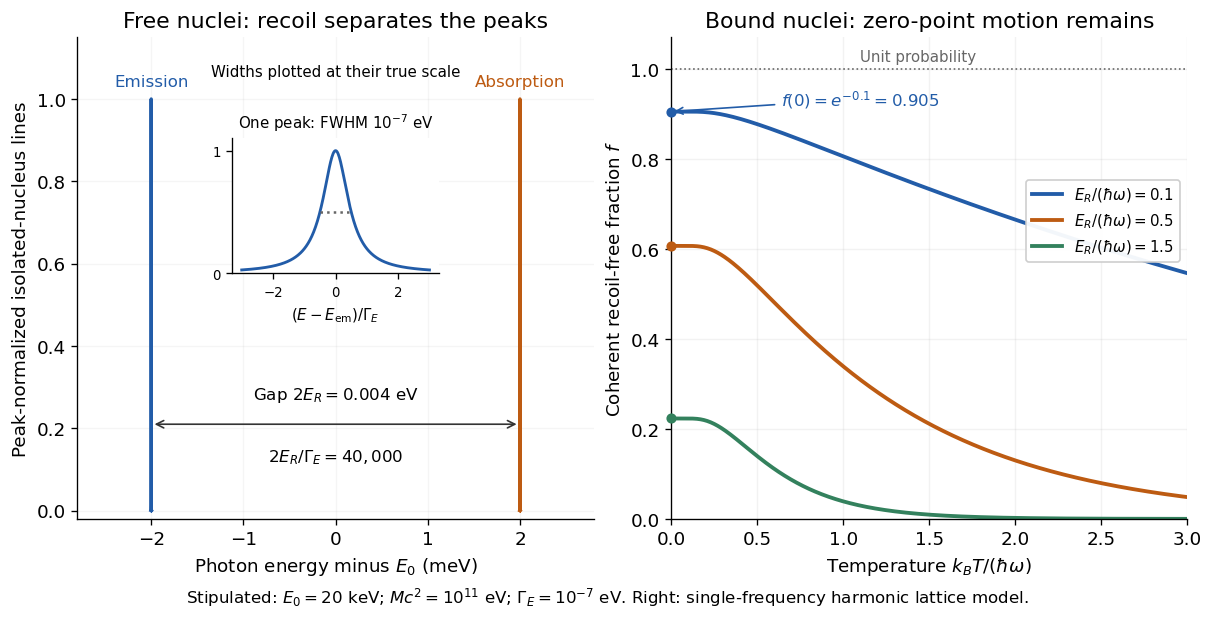
Why does an isolated atomic nucleus pose a problem? Start with an excited state at rest and let be its transition energy, with nuclear mass and . Conservation of momentum gives a recoil momentum of magnitude ; its nonrelativistic kinetic energy is thereforeBy conservation of energy, emission spends part of on nuclear recoil, whereas absorption must supply both and the final kinetic energy. To leading order,Thus the relevant comparison is against the overlapping spectral line widths, rather than alone. If greatly exceeds the widths, the isolated-nucleus lines have negligible overlap. Finite Lorentzian line shape tails mean that this is suppression, rather than an absolute prohibition on absorption.
For a bound atomic nucleus, the recoil-free channel transfers momentum to the center of mass of the emitting or absorbing solid, with negligible kinetic energy . Other channels exchange phonons and carry substantial energy into or out of the internal vibrations. A large makes the elastic channel's energy cost small; the vibrational quantum state determines its probability. Merely replacing by a large mass in the free-particle formula does not calculate that probability.
Here is a deliberately stipulated teaching system, independent of historical isotope data: , , and a single-line natural linewidth measured as an energy full width at half maximum. These give and . A solid of such nuclear masses has elastic recoil energy , far below . In this article is an energy width; the corresponding lifetime is , with the Planck constant divided by .
The Lamb-Mössbauer factor is the fraction in the coherent elastic line. In the harmonic-lattice approximation it is a Debye–Waller factor. Write the displacement of the emitting or absorbing atomic nucleus relative to its equilibrium site as , put , and define the angular wavenumber . Choose the equilibrium site so that . Its directional displacement variance is . A harmonic solid in thermal equilibrium has a Gaussian distribution for this displacement, whose characteristic function gives the elastic amplitudeTaking the squared magnitude gives the intensity fractionThe factor belongs to the amplitude exponent; it disappears when the amplitude is squared. For an isotropic solid, , so an equivalent expression is . Directional and three-dimensional mean squared displacements must not be substituted for one another without this factor.
An Einstein solid approximation replaces the vibrational spectrum by one positive angular frequency . For the directional quantum harmonic oscillator, with the same effective mass as in ,Here is the Boltzmann constant and is temperature. This follows by taking the expected value of in each oscillator energy eigenstate, , and averaging with the Boltzmann distribution. Substitution givesThe zero-temperature limit retains zero-point energy and a nonzero displacement variance. Cooling therefore increases the recoil-free fraction towards a limit below one for finite . At high temperature, the exponent tends to . This is a single-frequency approximation to a harmonic lattice's coherent elastic weight, not a complete description of all zero-net-energy processes of an isolated oscillator. Real vibrational spectra, directional binding and anharmonic motion can change its predictions.
Extend the stipulated teaching system by choosing , so . Then , while at . If source and absorber are independent, the fraction of events eligible for recoil-free emission followed by recoil-free absorption contains the product ; this gives for two zero-temperature copies. It is not the total probability of absorption, which also depends on the number of resonant atomic nuclei, geometry and spectral line overlap.
Let be the source velocity towards the absorber, positive for approach along the photon direction. A first-order Lorentz transformation of the photon energy gives ; hence, for ,Moving the source shifts its emission line through the stationary absorption line. A minimum in transmitted photon counts marks their strongest overlap. The absorber is the narrow energy discriminator; the downstream particle detector only needs to count the transmitted gamma rays.
For a thin absorber with unsplit Lorentzian line shapes, the overlap is a convolution of the source and absorber profiles. The combined full width at half maximum is . A simple expected transmission model isHere is the off-resonance intensity, encodes a relative shift of the two transition energies, and includes the resonant absorber strength and . The convolution result can be checked by multiplying the Fourier transforms of two Cauchy distributions: their exponential decay constants add. The width of the absorption dip in velocity is , rather than the width of one individual spectral line converted to velocity.
For the teaching system with and , the dip's full width at half maximum is . Stipulate at zero temperature and expected off-resonance counts per equal-duration bin: the central bin then has expected counts, and the half-depth bins have . These are model expectations, without sampled counting noise. Holding all other parameters fixed while heating both lattices to multiplies by . This isolates how a falling recoil-free fraction weakens the dip.
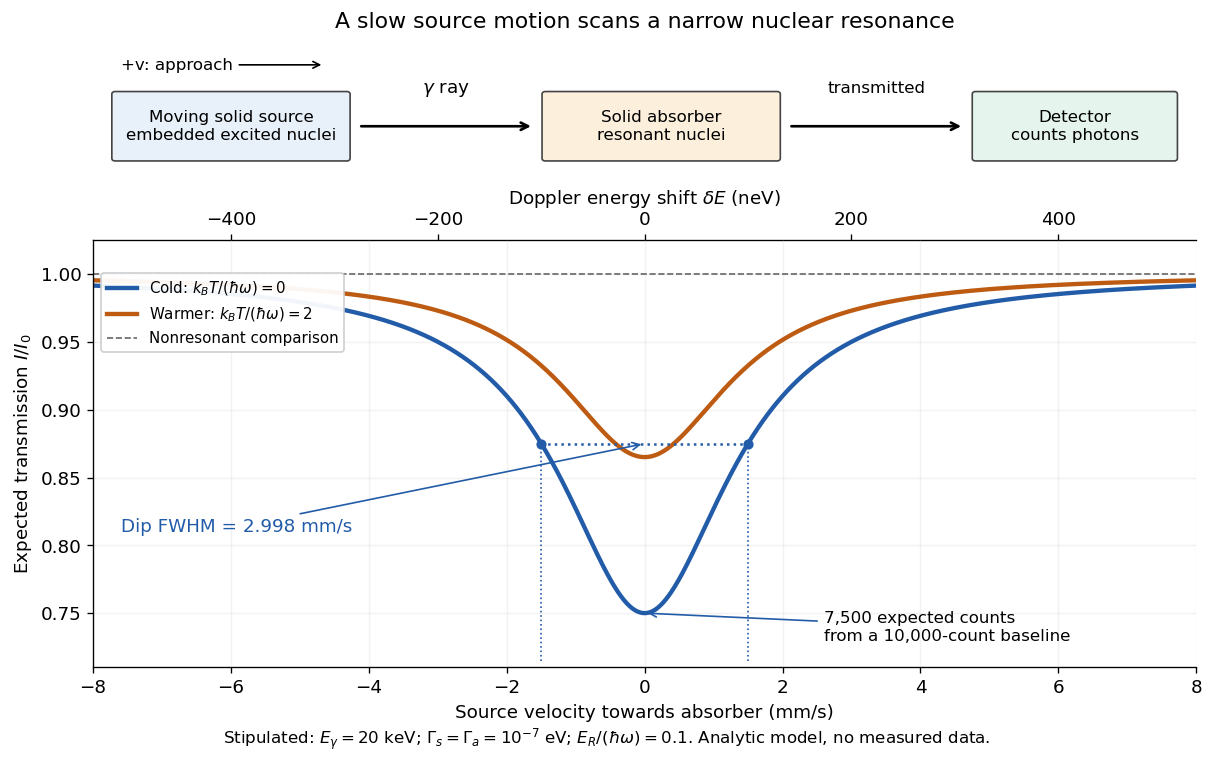
Mechanical velocity scans an absorption line much narrower than detector resolution
. Original ideal transmission model, with schematic source, absorber and counting detector. Both curves use the same stipulated energy widths; heating changes only . Dashed markers show the cold curve's half-depth positions. This is a new analytic teaching scan, not a historical measurement or a fit. The upper scale converts velocity to Doppler effect energy shift. Details.The thin-absorber model is deliberately limited. A thick absorber can saturate and broaden the dip; unresolved hyperfine structure can create multiple components. Differences in chemical surroundings can shift the centers, and uncontrolled motion can smear them. These effects must be modeled before interpreting an observed width as a natural linewidth. Their sensitivity also makes the Mössbauer effect useful: a small displacement of a narrow dip can reveal a small change in the local nuclear environment.
Rudolf Ludwig Mössbauer found the effect during his Heidelberg work in 1957.[ref]
Rudolf Ludwig Mössbauer, CV by Lindau Nobel Laureate Meetings. CV, opening paragraphs: Heidelberg discovery in 1957
His 1961 lecture Recoilless nuclear resonance absorption of gamma radiation describes crystalline preparations using the transition of the iridium isotope . Separate cryostats, lead collimation and a particle scintillation detector measured transmission. Liquid-air cooling of both preparations enhanced absorption; cooling only the source against a room-temperature absorber slightly reduced it. A rotating source cryostat supplied nearly constant projected velocities over selected arcs. Centimetres per second suppressed absorption relative to zero velocity; a nonresonant absorber supplied the comparison. This tested a narrow common emission/absorption energy beyond the detector's resolution. Temperature data alone had not established its width. The lecture cites the initial and direct-verification publications from 1958.[ref] Articles were limited to the first 100 out of 219 total.
Articles by others on the same topic

Nuclear physics is the branch of physics that deals with the study of atomic nuclei, their constituents (protons and neutrons), and the interactions that occur between them. It encompasses a variety of topics, including: 1. **Structure of the Nucleus**: Understanding the arrangement of protons and neutrons within an atomic nucleus, including models that describe nuclear stability and the forces that hold the nucleus together (strong nuclear force).



Nuclear physics is basically just the study of the complex outcomes of weak interaction + quantum chromodynamics.