Reverse the finite list of sequence terms and add it to the original list. At position ,Every position therefore contributes the same value. Reversal preserves the sum, giving and the stated formula. The symmetry explains why the endpoint average represents the whole list; one does not need to add each entry separately.
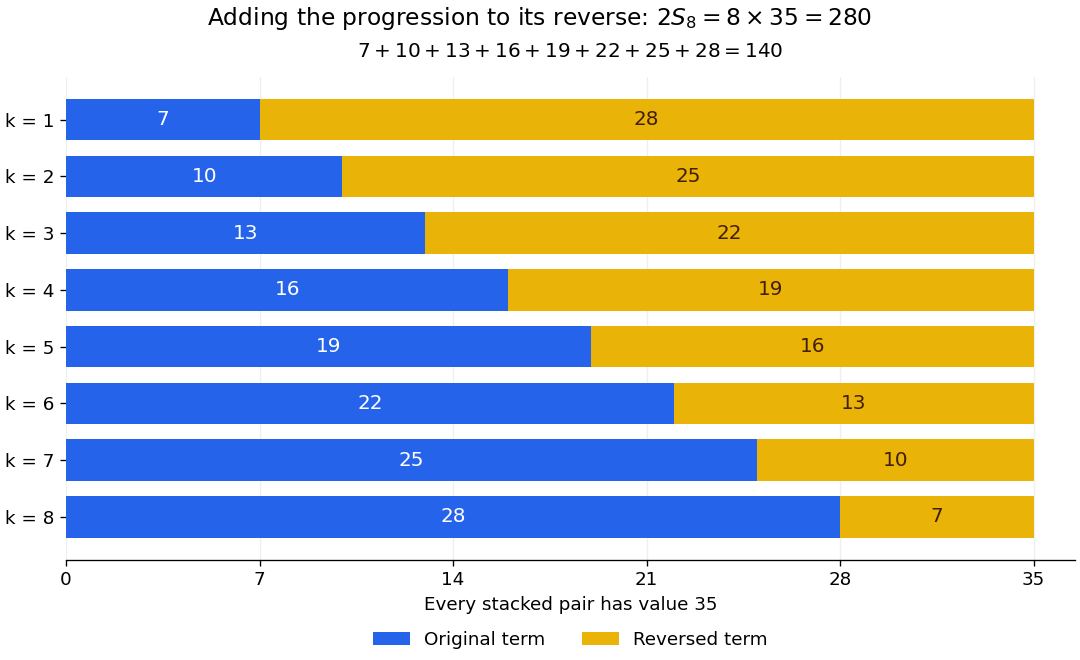
An arithmetic progression and its reverse make eight equal pairs, each of value thirty-five
. Original positive-value example . Blue bars show the original entries; yellow bars show the reversed entries. The combined sum is , twice the original sum . The algebraic argument also applies when some entries are negative. Details.
Articles by others on the same topic
There are currently no matching articles.