In the rotating terrestrial frame, horizontal pressure gradient force and Coriolis force balance in geostrophic balance. Gravity establishes the approximately vertical hydrostatic equilibrium; it is not an additional horizontal force in this balance. With eastward , northward , upward unit vector and Coriolis parameter ,The geostrophic wind runs along atmospheric isobars, with lower pressure on its left in the Northern Hemisphere.
Interpreting the stated south-to-north gradient as , , while . Using the external nominal Earth's rotation rate gives the meridional-pressure-gradient geostrophic windBoth zonal velocities are westward; their signs reverse if the supplied gradient is interpreted as a northward decrease. [ref]
IERS Conventions (2010) by International Earth Rotation and Reference Systems Service. Table1.2, physical PDF p.19: nominal mean angular velocity
The validity criteria for geostrophic balance require horizontal acceleration and friction to be small compared with the balancing forces: Rossby number and slow evolution compared with . The approximation fails near the equator, on sufficiently small or rapidly changing scales, in strongly curved flow needing appreciable centripetal acceleration, and in the frictional surface layer. Neglecting friction near the ground is the stated idealization.
For an illustrative geostrophic wind with linear drag, use acceleration with . The steady horizontal momentum equation givesDrag reduces the wind and hence its Coriolis acceleration; the wind crosses isobars toward lower pressure. Here it points southwest. The pressure-gradient acceleration points south, Coriolis northwest and drag northeast; the three forces sum to zero. The cross-isobar angle satisfies for . A turbulent boundary layer has a vertically varying stress rather than necessarily this constant linear drag.
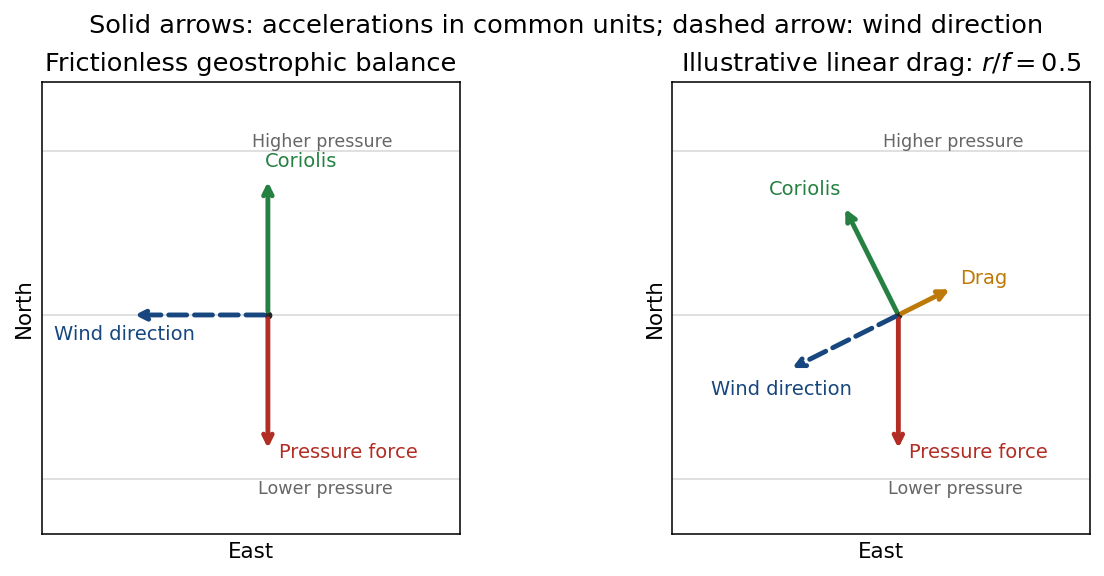
For northward-increasing pressure, frictionless westward flow becomes a slower southwestward flow under illustrative linear drag
. Source. Details. 
Use spectral radiant exitance per unit wavelength. The Planck law isA hotter blackbody radiates more at every wavelength, its wavelength peak moves to shorter wavelengths according to Wien's displacement law, and its integrated flux rises as by the Stefan–Boltzmann law. The wavelength convention matters: a spectrum plotted per unit frequency has a different peak transformation.
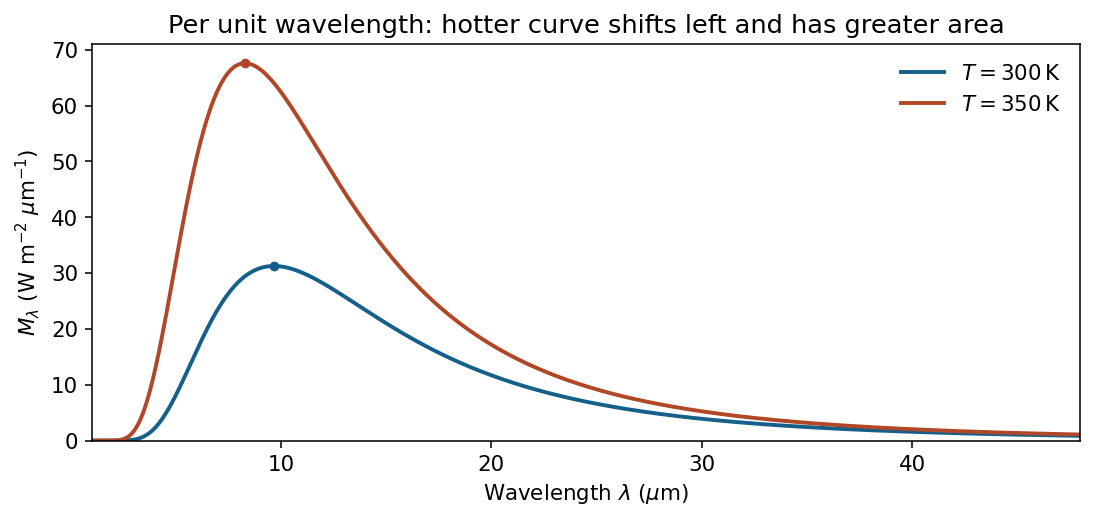
Illustrative wavelength spectra: a hotter blackbody has a larger total flux and a shorter peak wavelength
. Source. Details. 
For planetary equilibrium temperature, assume an isotropic blackbody star, a circular orbit, negligible internal heating, unit surface thermal emissivity and efficient global heat redistribution so the surface has one temperature. The received stellar irradiance is . A planet of radius intercepts but radiates over , giving the projected-area factor in planetary energy balanceWithout the uniform-temperature assumption, this calculation gives , not a unique arithmetic mean of surface temperature.
With Bond albedo , the absorbed fraction is . Hencea decrease of approximately . This albedo weights incident stellar light and does not imply thermal emissivity .
Define the planetary effective emissivity by outgoing top-of-atmosphere flux . Maintaining the same absorbed stellar power with givesThe greenhouse effect allows thermal radiation to escape from colder layers, so the outgoing flux is less than a black surface at would emit. Downward atmospheric emission contributes to the surface energy balance; this does not violate the top-of-atmosphere energy balance.[ref]
Climate and Earth's Energy Budget by NASA Earth Observatory. Thermal radiation, atmospheric absorption and effective radiating versus surface temperature
A single-layer greenhouse model makes the distinction quantitative. Take a shortwave-transparent, isothermal layer with infrared absorptivity and emissivity , above a surface black in the thermal infrared. Writing , its surface and atmospheric balances areFor , . Radiation escaping to space is , soThus is the planet's effective emissivity; is the layer's infrared emissivity within this particular model. They are not interchangeable. Real atmospheres require wavelength-dependent absorption, a vertical temperature profile and nonradiative heat transport; the measured temperatures alone do not uniquely retrieve an atmospheric optical profile.
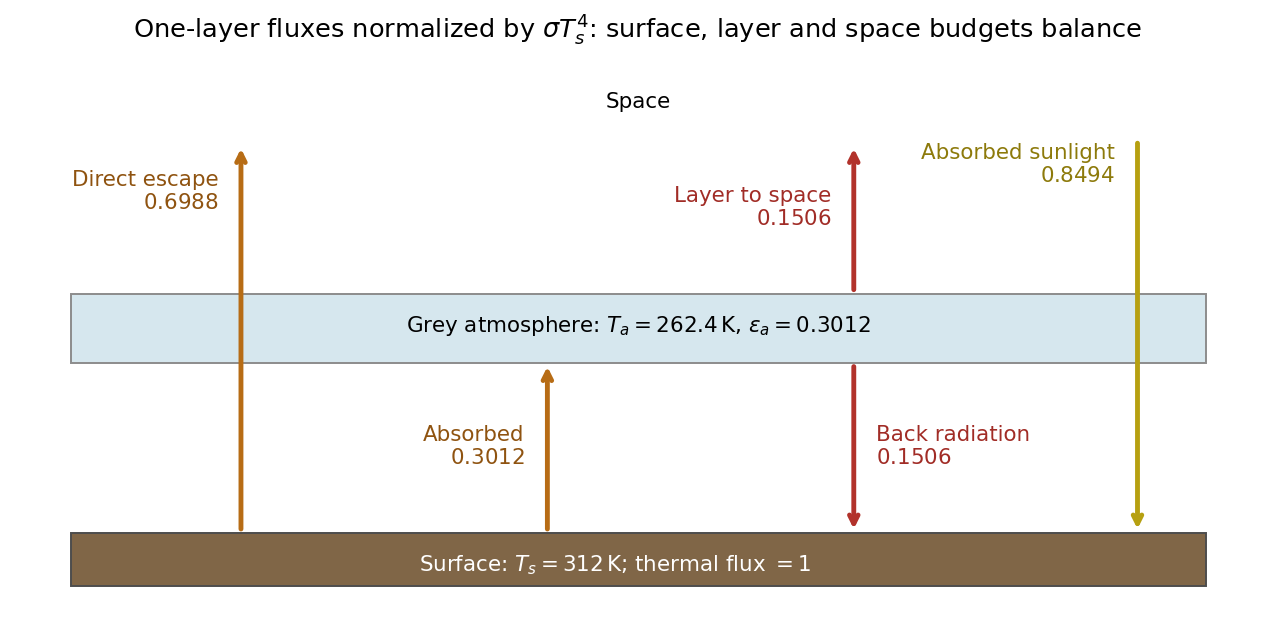
One-layer radiative equilibrium distinguishes planetary effective emissivity from the infrared emissivity of the atmosphere
. Source. Details. 
A teleconnection is correlated atmospheric variability between separated regions. A principal dynamical pathway is a Rossby-wave teleconnection: a displaced air column conserves potential vorticity, so changing planetary vorticity must be balanced by changing relative vorticity. The background potential-vorticity gradient supplies the restoring mechanism.
In a uniform zonal current on a beta plane, a simple Barotropic Rossby wave hasThe intrinsic phase propagates westward for ; advection can leave a nearly stationary pattern in the terrestrial frame. Energy and information travel with the group velocity, not necessarily with individual crests or the same air parcels. A jet stream can guide wave packets and link distant ridges and troughs.
For example, persistent anomalous tropical heating can excite wave trains that alter remote pressure, temperature and storm tracks. Tropical Pacific ocean-temperature anomalies can modify that heating, yielding reproducible extratropical patterns. Their phase and strength depend on the background winds, potential-vorticity gradients, damping, season and eddy feedbacks. A correlation pattern is not by itself proof of a unique causal pathway, and not every teleconnection is a single stationary linear wave.[ref]
Teleconnections and stationary Rossby waves by Isaac Held. 9March2015: rotating-sphere response to localized equatorial heating and extratropical ENSO patterns
A foehn wind is relatively warm, dry downslope air on a mountain's lee side. In the classical condensation pathway, ascending windward air expands and cools at the dry adiabatic lapse rate until the lifting condensation level. Condensation then releases latent heat, reducing the cooling rate to the moist adiabatic lapse rate. Atmospheric precipitation removes condensate, and the descending parcel warms by compression at approximately the dry rate. Its relative humidity falls.
For equal starting and finishing heights, complete condensate removal and a constant moist lapse rate above condensation height , the precipitation-driven foehn warming isHere is the parcel's maximum height and . The warming is adiabatic compression during descent, not heating by friction. Without condensation or a difference in source air, a reversible dry parcel returning to its original height would regain its original temperature.
Precipitation is not essential to every foehn event. Isentropic foehn drawdown can bring air of higher potential temperature from aloft down the lee slope; turbulent mixing and extra solar heating beneath clear skies can also contribute. The sketch shows the classical rainout pathway rather than asserting a unique mechanism.[ref]
Foehn effect by Met Office. How does the foehn effect work? Condensation/rainout, drawdown, mixing and radiative warming
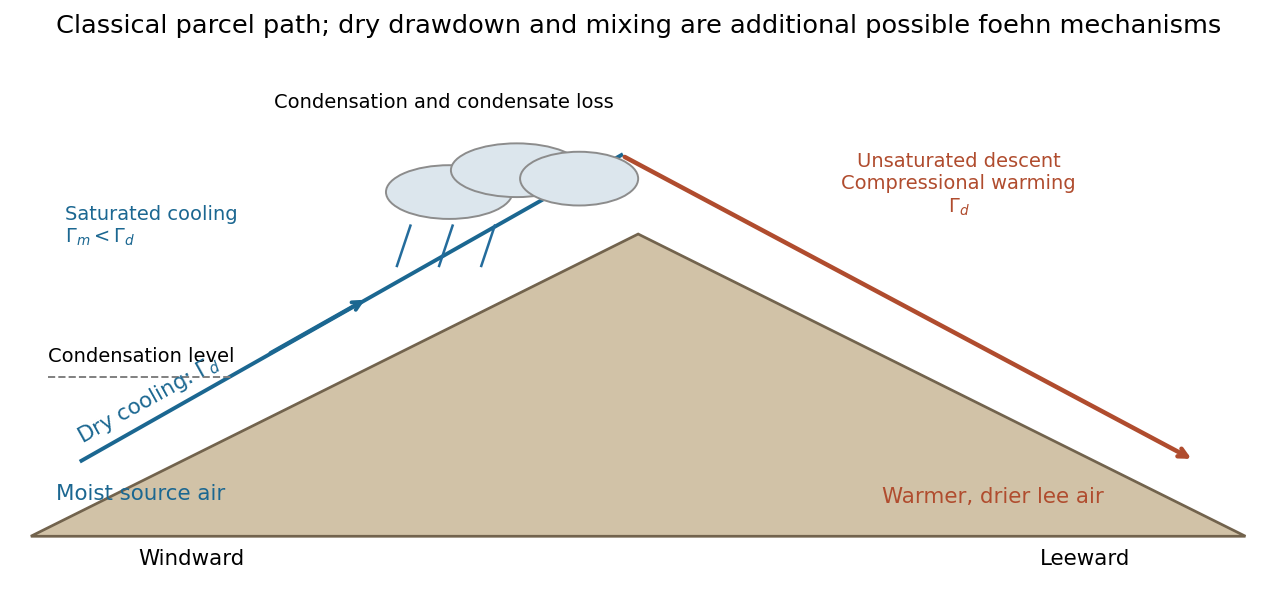
Classical foehn pathway: moist ascent and condensate loss followed by dry compressional warming on the lee side
. Source. Details. 
For dry atmospheric Ertel potential vorticity, use absolute vorticity and potential temperature :The conservation statement is Ertel's theorem for smooth, inviscid, adiabatic flow with conservative body forces and a thermodynamic equation of state . Stretching of cancels deformation of in their material derivative; the remaining baroclinic triple product vanishes because lies in the span of . The atmospheric form includes ; the commonly used Boussinesq approximation version has a different normalization.
In a predominantly vertical stratification, . Thus rotation and stratification jointly label air masses. Material conservation explains how parcels deform and stretch while preserving a useful scalar, supports Rossby waves, and helps diagnose sharp fronts, jets and stratospheric intrusions.
Under an appropriate balance model, potential-vorticity inversion recovers associated wind and temperature fields from a PV distribution together with stratification and boundary data. PV alone does not specify every component of an arbitrary atmospheric flow. Potential-vorticity generation by heating and friction limits conservative parcel reasoning near strong heating, surface stress or mixing.[ref]
Fundamentals of Atmosphere-Ocean Dynamics by Michael Edgeworth McIntyre. PartII§12, equationII.17, physical PDF pp.150–152: dry atmospheric PV and qualified invertibility
Articles by others on the same topic
There are currently no matching articles.