Let . It is never zero, since . On the unit circle,Dividing these identities givesAny other continuous lift of the argument differs by an integer multiple of , which leaves the exponential unchanged.
Differentiate the argument through the nonvanishing curve, using . Since ,Also . Subtracting one therefore givesThus the lifted boundary angle is strictly increasing. Its total change around the circle is , because the disk automorphism has boundary degree one. The same total change follows directly from the winding number one of . This is the boundary-angle derivative of a disk automorphism.
The disk automorphism satisfies and maps the unit circle bijectively to itself. Its derivative is bounded above and away from zero on the closed disk. By conformal invariance of planar Brownian motion, the image path up to the exit time is a time-changed planar Brownian motion started at zero. Its exit point is ; the clock changes when it exits, but not where.
The original exit time is finite almost surely. For example, is a martingale, so . Boundedness of makes the image exit clock finite too. By rotational invariance of planar Brownian motion, the image exit angle is uniform on .
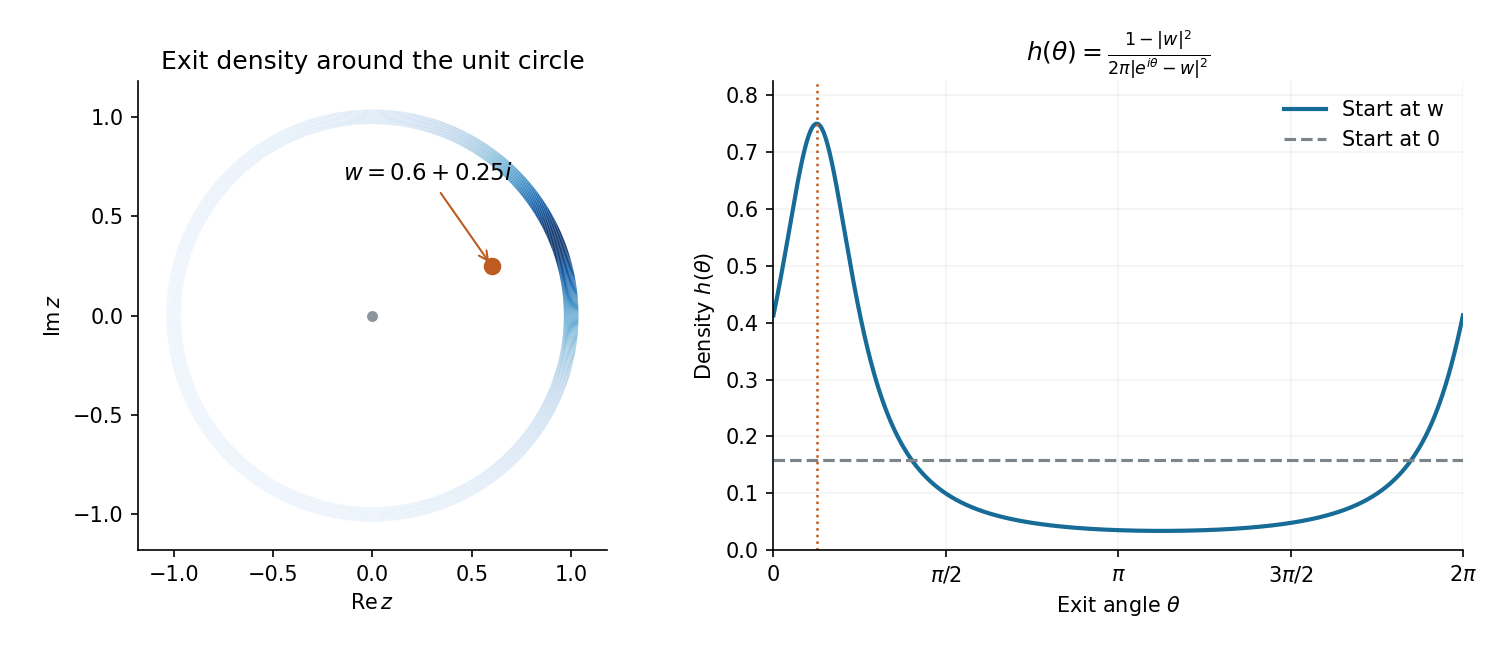
Let . Parts (a) and (b) show that modulo is uniform, where is strictly increasing and increases by exactly in one circuit. The one-dimensional change-of-variables formula therefore givesIts integral is one because the total angle change is . This harmonic measure density is the Poisson kernel for the unit disk divided by . It is uniform for and concentrates near the boundary point closest to as increases.

Articles by others on the same topic
There are currently no matching articles.