Source: released examination bundle,
Part C 2007 11.pdf, pages 457–460. All three questions are covered. No mark allocations are printed.Write , where the coordinates are independent standard Brownian motions, and write . The Cauchy-Riemann equations imply . Itô's formula therefore makescontinuous local martingales. Their quadratic variations and quadratic covariation areIndeed the two gradient norms are equal to , and their dot product vanishes by the Cauchy-Riemann equations.
The clock is finite at every finite time, since a continuous Brownian path has compact range there and is continuous. To show its lifetime is infinite, choose a small disc on which ; such a disc exists because the entire function is nonconstant. A supporting recurrence result is that planar Brownian motion spends infinite total time in every nonempty open disc almost surely. One proof combines recurrent returns to a smaller disc with the strong Markov property: each visit has a uniformly positive chance of lasting a fixed positive time in the larger disc. Equivalently, use the divergence of a positive planar Brownian occupation integral. ThereforeFinally the common-clock time change of orthogonal local martingales states that two continuous local martingales starting at zero with common bracket , zero cross bracket, and are the coordinates of a planar Brownian motion evaluated at . Applying it gives a planar Brownian motion starting at zero withThis proves conformal invariance of planar Brownian motion in the entire-function setting, including the divergence of the conformal Brownian clock for an entire function.
Apply part (a) to the entire function . Its derivative has modulus one, so its conformal Brownian clock is . Thuswhich is a planar Brownian motion starting from the rotated initial point. In particular, if the initial point is zero, its law is unchanged. This is rotational invariance of planar Brownian motion.
Start a planar Brownian motion at zero and apply part (a) to the entire function . ThenThe left side never vanishes. The clock is continuous, starts at zero, and tends to infinity almost surely, so its range is all nonnegative times. Consequently the complex Brownian motion never reaches zero at any time . Every planar Brownian motion started at one has that same law, henceThis is the complex exponential construction of planar Brownian motion and proves that a fixed point is a polar point for planar Brownian motion. The divergence of the clock is essential: it makes this a conclusion about all Brownian times.
Let . It is never zero, since . On the unit circle,Dividing these identities givesAny other continuous lift of the argument differs by an integer multiple of , which leaves the exponential unchanged.
Differentiate the argument through the nonvanishing curve, using . Since ,Also . Subtracting one therefore givesThus the lifted boundary angle is strictly increasing. Its total change around the circle is , because the disk automorphism has boundary degree one. The same total change follows directly from the winding number one of . This is the boundary-angle derivative of a disk automorphism.
The disk automorphism satisfies and maps the unit circle bijectively to itself. Its derivative is bounded above and away from zero on the closed disk. By conformal invariance of planar Brownian motion, the image path up to the exit time is a time-changed planar Brownian motion started at zero. Its exit point is ; the clock changes when it exits, but not where.
The original exit time is finite almost surely. For example, is a martingale, so . Boundedness of makes the image exit clock finite too. By rotational invariance of planar Brownian motion, the image exit angle is uniform on .
Let . Parts (a) and (b) show that modulo is uniform, where is strictly increasing and increases by exactly in one circuit. The one-dimensional change-of-variables formula therefore givesIts integral is one because the total angle change is . This harmonic measure density is the Poisson kernel for the unit disk divided by . It is uniform for and concentrates near the boundary point closest to as increases.
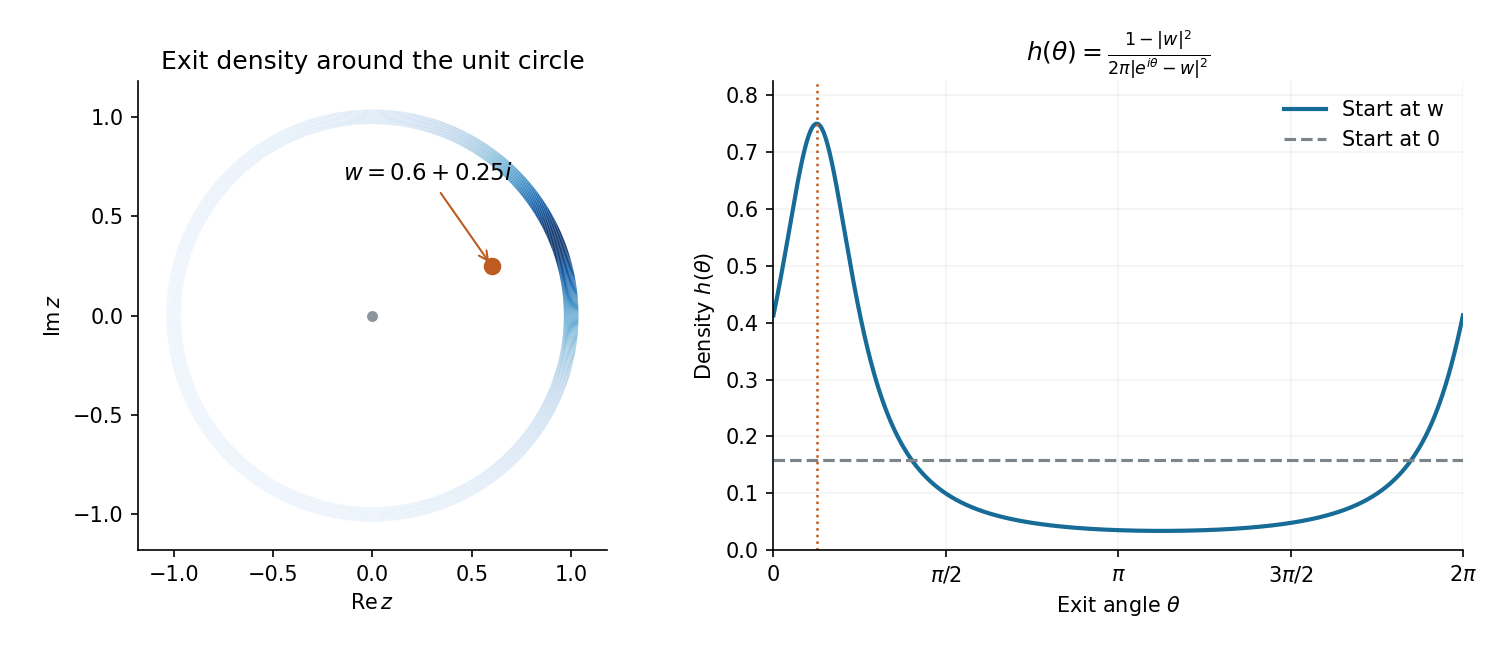
The disk exit-angle density for Brownian motion started at w=0.6+0.25i. Darker boundary arcs have greater density; the dashed horizontal line is the uniform density for a start at the centre.
Details. 
A bounded holomorphic function of planar Brownian motion is a local martingale up to exit, because its real and imaginary parts are harmonic and Itô's formula has zero drift. Stop before the given . Localization inside compact subdisks gives the local martingale , and makes it bounded. The bounded local martingale criterion therefore gives a true martingale.
Exit from the unit disk is finite almost surely, so is finite too. Taking and using the dominated convergence theorem yieldsThe same proof works for any bounded holomorphic function, after rescaling if needed; it does not require the stopping time itself to be bounded.
Since , the function extends analytically to zero by . It is bounded on the disk: outside , , while on the closed half-radius disk its analytic extension is continuous and hence bounded.
Fix and choose . Let be the first exit time of Brownian motion started at from the radius- disk. The bounded analytic martingale identity in part (a) givesOn this exit circle, . The triangle inequality gives . Letting proves , and thereforeAt zero the claim holds by the assumed zero value. This is the Schwarz lemma, obtained from Brownian optional stopping rather than an analytic maximum principle.
Let be an equality point and set , so . For any , the same Brownian exit identity givesPart (i) gives , so the real random variable in the expectation is at most one. Equality of its mean to one forces almost surely. By the scaled version of the exit density from Question 2, every nonempty arc of the exit circle has positive probability. Continuity of on that circle therefore implies at every boundary point of the radius- disk.
For any inside that circle, the Brownian exit identity now gives . Letting increase to one makes this true throughout . Writing yieldsThis completes the equality case of the Brownian proof of the Schwarz lemma.
Articles by others on the same topic
There are currently no matching articles.