For the three elementary transformations just proposed, a qualitative free-energy profile has three transition states and two intermediates. The sugar substituents and indole C3 substituent stay unchanged, so the structural shorthand below suppresses them while retaining the reacting atoms.
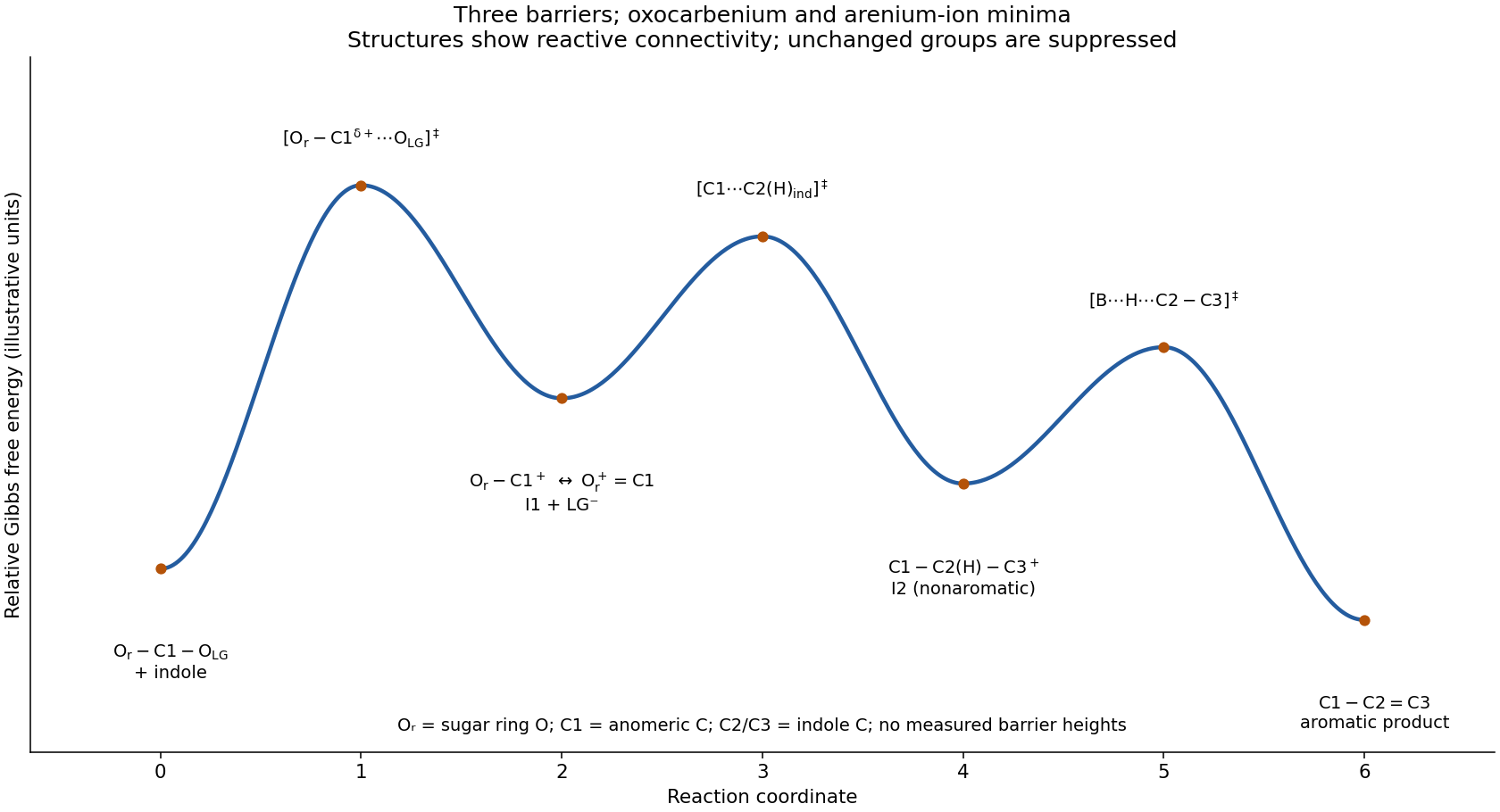
Qualitative three-step free-energy profile with intermediate and transition-state connectivity
. Details. 
The first transition state has a partially broken anomeric C1–O(leaving group) bond and developing oxocarbenium character, . Its following minimum is the glycosyloxocarbenium ion plus counterion. The second transition state has a forming C1–C2 bond, , and developing positive charge in the indole. Its following minimum is the covalently joined arenium ion with an intact C2–H bond. The third transition state has simultaneous C2–H cleavage, B–H formation and restoration of the indole pi bond, . It leads to the aromatic C-linked product and protonated base.
The vertical separations are illustrative because no activation free energies or equilibrium constants are supplied. In particular, the highest barrier cannot be identified experimentally from this drawing alone. protonation of the leaving group is treated as an initial rapid equilibrium in the chosen mechanism; explicitly resolving it would add the corresponding proton-transfer state and intermediate.
Articles by others on the same topic
There are currently no matching articles.