ammonia and cyclohexylamine are neutral donors, whereas each coordinated chloride and acetate has charge . Charge balance therefore gives Pt(II) in cisplatin and Pt(IV) in satraplatin:The two acetate groups count once each; their carbonyl and alkoxy oxygen atoms do not make each ligand doubly charged.
cisplatin has square planar molecular geometry and a metal centre. Choose and along the four Pt–donor directions. The strongly antibonding orbital is highest and remains empty; the other four d orbitals are doubly occupied. The square-planar splitting is represented by the conventional qualitative orderThe ordering among the lower occupied levels can depend on the ligand set, and the cis arrangement removes exact fourfold symmetry. The robust result is the filled lower four levels and empty highest level.
satraplatin has approximately octahedral molecular geometry around Pt(IV), . Its large octahedral splitting favours a low-spin complex:All three orbitals are paired. Mixed ligands remove exact degeneracies, but do not change this qualitative occupancy.
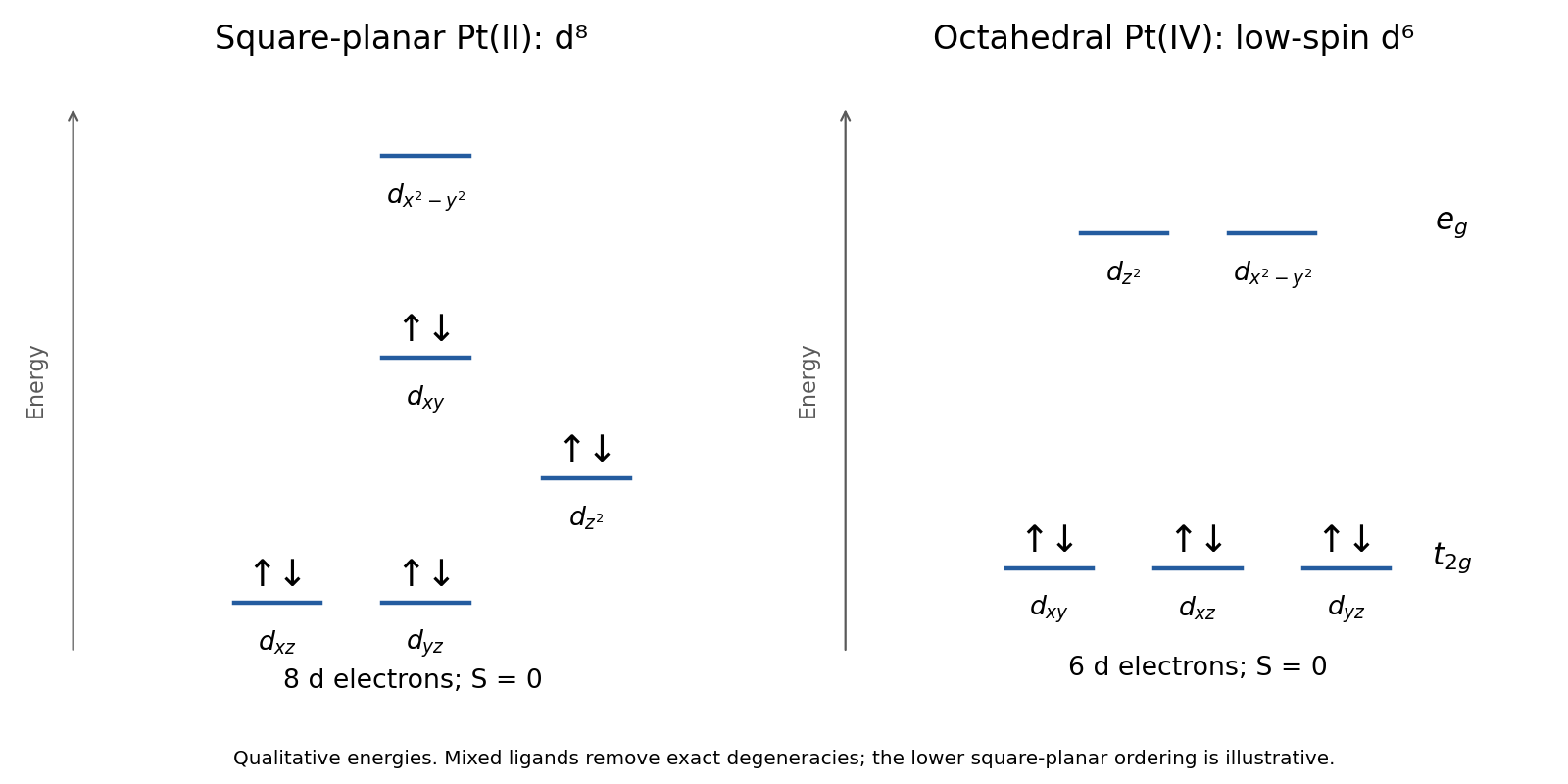

platinum is in group 10, so subtracting its oxidation state gives for Pt(II) and for Pt(IV). Adding two electrons from each coordinated donor gives the local valence electron counting resultsEach acetate in the depicted structure is monodentate, binding through one oxygen. The 16-electron count of the square-planar complex is normal for a low-spin late-metal centre; it is not a missing ligand inferred from the 18-electron rule.
Both complexes have all their electrons paired, so . Their spin-only magnetic moment is thereforeThey exhibit diamagnetism. The formula describes the spin contribution; it does not say that a closed-shell sample has no diamagnetic response to an applied field.
Articles by others on the same topic
There are currently no matching articles.