ammonia and cyclohexylamine are neutral donors, whereas each coordinated chloride and acetate has charge . Charge balance therefore gives Pt(II) in cisplatin and Pt(IV) in satraplatin:The two acetate groups count once each; their carbonyl and alkoxy oxygen atoms do not make each ligand doubly charged.
cisplatin has square planar molecular geometry and a metal centre. Choose and along the four Pt–donor directions. The strongly antibonding orbital is highest and remains empty; the other four d orbitals are doubly occupied. The square-planar splitting is represented by the conventional qualitative orderThe ordering among the lower occupied levels can depend on the ligand set, and the cis arrangement removes exact fourfold symmetry. The robust result is the filled lower four levels and empty highest level.
satraplatin has approximately octahedral molecular geometry around Pt(IV), . Its large octahedral splitting favours a low-spin complex:All three orbitals are paired. Mixed ligands remove exact degeneracies, but do not change this qualitative occupancy.
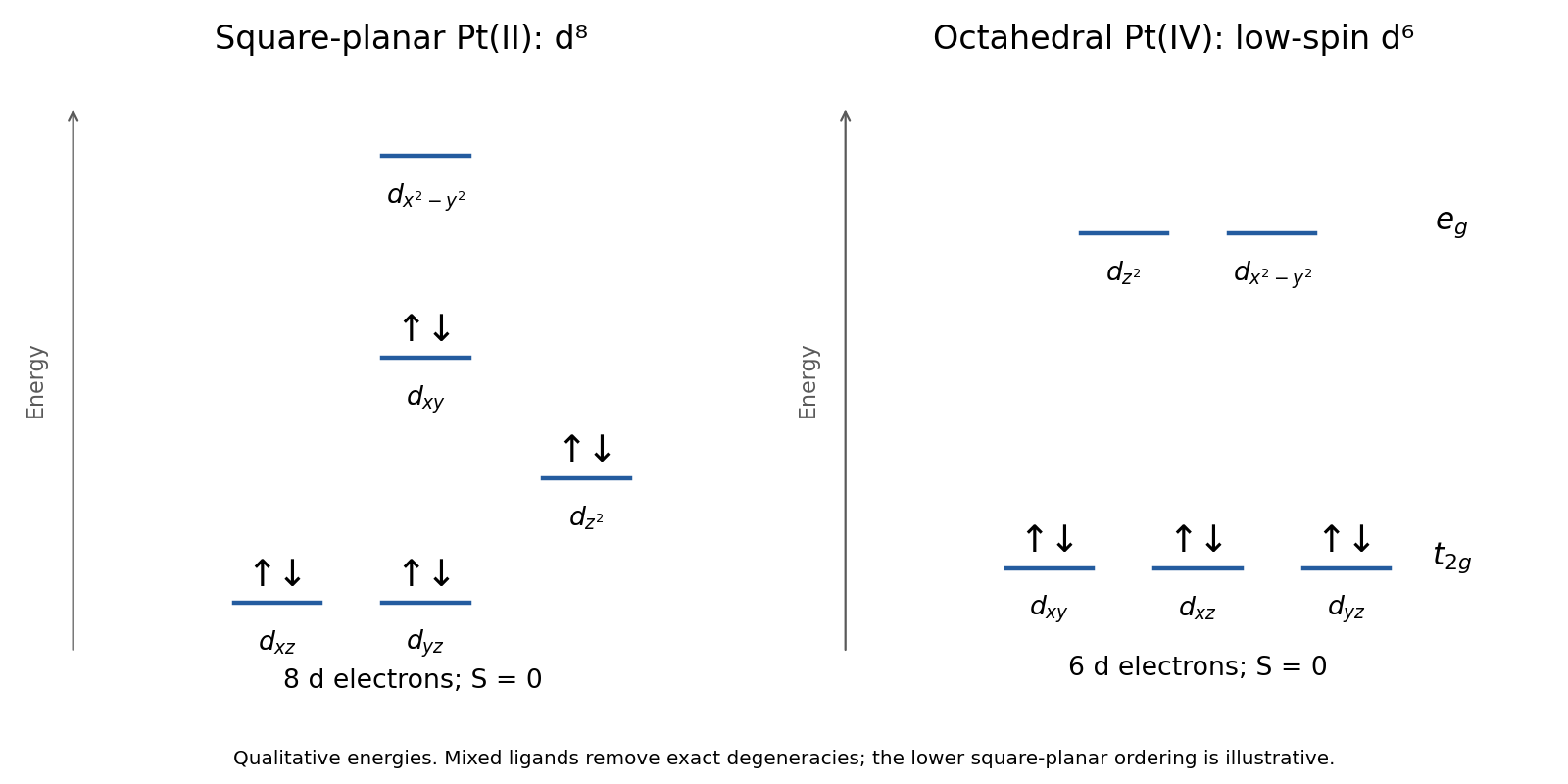
platinum is in group 10, so subtracting its oxidation state gives for Pt(II) and for Pt(IV). Adding two electrons from each coordinated donor gives the local valence electron counting resultsEach acetate in the depicted structure is monodentate, binding through one oxygen. The 16-electron count of the square-planar complex is normal for a low-spin late-metal centre; it is not a missing ligand inferred from the 18-electron rule.
Both complexes have all their electrons paired, so . Their spin-only magnetic moment is thereforeThey exhibit diamagnetism. The formula describes the spin contribution; it does not say that a closed-shell sample has no diamagnetic response to an applied field.
ammonia and cyclohexylamine are sigma-donor ligands; chloride and acetate are sigma- and pi-donor ligands. The nitrogen lone pair of each amine points toward the metal and forms the donor interaction. These saturated amines have no low-lying conjugated acceptor system that would make them conventional pi-acceptor ligands.
chloride uses a lone pair for sigma donation and has additional occupied orbitals perpendicular to the bond that can donate with pi symmetry. An oxygen-bound acetate similarly has occupied oxygen-centred orbitals available for sigma and pi donation, although its carboxylate resonance in chemistry changes their energies and distribution. Neither should be classified as a pi acceptor merely because its bonding can be drawn with multiple bonds or resonance in chemistry contributors. None of these four is a standard sigma-donor/pi-acceptor ligand.
cyclohexylamine is expected highest in the spectrochemical series for comparable metal environments. Its alkyl substituent increases the electron-donating ability of nitrogen relative to ammonia, strengthening the sigma interaction and raising the metal–ligand sigma-antibonding levels. The anionic pi donors tend to raise occupied metal levels and give smaller splittings. Steric effects and the metal can modify the exact ordering, so the comparison is a ligand field trend rather than a universal basicity-to-splitting identity.
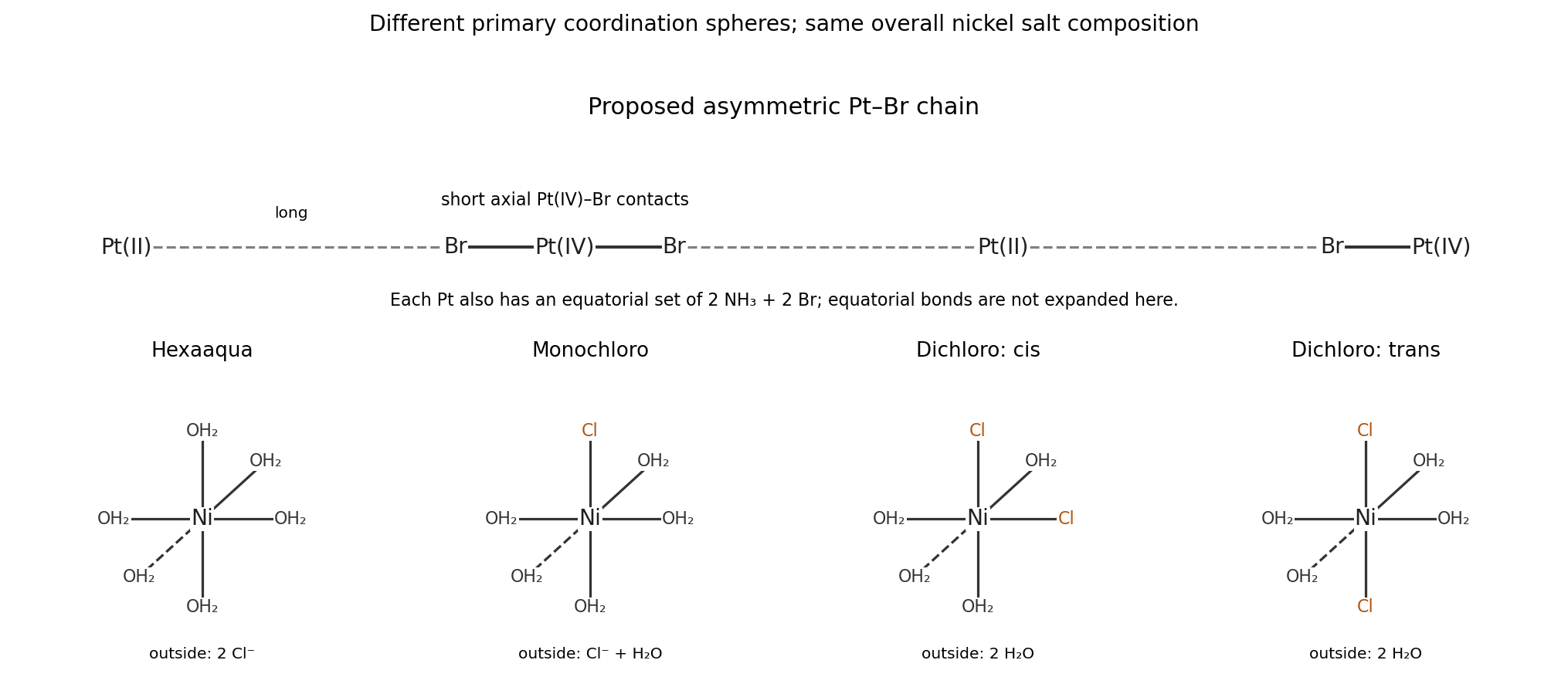
The average Pt oxidation state is , since six bromides balance the two metal atoms. A natural mixed valence assignment is alternating Pt(II), , and Pt(IV), , rather than two equivalent Pt(III) sites. Use neutral square-planar units and octahedral units. At every site place two ammonia and two bromide ligands in an equatorial plane; the Pt(IV) sites have two additional axial bromides pointing toward the adjacent Pt(II) sites.
Along the chain the connectivity isEvery Pt–Br–Pt bridge is asymmetric: short to Pt(IV), long to Pt(II). The latter contact is a secondary axial interaction, consistent with the preference of Pt(II) for a square-planar primary coordination sphere. The Pt(IV) site is smaller and more strongly attracts the bridging bromides. A drawing with all axial distances identical would obscure the distinct local environments.
There are four equatorial bromides and two axial bridging bromides per two-Pt repeat, giving precisely . A direct Pt–Pt bond is not required. This is a proposed structure consistent with the stated composition and two environments; the formula alone does not determine every equatorial cis/trans arrangement or numerical bond length.


The more radially extended Pt orbitals give strong metal–ligand overlap and covalent bonding. This helps compensate the energetic cost of reaching Pt(IV), and the large octahedral ligand field splitting strongly stabilizes its low-spin configuration, with a crystal field stabilization energy contribution before separately counting pairing and the full bond energies. Ni bonding is less effective in this respect; Pd compounds also generally favour the very stable M(II) arrangement more strongly than Pt does. The stronger bonding and large ligand-field stabilization available to Pt(IV) make oxidation to more favourable relative to its congeners. This is a comparative trend, not a claim that Ni(IV) or Pd(IV) complexes cannot exist.
Articles by others on the same topic
There are currently no matching articles.