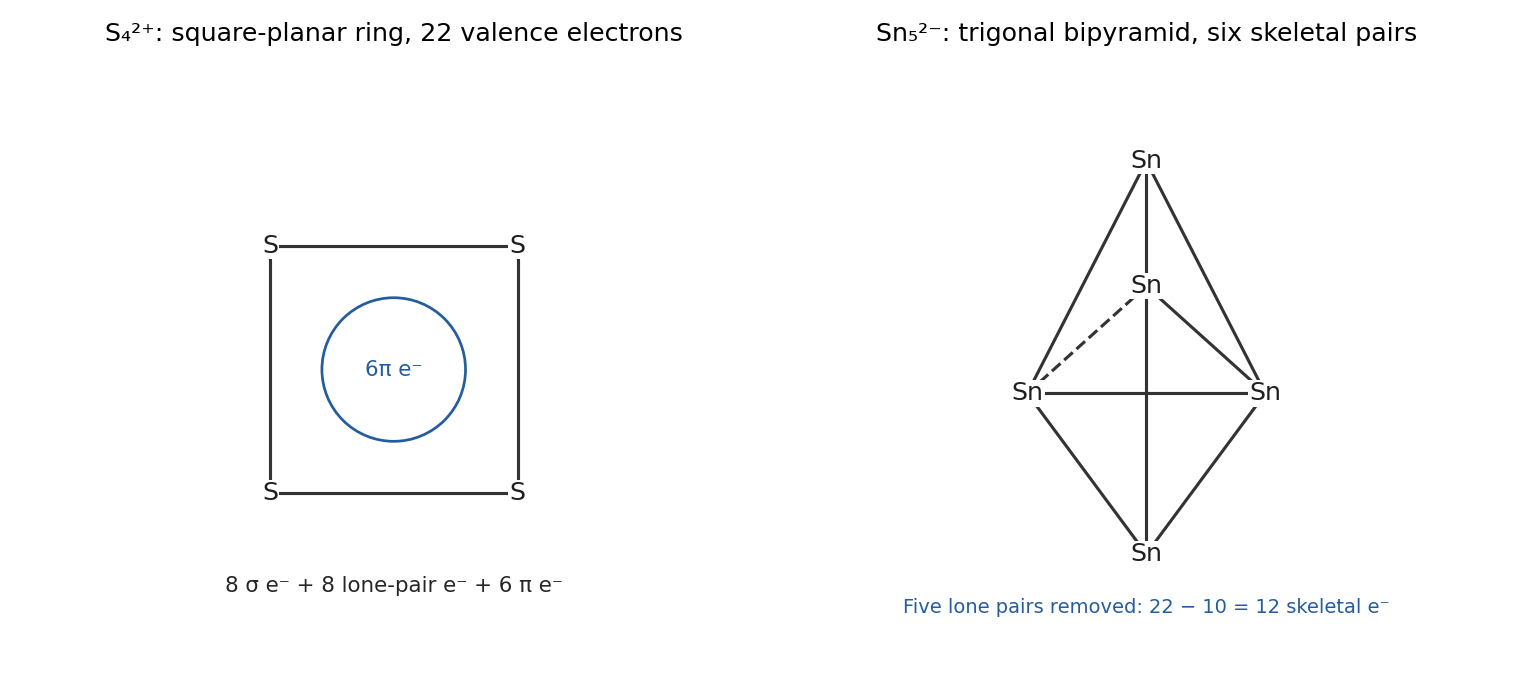
is approximately square planar; is a closo trigonal bipyramid. Both have 22 valence electrons, and , but their different local orbital requirements prevent inferring identical shapes from this total alone.
For the sulfur ring, four S–S sigma bonds use eight electrons and four in-plane lone pairs use another eight, leaving six electrons in the perpendicular cyclic pi system. The resulting filled bonding and degenerate nonbonding pi levels give a six-pi-electron aromatic description of a four-membered ring, consistent with equivalent S–S links in the ideal square. The out-of-plane p orbitals are retained; this is not a tetrahedral four-vertex closo cage.
For tin, allocate one mainly s-rich lone pair to each atom. The remaining electrons form six skeletal pairs, exactly for . Wade's rules therefore predict a trigonal bipyramid, with three equatorial vertices and two axial vertices. The axial pair is not joined by a polyhedral edge; its bonding is part of the delocalized three-dimensional framework. The contrast is a planar aromatic sigma/pi ring versus a three-dimensional multicentre-bonded Zintl cluster, rather than cationic charge alone imposing planarity or anionic charge alone imposing a polyhedron.

Articles by others on the same topic
There are currently no matching articles.